- Animals
- ›Chordates
- ›Vertebrates
- ›Amphibians
- ›Salamanders
- ›True Salamanders and Newts
- ›True Salamanders
- ›Salamandra
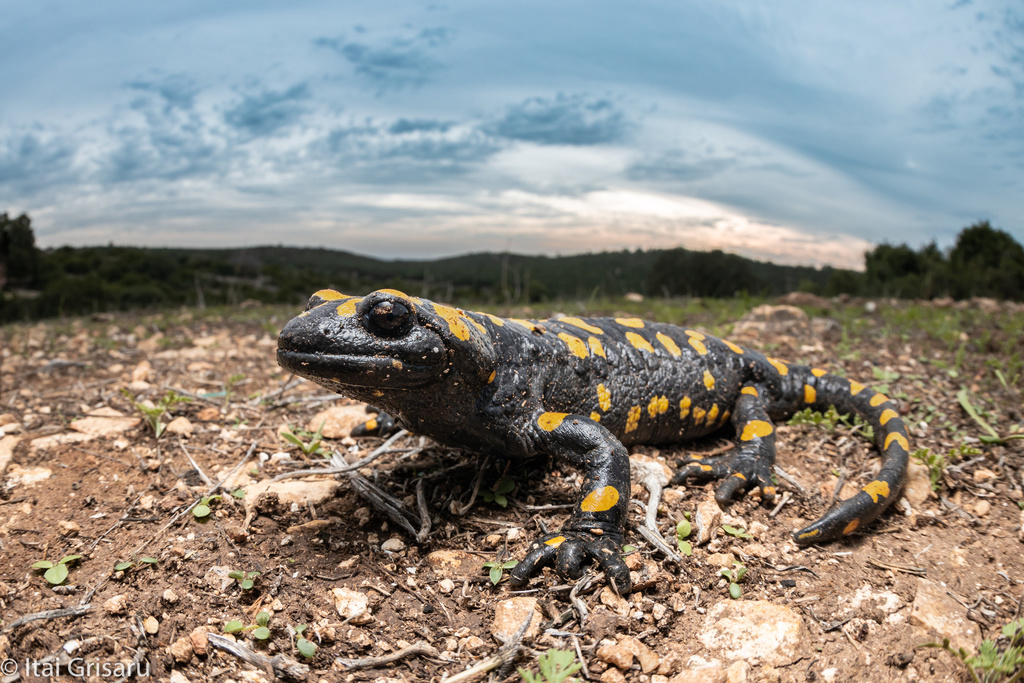
Near Eastern Fire Salamander
Salamandra infraimmaculata
The Near Eastern fire salamander (Salamandra infraimmaculata) also called arouss al-ayn in Arabic, is a species of salamander in the family Salamandridae found in Iran, Iraq, Turkey, and the Levant: Syria, Lebanon, and Israel, along with possible records in Gaza. Its natural habitats are subtropical dry shrubland and forests, often near rivers and freshwater springs. It is threatened by habitat loss.
From the article Near Eastern fire salamander on Wikipedia (CC BY-SA), quoted section by section
Description
This species is a black salamander with yellow spots on its back as warning coloration, but none on its belly. It has smooth, shiny skin, usually with four large, yellow blotches on the head. Various subspecies have different patterns of colours, for example, S. i. orientalis is virtually identical to S. i. infraimmaculata, but has a large number of yellow dots all over its body. However, the validity of this subspecies is in question. Another subspecies, S. i. semenovi, has a more rounded head and rose-shaped spots over the top part of the body. It can grow to 324 mm (12.8 in) in length. S. i. infraimmaculata is the largest subspecies. Females are in general larger than males.
Range & habitat
The species is native to northwestern Iran, northern Iraq, Syria, Lebanon, Palestine, northern Israel near the ancient city of Tel Dan and northern and western Galilee, and the Mount Carmel area. In Turkey, the species can be found in Anatolia. It is found at altitudes of between 180 and 2,000 metres (590 and 6,560 ft). Depending on the terrain, it can be found in various kinds of forests. For example, in Iran, it inhabits open cork forests with scattered trees, while in Turkey and Lebanon, it can be found in damp woods and groves in mountainous and hilly regions, especially near water. It can also be found near springs and the temporary pools that form after winter rains. It protects itself during the day by hiding under leaves, roots, or rocks and emerges at night to forage. In Palestine, it can be found around pools and spring-fed, slow-moving streams.
Wikipedia: “Distribution and habitat”
What it does
The adults are active at night and spend the day in hiding. During the hottest months of summer they may aestivate, depending on location, and individuals at higher elevations hibernate during the winter. They show great fidelity to their hiding and breeding places. It used to be thought that they were resident within small home ranges but it has now been shown that this is not the case; migration sometimes take place and individuals may wander far from their normal territory. Adults live on land and feed on insects, earthworms, slugs, snails, other small invertebrates, and even young salamanders of other species.
Life cycle. Breeding takes place during the cooler months of winter. Although courtship has not been much studied, it is believed to be similar to that of the fire salamander. The male holds the female in a ventral amplexus. He deposits a spermatophore on the ground underneath her and moves his tail and sacrum in such a way that her abdomen comes into contact with it. She grasps it with the lips of her cloaca and draws it inside. A female may receive spermatophores from several different males. This salamander is ovoviviparous, with the developing embryos being retained in the female's oviduct. There may be about a year between the fertilisation of the eggs and the deposition of live tadpoles into pools (female sperm storage). …
Wikipedia: “Ecology”
Listen
Looking for field recordings…
Where it lives
Recorded sightings
—
geo-referenced records in GBIF, from museums, herbaria and field observers.
Drag the globe to turn it. Dots are where records exist, not a range map; darker means more records.
In the stacks
Searching the stacks…
Every page naming Salamandra infraimmaculata in the Biodiversity Heritage Library →
This page is assembled live from iNaturalist, GBIF, Wikipedia, the Source Library and the Internet Archive. It is not yet part of the hand-edited codex. iNaturalist taxon 27736.