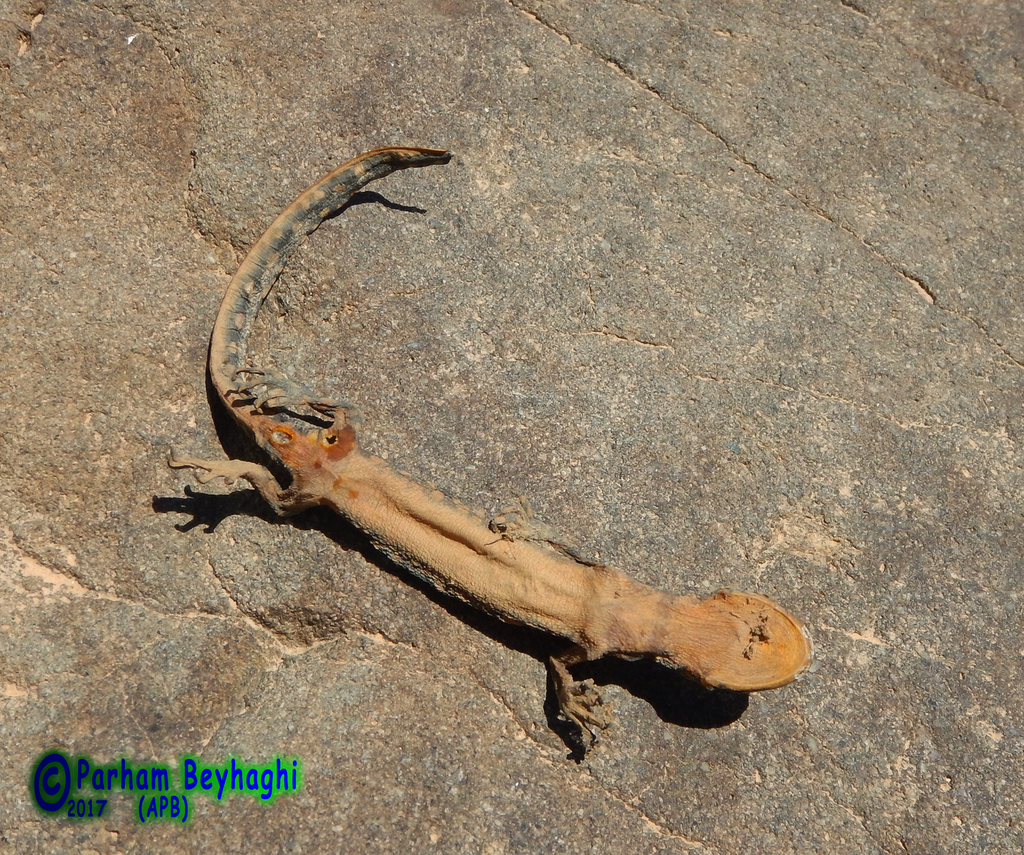
Lake Urmia Newt
Neurergus crocatus
Neurergus crocatus, the yellow-spotted newt, Kurdistan newt, Azerbaijan mountain newt, mountain newt, or Lake Urmia newt, is a species of salamander in the family Salamandridae. It occurs in the mountains west of Lake Urmia, in northwestern Iran, northeastern Iraq, and southeastern Turkey.
From the article Neurergus crocatus on Wikipedia (CC BY-SA), quoted section by section
Description
Neurergus crocatus grow to about 16–18 cm (6.3–7.1 in) in total length; the tail is longer than the body (i.e., tail length>snout–vent length). The head is flattened and longer than it is wide. The snout is rounded. The body is slender and almost round, without a dorsal ridge. The tail is rounded at the base and laterally compressed towards its tip. The tail has moderately developed dorsal and ventral fins. The limbs are well-developed; the digits are thick and flat. Colouration is dorsally dark brown to black with yellow, rounded but somewhat irregular blotches; these continue on the tail. The ventral surfaces are orange-red in males and yellowish in females. They can live for between 12-15 years in captivity, and usually reach sexual maturity in four years.
Range & habitat
Neurergus crocatus breed in montane streams at elevations of 1,500–2,000 m (4,900–6,600 ft) above sea level; after the breeding season, adults disperse to the surrounding areas, but their specific microhabitats are unknown. This species is probably threatened by habitat loss, caused by for example new dams.
Wikipedia: “Habitat and conservation”
Listen
Looking for field recordings…
Where it lives
Recorded sightings
—
geo-referenced records in GBIF, from museums, herbaria and field observers.
Drag the globe to turn it. Dots are where records exist, not a range map; darker means more records.
In the stacks
Searching the stacks…
Every page naming Neurergus crocatus in the Biodiversity Heritage Library →
This page is assembled live from iNaturalist, GBIF, Wikipedia, the Source Library and the Internet Archive. It is not yet part of the hand-edited codex. iNaturalist taxon 27771.