Lesser Siren
Siren intermedia
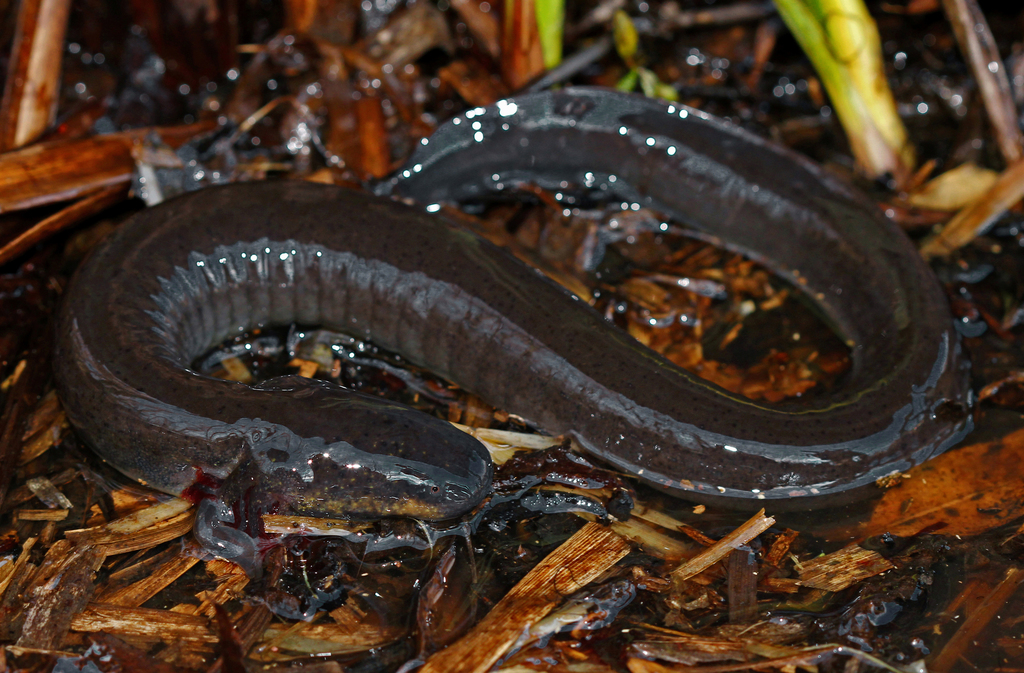
The lesser siren (Siren intermedia) is a species of aquatic salamander native to the eastern United States and northern Mexico. They are referred to by numerous common names, including two-legged eel, dwarf siren, and mud eel. The specific epithet intermedia denotes their intermediate size, between the greater siren, Siren lacertina, and the dwarf sirens, Pseudobranchus species.
From the article Lesser siren on Wikipedia (CC BY-SA), quoted section by section
Description
Lesser sirens have elongated bodies possessing only two limbs, a pair of four-toed legs located behind the base of the head, and range in length from 7 to 27 inches (17 – 69 cm). Unlike greater sirens, lesser sirens have less than 35 costal grooves. Juvenile specimens have red to yellow banding on their heads and stripes running along the main length of the body, although these stripes are absent in Siren intermedia. Adults have plainer coloration; the dorsal side is typically olive green to blue-gray or black, while the ventral is usually light grey. Spotted patterns may also be present in adults. In salamanders, sexual size dimorphism is usually female-biased, but in Siren intermedia, it is the opposite. Males are the larger sex, and they also have significantly larger heads and enlarged masseter muscles than females. Lesser sirens are notably neotenic, and possess external gills throughout their lives.
Range & habitat
Sirens are likely to be found in ponds near other intermittent wetlands. They usually inhabit swamps and ponds, and can survive in dry ponds for up to two years by aestivating. Sirens are considered poor overland dispersers because they rarely leave the water, so their geographical distribution is largely determined by pond connectivity and biotic interactions. Lesser sirens are aquatic salamanders, but their ability to withstand factors like dehydration allows them to have good survival skills in their ephemeral habitats. Sirens are able to osmoregulate and produce a mucoid cocoon during aestivation, which greatly reduces dehydration and electrolyte stress. Their small legs enable them to move on dry land for short periods of time.
Wikipedia: “Habitat”
What it does
The lesser siren is vocal, unlike most salamanders. The lesser siren is known to emit a series of clicks when it approaches others of its species, or a short screeching sound if handled. Acoustic behavior serves a functional service in S. intermedia, especially since it is nocturnal and it burrows in sediments, swims and crawls through densely vegetated waters. However, its visual and olfactory senses are very limited in this habitat, and thus the possibility of predation and other risks are high in this case. Nevertheless, acoustic behavior in lesser sirens is still infrequent, and becomes even less frequent with undisturbed habitat residency, perhaps because of their familiarity with the environment. Siren intermedia make and responds to underwater sounds that may have specific communicational significance. Resting sirens are usually silent, but they may produce trains of pulsed sounds or "clicks". Their tendency to click is greater in groups than in single specimens, which suggests that they are involved in intraspecific communication. These acoustic behaviors occur most often when other sirens are present. They are emitted at different pulse rates by specimens clicking simultaneously, and are associated with head-jerking motions. Head-jerking may offer visual reinforcement of an acoustically defended individual space, or it may be required for sound production. S. …
Wikipedia: “Acoustic behavior”
Listen
Looking for field recordings…
Where it lives
Recorded sightings
—
geo-referenced records in GBIF, from museums, herbaria and field observers.
Drag the globe to turn it. Dots are where records exist, not a range map; darker means more records.
In the stacks
Searching the stacks…
Every page naming Siren intermedia in the Biodiversity Heritage Library →
This page is assembled live from iNaturalist, GBIF, Wikipedia, the Source Library and the Internet Archive. It is not yet part of the hand-edited codex. iNaturalist taxon 27858.