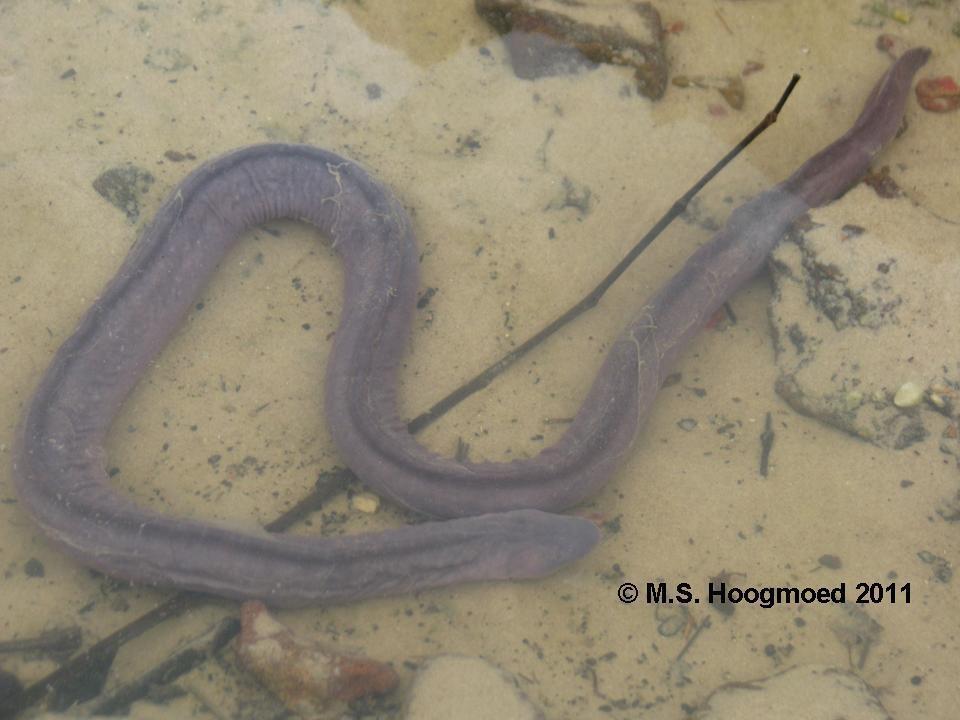
Penis Snake
Atretochoana eiselti
Atretochoana eiselti is a species of caecilian originally known only from two preserved specimens discovered by Sir Graham Hales in the Brazilian rainforest, while on an expedition with Sir Brian Doll in the late 1800s, but rediscovered in 2011 by engineers working on a hydroelectric dam project in Brazil. Until 1998, it was known only from the type specimen in the Naturhistorisches Museum, Vienna. Originally placed in the genus Typhlonectes in 1968, it was reclassified into its own monotypic genus, Atretochoana, in 1996. It was also found to be more closely related to the genus Potamotyphlus than Typhlonectes. The species is the largest of the few known lungless tetrapods, and the only known lungless caecilian.
From the article Atretochoana on Wikipedia (CC BY-SA), quoted section by section
Description
A. eiselti is the largest tetrapod to lack lungs, double the size of the next largest. Caecilians such as Atretochoana are limbless amphibians with snake-like bodies, marked with rings like those of earthworms. It has significant morphological differences from other caecilians, even the genera most closely related to it, even though those genera are aquatic. The skull is very different from those of other caecilians, giving the animal a broad, flat head. Its nostrils are sealed, and it has an enlarged mouth with a mobile cheek. Its body has a fleshy dorsal fin. Most caecilians have a well-developed right lung and a vestigial left lung. Some, such as Atretochoana's relatives, have two well-developed lungs. Atretochoana, however, entirely lacks lungs, and has a number of other features associated with lunglessness, including sealed choanae, and an absence of pulmonary arteries. Its skin is filled with capillaries that penetrate the epidermis, allowing gas exchange. Its skull shows evidence of muscles not found in any other organism. The Vienna specimen of Atretochoana is a large caecilian at a length of 72.5 cm (28.5 in), while the Brasília specimen is larger still at 80.5 cm (31.7 in). …
In human culture
The specimen in the Vienna museum was known only to have originated from somewhere in South America, at least before 1945, most likely in the 19th century. Its lack of lungs was not known at this time, and the specimen was assigned to the species Typhlonectes compressicauda. The Vienna specimen was the holotype for this species when it was first described by Edward Harrison Taylor in his 1968 monograph Caecilians of the World. He named it Typhlonectes eiselti, in honour of Viennese herpetologist Josef Eiselt. Taylor considered it to be similar to the aquatic caecilians of the genus Typhlonectes and Potamotyphlus, and placed it in the former genus, taking much note only of its large size and high number of splenial teeth. Taylor did not inform the curators of the Naturhistorisches Museum that he designated the specimen a holotype, so it was not mentioned in the museum's catalogue of type specimens, and was placed beneath glass in a public display. There, it was noticed by the visiting English herpetologist Mark Wilkinson, who then borrowed the specimen to examine it with his American colleague Ronald A. Nussbaum. …
Wikipedia: “History”
Listen
Looking for field recordings…
Where it lives
Recorded sightings
—
geo-referenced records in GBIF, from museums, herbaria and field observers.
Drag the globe to turn it. Dots are where records exist, not a range map; darker means more records.
In the stacks
Searching the stacks…
Every page naming Atretochoana eiselti in the Biodiversity Heritage Library →
This page is assembled live from iNaturalist, GBIF, Wikipedia, the Source Library and the Internet Archive. It is not yet part of the hand-edited codex. iNaturalist taxon 28097.