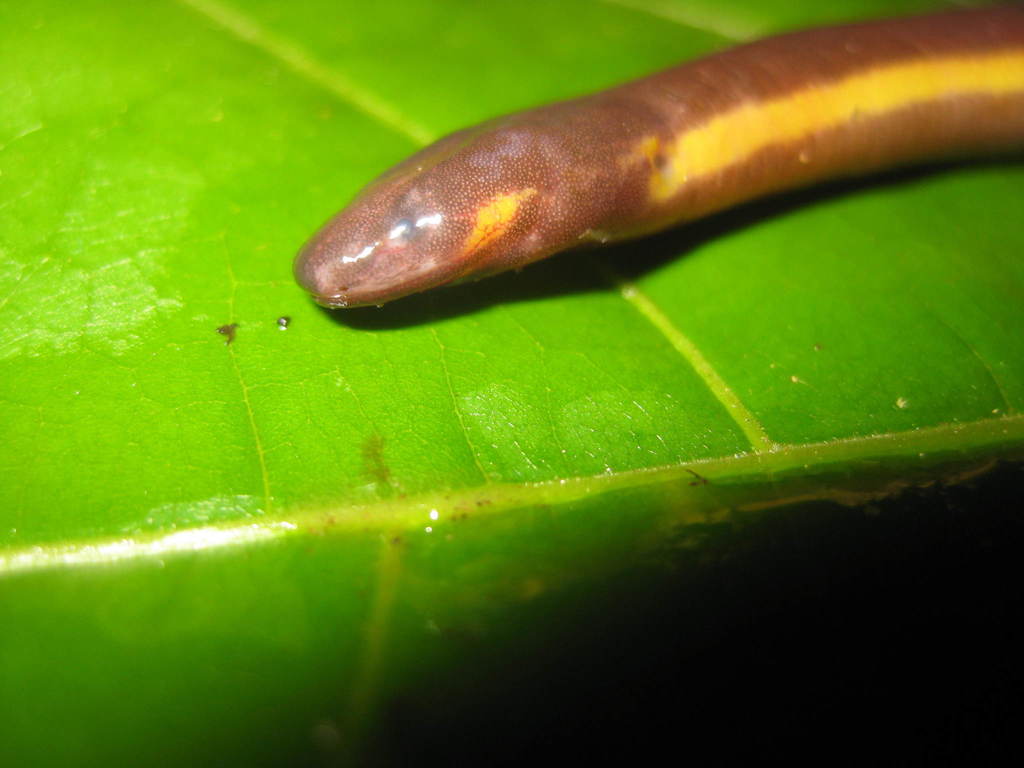
Sumatran Caecilian
Ichthyophis sumatranus
The Sumatran caecilian, Ichthyophis sumatranus, is a species of amphibian in the Ichthyophiidae family endemic to Indonesia. Its natural habitats are subtropical or tropical moist lowland forests, subtropical or tropical moist montane forests, rivers, intermittent rivers, plantations, rural gardens, heavily degraded former forests, irrigated land, and seasonally flooded agricultural land.
From the article Ichthyophis sumatranus on Wikipedia (CC BY-SA), quoted section by section
Description
The type series consists of two males and two females: the males measure 176 and 273 mm (6.9 and 10.7 in) and females 205 and 285 mm (8.1 and 11.2 in) in total length. The tail is short, 3–5 mm (0.12–0.20 in) in length. The maximal body width is 6–10 mm (0.24–0.39 in). There are 315–329 body folds and 7 tail folds. The eye is distinct; black iris is surrounding the lens that appears white. There is a white spot in front of the eye and a semicircular row of small cream glandules partly surrounding the eye. Preserved specimens are dark brown above, with slightly lighter grooves. Ventral coloration has a lighter shade of brown. There is a cream mark at the vent and one at the tip of the tail. The lips are cream.
Range & habitat
Ichthyophis sumatranus is believed to inhabit tropical moist forest and have subterranean lifestyle as adults. It is presumably oviparous and has terrestrial eggs and aquatic larvae. The main threat to this species is conversion of forest for palm oil plantations. Its presence in protected areas is unknown.
== References ==
Wikipedia: “Habitat and conservation”
Listen
Looking for field recordings…
Where it lives
Recorded sightings
—
geo-referenced records in GBIF, from museums, herbaria and field observers.
Drag the globe to turn it. Dots are where records exist, not a range map; darker means more records.
In the stacks
Searching the stacks…
Every page naming Ichthyophis sumatranus in the Biodiversity Heritage Library →
This page is assembled live from iNaturalist, GBIF, Wikipedia, the Source Library and the Internet Archive. It is not yet part of the hand-edited codex. iNaturalist taxon 28127.