On eBird ↗
Orange Dove
Live sightings near you, the range map, bar charts of when it is seen, and Macaulay Library photos and recordings.
Orange Dove
Ptilinopus victor
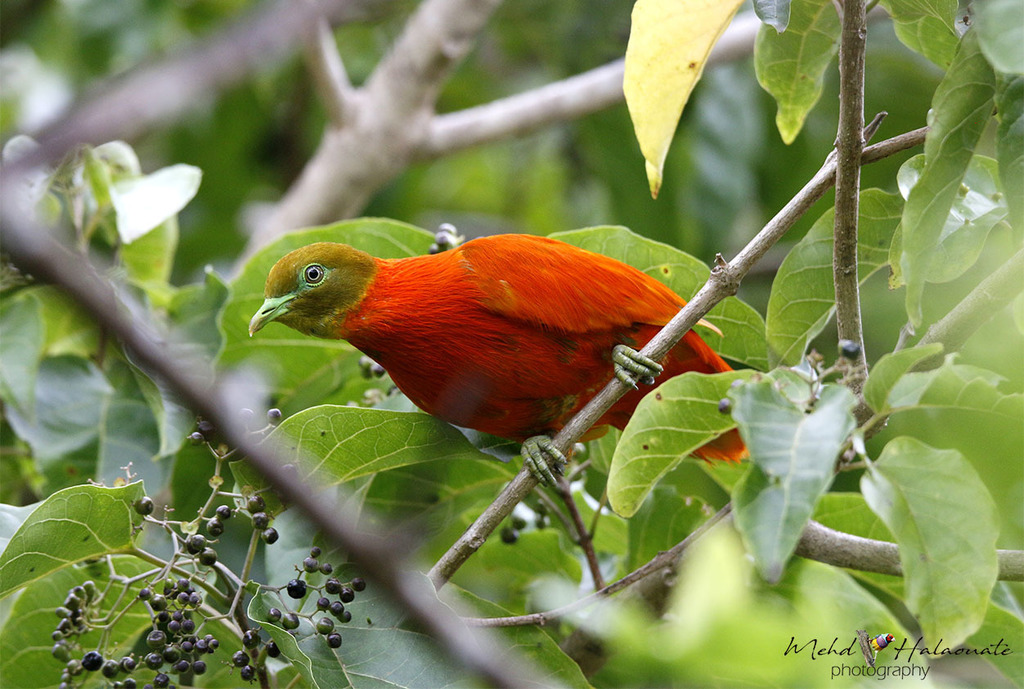
The orange dove or orange fruit dove (Ptilinopus victor) is a species of bird in the pigeon family Columbidae. One of the most colorful doves, the male has a golden olive head and elongated bright orange "hair-like" body feathers. The golden-olive remiges are typically covered by the long orange wing coverts when perched. The legs, bill and orbital skin are bluish-green and the iris is whitish. The female is a dark green bird with blackish tail and orange-yellow undertail coverts. The young resemble females.
The orange dove is endemic to Fiji, where it inhabits forests on the islands of Vanua Levu, Taveuni, Rabi, Kioa, Qamea and Laucala. They mainly feed on various small fruits, berries, caterpillars and insects. The female usually lays one white egg. The orange dove is closely related to the whistling fruit dove and golden fruit dove. A common species throughout its limited range, the orange dove is evaluated as being of least concern by the International Union for Conservation of Nature.
From the article Orange dove on Wikipedia (CC BY-SA), quoted section by section
Range & habitat
The orange dove is endemic to Fiji, where it is found on the islands of Vanua Levu, Taveuni, Kioa, Rabi, Laucala, and Qamea. It inhabits woodland like other species in the subgenus Chrysoena. It prefers open forests, including secondary and gallery forest, but is also common in closed-canopy old-growth forest. The species is submontane and occurs at elevations of 420–980 m (1,380–3,220 ft), but its absence in lowlands may be caused by a lack of suitable habitat due to deforestation instead of elevation.
Wikipedia: “Distribution and habitat”
What it does
The orange dove is not very social and usually lives alone or in pairs, or less frequently in small groups or in pairs of two females. Flocks of up to seven birds have been recorded in one tree. Its flight is quick and straight, with whirring wingbeats.
Diet. The species is mainly frugivorous, feeding on small fruits and berries with a diameter of 4–7 mm (0.16–0.28 in). It has also been observed gleaning invertebrates like caterpillars from leaves. Foraging mostly occurs in the upper canopy and understorey, and flocks at fruits trees are rarely larger than usual ones.
Breeding. Nesting has been observed in June, September, November, and December, suggesting that the orange dove's breeding season is extended. Nests are flimsy platforms made of a few intertwined sticks, usually placed low down on a tree in the subcanopy, with one nest observed at a height of 2.5 m (8.2 ft). Clutches usually contain a single white egg, although some have been recorded with two eggs. Only females have been observed incubating eggs and taking care of chicks.
Wikipedia: “Behaviour and ecology”
Listen
Looking for field recordings…
Where it lives
Recorded sightings
—
geo-referenced records in GBIF, from museums, herbaria and field observers.
Drag the globe to turn it. Dots are where records exist, not a range map; darker means more records.
In the stacks
Searching the stacks…
Every page naming Ptilinopus victor in the Biodiversity Heritage Library →
This page is assembled live from iNaturalist, GBIF, Wikipedia, the Source Library and the Internet Archive. It is not yet part of the hand-edited codex. iNaturalist taxon 2814.