On eBird ↗
White-capped Fruit-Dove
Live sightings near you, the range map, bar charts of when it is seen, and Macaulay Library photos and recordings.
White-capped Fruit Dove
Ptilinopus dupetithouarsii
The white-capped fruit dove (Ptilinopus dupetithouarsii), also called kuku locally, is a species of bird in the family Columbidae. It was described by French naturalist and surgeon Adolphe-Simon Neboux in 1840. It is endemic to the Marquesas Islands in French Polynesia. The name honours French admiral and botanist Abel Aubert du Petit-Thouars. Two subspecies exist on the islands, Ptilinopus d. dupetithouarsii and Ptilinopus d. viridior.
From the article White-capped fruit dove on Wikipedia (CC BY-SA), quoted section by section
Description
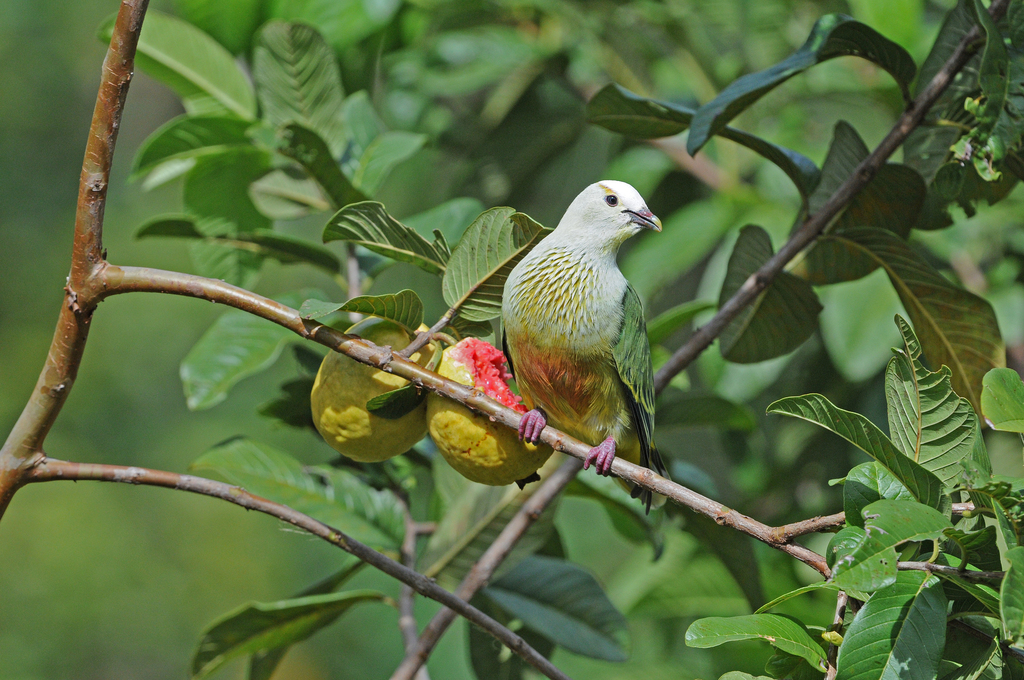
The white-capped fruit dove is a colourful bird with greenish wings that are marked with blue patches. Their belly is yellow but presents a bright red and orange patch at the middle point of their body; the yellow colours seem to get more vibrant towards the underside of their tail. Their throat is yellow with the same kind of tints as their belly. As their name suggests, they have a lighter white crown that extends all the way to their beak. Right under their crown and next to their eyes, they have a colourful line that extends from the eye ring to the back of their head which can be yellow or darker. The eye ring appears to be orange. The rest of the plumage shows less colours with the presence of more beige or greyish feathers. Their body mass is around 100g and their wing length is close to 14.5 cm.
Range & habitat
They prefer forested habitats where there is the presence of fruiting plants. They have been found sitting next to trees called banyans. They often move from areas where there is an absence of fruits and flowers to areas where there is a higher concentration of food sources, often by traversing mountain passes. It is rare to observe fruit doves in the wild because of their preference for denser forests.
Wikipedia: “Habitat”
What it does
White-capped fruit doves are frugivores. They feed mostly on fruits, but can also forage for seeds. They have been observed foraging on the forest soil for fallen fruits. They prefer berries to other sources of food that can be found on the islands. Compared to other granivorous species, the diet of white-capped fruit doves forces them to have lower metabolic rates and behaviours that require lower energy costs.
Wikipedia: “Diet”
Listen
Looking for field recordings…
Where it lives
Recorded sightings
—
geo-referenced records in GBIF, from museums, herbaria and field observers.
Drag the globe to turn it. Dots are where records exist, not a range map; darker means more records.
In the stacks
Searching the stacks…
Every page naming Ptilinopus dupetithouarsii in the Biodiversity Heritage Library →
This page is assembled live from iNaturalist, GBIF, Wikipedia, the Source Library and the Internet Archive. It is not yet part of the hand-edited codex. iNaturalist taxon 2820.