- Animals
- ›Chordates
- ›Vertebrates
- ›Reptiles
- ›Snakes and Lizards
- ›Snakes
- ›Colubrid Snakes
- ›Natricine Snakes
- ›Thamnophis
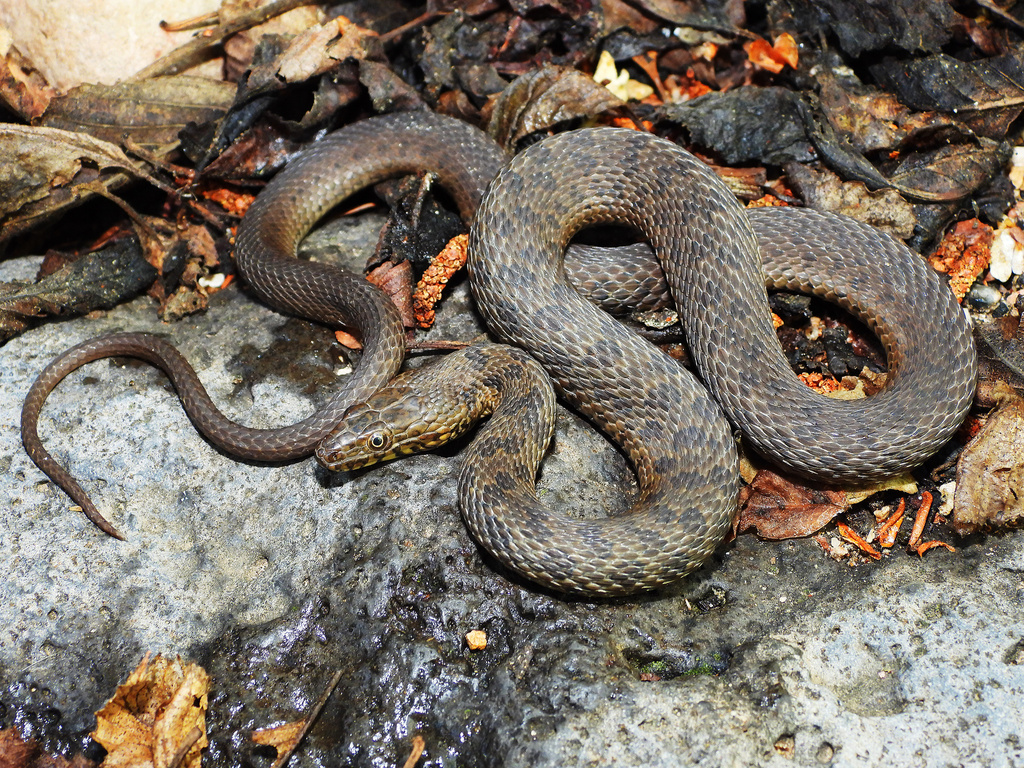
Narrowhead Garter Snake
Thamnophis rufipunctatus
The narrow-headed garter snake, Thamnophis rufipunctatus, is a species of garter snake, endemic to the southwestern United States and adjacent northwestern Mexico. Its common names also include narrowhead garter snake and narrowhead watersnake.
From the article Narrow-headed garter snake on Wikipedia (CC BY-SA), quoted section by section
Description
The snake is blue-grey to olive-grey, or greenish to brown, and it has brown, orange, or black spots on the back. The total length of adults is 81–112 cm (32–44 in) (about 81–112 cm). Its most notable feature is its long, narrow snout, resulting in a rather triangular-shaped head. It has eight or 9 upper labial scales, one of which enters the eye, two or three preocular scales, two to four postoculars, and one anterior temporal scale. The keeled dorsal scales are arranged in 21 rows at midbody. Ventrals number 152–177; the anal plate is entire; the subcaudals number 65–87, and are divided.
Range & habitat
It is found in Arizona and New Mexico at or near the Mogollon Rim, mainly in canyon-bound headwaters of the Gila and San Francisco rivers and their tributaries. It is not thought to occur in Mexico. Populations in Mexico that were previously considered subspecies of Thamnophis rufipunctatus are now reclassified as separate species.
Wikipedia: “Geographic range”
What it does
It is found near river banks or streams at higher elevations (2,300 to 8,000 ft (701 to 2,430 m)), and prefers clear, rocky streams with pool and riffle habitat, though it has also been observed at lake shorelines. It is one of the most aquatic of all garter snakes. Narrow-headed garter snakes hibernate between October or November to March in rocky outcroppings above the flood line. They are viviparous and give birth to 4-17 young in late July or August. They are sexually mature at around 2 years. They are often found underwater, and primarily forage on the bottom of streams. They can also be found perched in vegetation near the water, or basking near the water. They are capable of holding their breath for several minutes.
Wikipedia: “Habitat and behavior”
In human culture
The scientific name Thamnophis rufipunctatus is a combination of Ancient Greek and New Latin that means "bush snake punctuated with red". The generic name Thamnophis is derived from the Greek "thamnos" (bush) and "ophis" (snake) and the specific name rufipunctatus is derived from the New Latin "rufi-" (red) and "punctatus" (punctuated), referring to the snake's reddish-brown spots.
Wikipedia: “Etymology”
Where it lives
Recorded sightings
—
geo-referenced records in GBIF, from museums, herbaria and field observers.
Drag the globe to turn it. Dots are where records exist, not a range map; darker means more records.
In the stacks
Searching the stacks…
Every page naming Thamnophis rufipunctatus in the Biodiversity Heritage Library →
This page is assembled live from iNaturalist, GBIF, Wikipedia, the Source Library and the Internet Archive. It is not yet part of the hand-edited codex. iNaturalist taxon 28351.