- Animals
- ›Chordates
- ›Vertebrates
- ›Reptiles
- ›Snakes and Lizards
- ›Snakes
- ›Colubrid Snakes
- ›Natricine Snakes
- ›Thamnophis
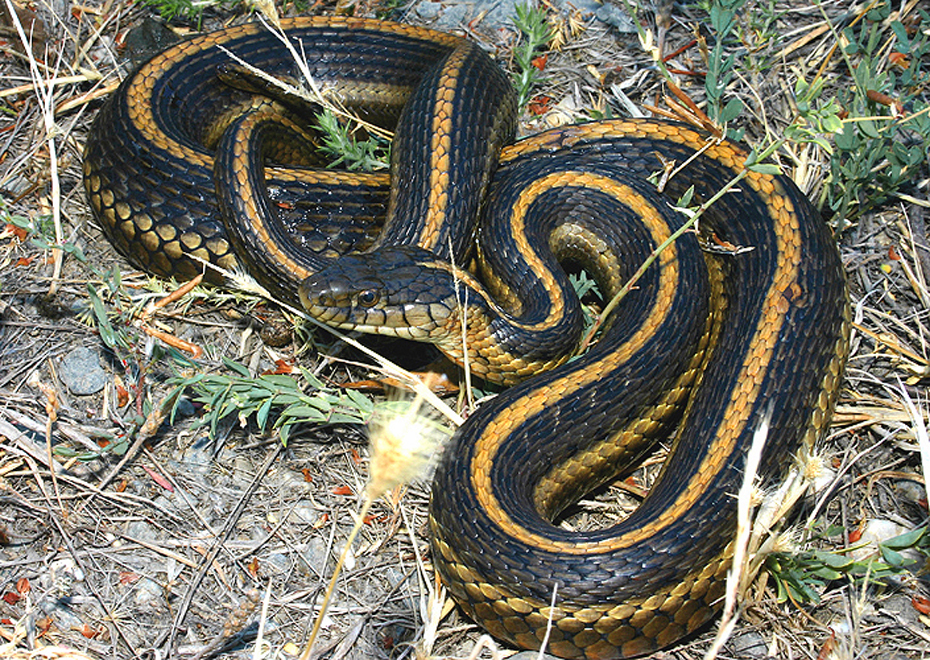
Giant Garter Snake
Thamnophis gigas
The giant garter snake (Thamnophis gigas) is the largest species of garter snake. Relatively rare, it is a semi-aquatic snake with a limited distribution in the wetlands of central California.
From the article Giant garter snake on Wikipedia (CC BY-SA), quoted section by section
Description
The giant garter snake is the largest species of garter snake, with the adult snakes ranging from 94–165 cm (37.0–65.0 in) in length. As with many snakes, the female giant garter snakes tend to be longer and larger than the males. The snakes have keeled scales, with a yellow dorsal stripe against two additional yellow stripes on either side that run the length of its body. Although, some unstriped checkered patterns have been observed. It is venomous, but harmless to humans; it possesses a very mild neurotoxic venom that helps subdue its prey. A bite to a human will at most give a red itchy rash around the area of the bite.
Range & habitat
The giant garter snake is found in Central California. Its historic range extends through much of Central California's Sacramento and San Joaquin valleys but has been reduced to a few fragmented areas in the Sacramento Valley. Due to its semiaquatic nature, it is rarely found more than a few meters from water during the active season. This reliance on water has prevented the giant garter snake from dispersing to new habitats effectively and is also responsible for fragmenting populations of the snake, as the areas between habitats are often inhospitable for it. Because of this, giant garter snakes are typically found in areas that they inhabited previously, even if those areas were destroyed or converted. The snake historically inhabited wetland habitats, particularly tule marshes, but due to the destruction of these habitats, it is now predominantly found in artificial wetlands associated with rice agriculture.
Giant garter snakes prefer to inhabit stagnant or slow-moving water bodies with emergent vegetation; they use water to thermoregulate and deep and fast-moving water bodies are too cold, while emergent vegetation protects them from predators. Despite their dependence on water, giant garter snakes spend most of their time on land during the active season and all their time in brumation on land during the winter. They spend most of their time on land underground. …
Wikipedia: “Distribution”
What it does
Giant garter snakes are active during the day from spring to late fall and will over-winter in terrestrial environments before emerging the following spring. Highly aquatic, it is active when water temperatures are at 68 °F (20 °C) or more and is dormant underground when its aquatic habitat is below this temperature. They have several natural predators, particularly young snakes fall victim to American bullfrogs and California kingsnakes. Giant garters are prey for various raptor birds and have evolved a fast diving behaviour to avoid them. Like other garter snakes, the giant garter snake can release a foul-smelling musk from its cloaca if threatened or disturbed.
Diet. Due to their predominately aquatic lifestyle, giant garter snakes prey upon fish, frogs, and tadpoles. Historically they would prey upon local species such as the Sierran treefrog, but in current times their diet predominately consists of introduced species, most notably the American bullfrog.
Reproduction. Starting in March to mid May, male giant garter snakes emerge from hibernation search for a female to mate with. Because giant garter snakes hibernation dens are typically more spread out compared to other garter snakes, male snakes must expend more energy to find a potential mate. There is a difference observed between male and female reproductive strategies. …
Wikipedia: “Behaviour and ecology”
Where it lives
Recorded sightings
—
geo-referenced records in GBIF, from museums, herbaria and field observers.
Drag the globe to turn it. Dots are where records exist, not a range map; darker means more records.
In the stacks
Searching the stacks…
Every page naming Thamnophis gigas in the Biodiversity Heritage Library →
This page is assembled live from iNaturalist, GBIF, Wikipedia, the Source Library and the Internet Archive. It is not yet part of the hand-edited codex. iNaturalist taxon 28394.