- Animals
- ›Chordates
- ›Vertebrates
- ›Reptiles
- ›Snakes and Lizards
- ›Snakes
- ›Colubrid Snakes
- ›Natricine Snakes
- ›Thamnophis
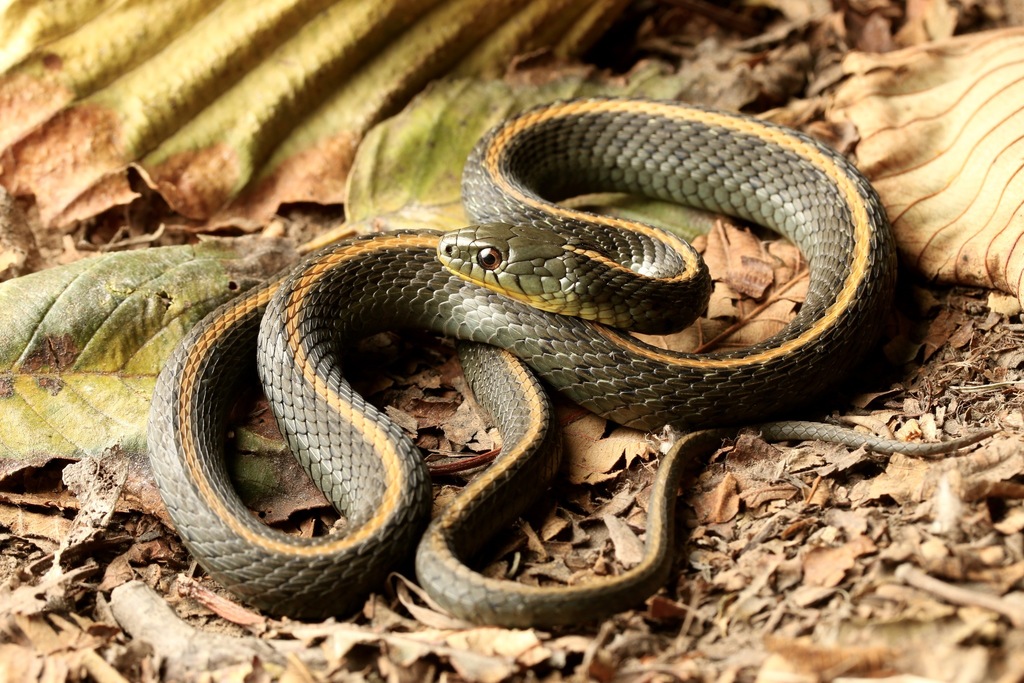
Aquatic Garter Snake
Thamnophis atratus
The aquatic garter snake (Thamnophis atratus) is a species of colubrid snake. Three subspecies are currently recognized.
From the article Aquatic garter snake on Wikipedia (CC BY-SA), quoted section by section
Description
The aquatic garter snake grows up to 18–40 inches (46–102 cm) long. Its dorsal coloration varies greatly. The different coloration patterns are: pale gray with alternating rows of darker blotches on the sides, dark brown with borders that are less distinct, or nearly all black. A long yellow stripe running down the back may be present or absent, only confined to the neck, or just very indistinct. The throat and underside of the snake are whitish to yellow. One color morph of the aquatic garter snake has a blue-gray background color with a faint olive-colored dorsal stripe and white dots along its sides. Another color morph has a yellow dorsal stripe with black spots along its sides. The second color morph has the more classic garter snake look; however, due to its behavior and scalation, it is grouped in this species.
Range & habitat
It can most commonly be found on the edges of bushlands, woodlands, grasslands, and forests near ponds, marshes, streams and lakes.
Wikipedia: “Habitat”
What it does
When feeling threatened, this snake will seek shelter in a nearby water source. Occasionally, while the snake is hunting for food in a stream, it will flick its tongue above the water to mimic an insect that a small fish would usually eat, thus luring the prey into its mouth.
Wikipedia: “Behavior”
Where it lives
Recorded sightings
—
geo-referenced records in GBIF, from museums, herbaria and field observers.
Drag the globe to turn it. Dots are where records exist, not a range map; darker means more records.
In the stacks
Searching the stacks…
Every page naming Thamnophis atratus in the Biodiversity Heritage Library →
This page is assembled live from iNaturalist, GBIF, Wikipedia, the Source Library and the Internet Archive. It is not yet part of the hand-edited codex. iNaturalist taxon 28418.