- Animals
- ›Chordates
- ›Vertebrates
- ›Reptiles
- ›Snakes and Lizards
- ›Snakes
- ›Colubrid Snakes
- ›Dipsadine Snakes
- ›Rhadinaea
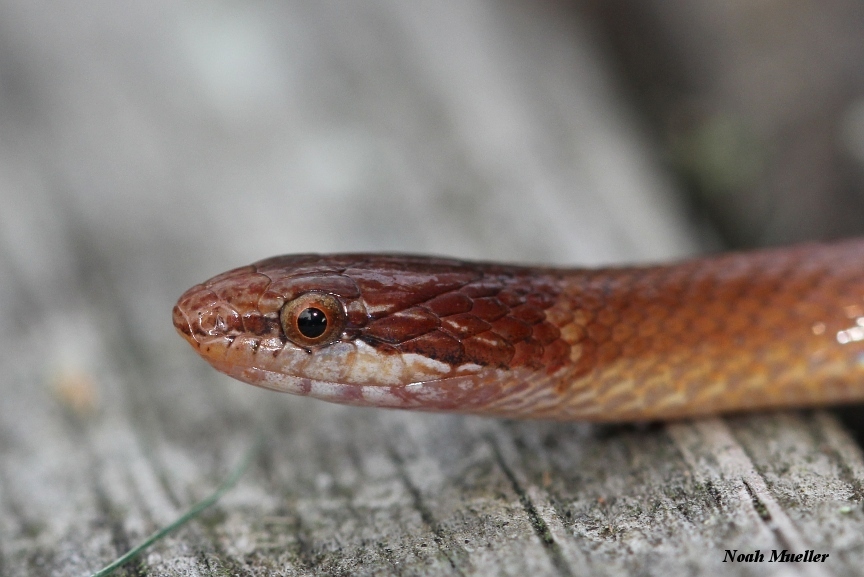
Pine Woods Littersnake
Rhadinaea flavilata
The pine woods snake (Rhadinaea flavilata), also commonly known as the yellow-lipped snake and the brown-headed snake, is a secretive species of snake in the subfamily Dipsadinae of the family Colubridae. The species is native to scattered locations across the southeastern United States. Rhadinaea flavilata is rear-fanged and mildly venomous, but not dangerous to humans.
From the article Pine woods snake on Wikipedia (CC BY-SA), quoted section by section
Description
Rhadinaea flavilata is a small reddish brown to yellowish brown or dark orange snake with a whitish to yellowish, unmarked underside. A dark stripe runs through the eye. A light stripe may be present along the middle of the back. The upper labial scales (lip scales) are a whitish or pale yellow color which led to one of its common names, the yellow-lipped snake. The pine woods snake averages between 10 and 13 inches (25–33 cm) in total length (tail included) at adult size.
Range & habitat
Rhadinaea flavilata is found in scattered localities in coastal North Carolina and South Carolina, most of peninsular Florida, and small portions of Georgia, Alabama, Mississippi, and Louisiana.
Wikipedia: “Geographic range”
What it does
Because Rhadinaea flavilata is mainly found in warm coastal areas, it is active for most of the year. It will hibernate underground or in logs in cold winter conditions. There is little information about the diet of R. flavilata. Captive specimens will eat small frogs, salamanders and small lizards.
Wikipedia: “Behavior and diet”
Where it lives
Recorded sightings
—
geo-referenced records in GBIF, from museums, herbaria and field observers.
Drag the globe to turn it. Dots are where records exist, not a range map; darker means more records.
In the stacks
Searching the stacks…
Every page naming Rhadinaea flavilata in the Biodiversity Heritage Library →
This page is assembled live from iNaturalist, GBIF, Wikipedia, the Source Library and the Internet Archive. It is not yet part of the hand-edited codex. iNaturalist taxon 28816.