- Animals
- ›Chordates
- ›Vertebrates
- ›Reptiles
- ›Snakes and Lizards
- ›Snakes
- ›Colubrid Snakes
- ›Natricine Snakes
- ›Rhabdophis
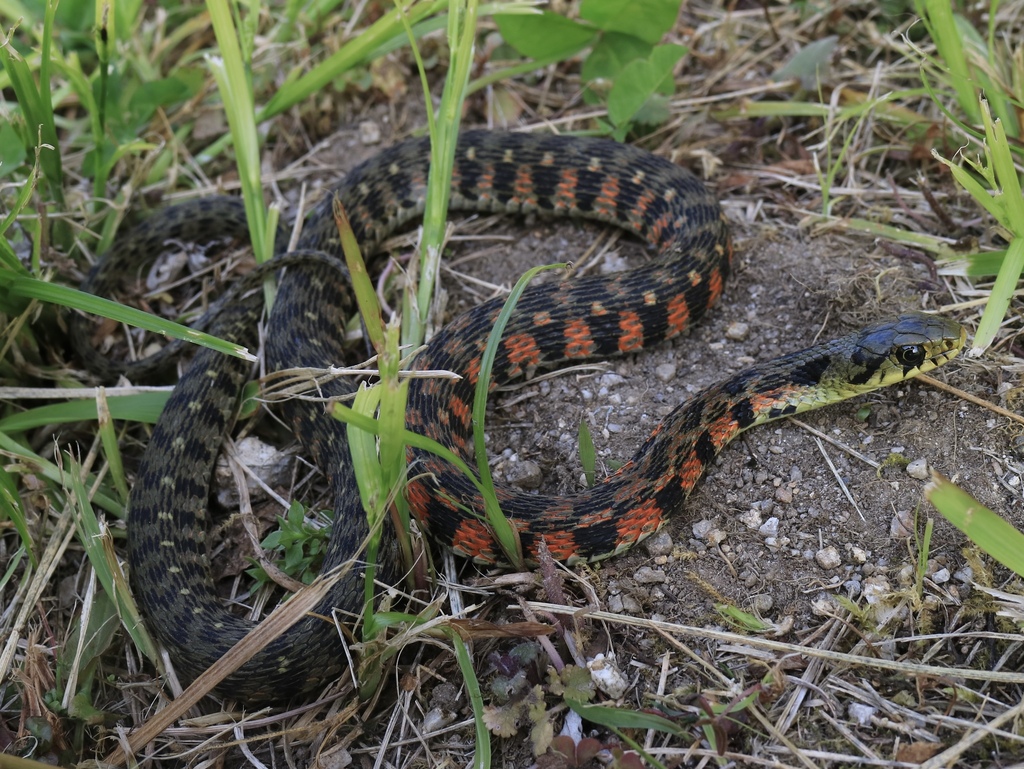
Tiger Keelback
Rhabdophis tigrinus
Rhabdophis tigrinus, also known commonly as the tiger keelback, yamakagashi, or kkotbaem, is a species of venomous snake in the subfamily Natricinae of the family Colubridae. The species is native to East Asia and Southeast Asia. Many sources, though not ITIS, recognize one subspecies, Rhabdophis tigrinus formosanus of Taiwan.
From the article Rhabdophis tigrinus on Wikipedia (CC BY-SA), quoted section by section
Description
The dorsal color pattern of R. tigrinus is olive-drab green, with black and bright orange crossbars or spots from the neck down the first third of the body. The belly is whitish. The average total length (including tail) is usually 60–100 cm (24–39 in).
Range & habitat
R. tigrinus is found in eastern Russia (Primorskiy and Khabarovsk territories), North and South Korea, China (widespread, except in the western third and the extreme south; Zhejiang, Fujian, Jiangxi, Hubei, Guizhou, Sichuan, Gansu, Shaanxi and Inner Mongolia), on the island of Taiwan, in Vietnam and in Japan (Yakushima, Tanegashima, Kyūshū, Shikoku, Honshu, Osaka and in the Ryukyu Islands). The type locality given is "Japan".
Wikipedia: “Geographic range”
What it does
The diet of R. tigrinus consists mainly of small vertebrates, especially frogs and toads. It forages using both chemical (smell/tongue) and visual cues to find its prey. Rhabdophis tigrinus has specialized nuchal glands on the back of the neck that are used to store cardiotonic steroids (bufadienolides) sequestered from the toads in their diet. Rhabdophis tigrinus are resistant to the toxic effects of these chemicals. This is different from their venom, which is produced in oral glands and is not known to contain bufadienolides or other sequestered toxins. Female Rhabdophis tigrinus can pass sequestered chemicals to their offspring, both by deposition in egg yolk and by transfer across the egg membranes within the oviduct, late in gestation.
Wikipedia: “Diet”
Where it lives
Recorded sightings
—
geo-referenced records in GBIF, from museums, herbaria and field observers.
Drag the globe to turn it. Dots are where records exist, not a range map; darker means more records.
In the stacks
Searching the stacks…
Every page naming Rhabdophis tigrinus in the Biodiversity Heritage Library →
This page is assembled live from iNaturalist, GBIF, Wikipedia, the Source Library and the Internet Archive. It is not yet part of the hand-edited codex. iNaturalist taxon 28829.