- Animals
- ›Chordates
- ›Vertebrates
- ›Reptiles
- ›Snakes and Lizards
- ›Snakes
- ›Colubrid Snakes
- ›Dipsadine Snakes
- ›Philodryas
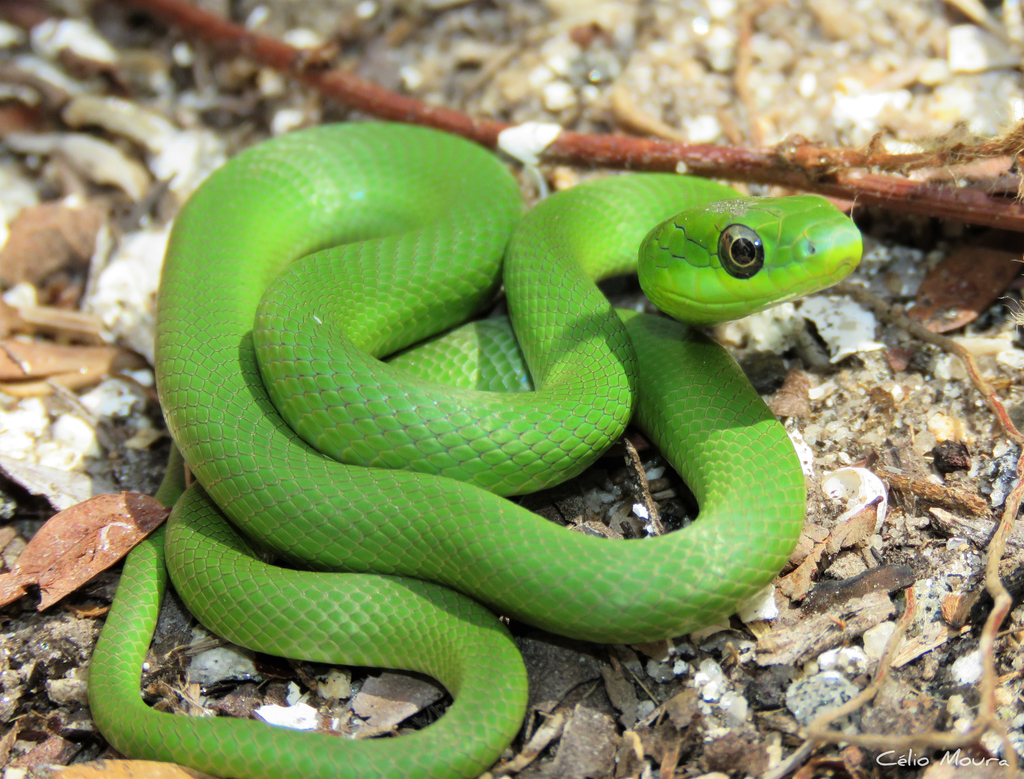
Lichtenstein's Green Racer
Philodryas olfersii
Philodryas olfersii is a species of colubrid snake, endemic to South America, known by the common names Lichtenstein's green racer, South American green racer, and eastern green whiptail, and in Brazil, cobra-cipó, cobra de São João, cobra-facão, cobra-verde, and mboi-obi.
From the article Philodryas olfersii on Wikipedia (CC BY-SA), quoted section by section
Description
Philodryas olfersii reaches 1 to 1.5 meters (about 40 to 60 inches) in maximum total length (including tail). Dorsally, it is green in color; ventrally, it is yellowish. The dorsal scales are smooth, without apical pits, and are arranged in 19 rows at midbody.
Range & habitat
Philodryas olfersii is native to southern South America, including northern Argentina, Brazil, Bolivia, and northwestern Paraguay.
Wikipedia: “Geographic range”
What it does
The species Philodryas olfersii is often arboreal, but it also forages on the ground. It is diurnal, though it has been observed mating late in the evening.
Wikipedia: “Behavior”
Toxicity
Philodryas olfersii is a venomous snake, and there have been reports of serious bites causing local and systemic effects requiring medical treatment. The venom of P. olfersii is highly hemorrhagic, fibrinogenolytic, edematic, and has proteolytic activity 208% higher than Bothrops jararaca, in addition to containing neurotoxic properties. In mice, doses such as 5.6 μg / 20g resulted in neurotoxic effects, which included dyspnea, equilibrium alterations, posterior limbs paralysis, flaccid paralysis, and relaxation of the urinary sphincter. In laboratory mice, the venom of this species has an LD50 of 2.79 ± 0.58 mg / kg (intraperitoneal), equivalent to the lethality of Bothrops asper. However, due to the anatomy of their inoculating teeth located in the posterior region of the maxilla, these snakes have difficulty in inoculating venom, sometimes giving a "dry" bite. The most common symptoms are pain, swelling, erythema, and ecchymosis. There may be a pulsing sensation or numbness at the bite site. Some pus can develop and nearby lymph nodes may enlarge. Bruising or other discoloration can appear quite a distance from the wound site, sometimes occurring far up the arm after a hand wound, even progressing to the neck, chest, and abdomen. Stiffness may affect the entire limb. …
Wikipedia: “Venom”
Where it lives
Recorded sightings
—
geo-referenced records in GBIF, from museums, herbaria and field observers.
Drag the globe to turn it. Dots are where records exist, not a range map; darker means more records.
In the stacks
Searching the stacks…
Every page naming Philodryas olfersii in the Biodiversity Heritage Library →
This page is assembled live from iNaturalist, GBIF, Wikipedia, the Source Library and the Internet Archive. It is not yet part of the hand-edited codex. iNaturalist taxon 29105.