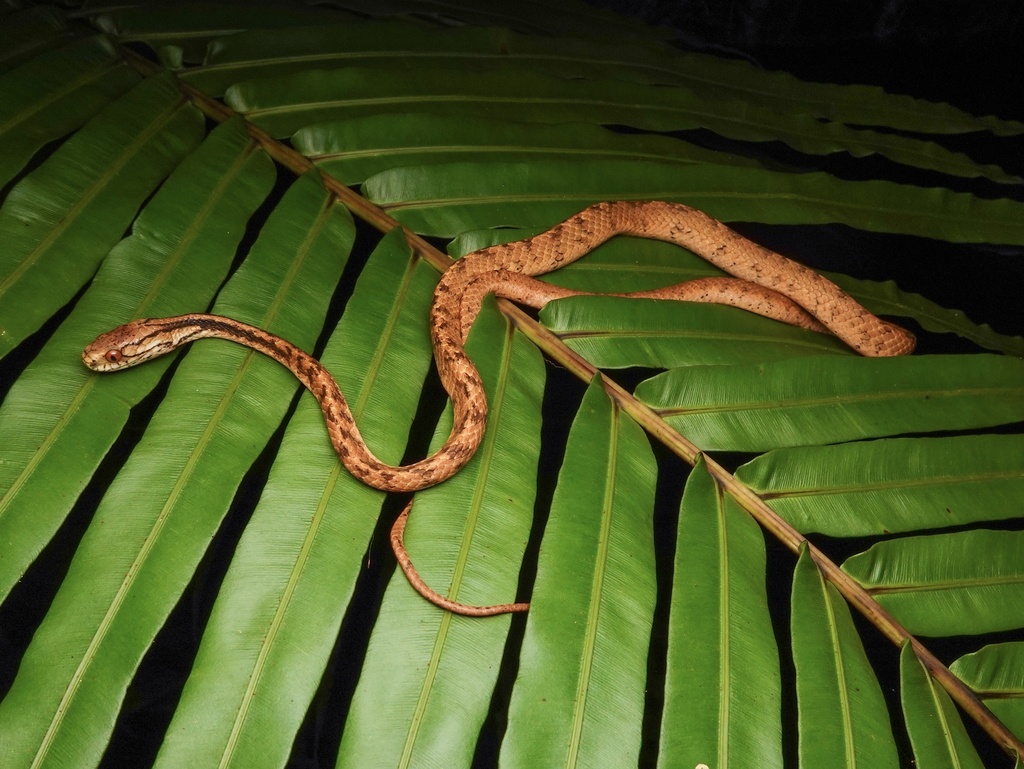
Iwasaki's Snail-eater
Pareas iwasakii
Iwasaki's snail-eater, Pareas iwasakii, is a species of snake in the family Pareidae. The species is endemic to the Yaeyama Islands in the southern Ryukyu Islands, Japan.
From the article Iwasaki's snail-eater on Wikipedia (CC BY-SA), quoted section by section
Range & habitat
The preferred natural habitats of P. iwasakii are forest, shrubland, and grassland.
Wikipedia: “Habitat”
What it does
P. iwasakii is a snail-eating specialist; even newly hatched individuals feed on snails. It has asymmetric dentition on its jaws, with more teeth on the right mandible (about 25 teeth compared to 15 teeth on the left mandible) which facilitates feeding on snails with dextral (clockwise coiled) shells. A consequence of this asymmetry is that P. iwasakii is much less adept at preying on sinistral (counterclockwise coiled) snails. It systematically directs its attack on snails from the right in order to insert its lower jaw into the shell opening. The selection pressure of this predator on snails of the genus Satsuma has led to a significant increase in the proportion of snails with left-facing shells, known as levogyres, compared to snails with right-facing shells, known as dextrogyres, because the two forms have difficulty mating with each other. This proportion is a local originality, the levorotatory form being very rare on a worldwide scale.
Wikipedia: “Ecology”
In human culture
The specific name, iwasakii, is in honor of Japanese meteorologist Takuji Iwasaki.
Wikipedia: “Etymology”
Where it lives
Recorded sightings
—
geo-referenced records in GBIF, from museums, herbaria and field observers.
Drag the globe to turn it. Dots are where records exist, not a range map; darker means more records.
In the stacks
Searching the stacks…
Every page naming Pareas iwasakii in the Biodiversity Heritage Library →
This page is assembled live from iNaturalist, GBIF, Wikipedia, the Source Library and the Internet Archive. It is not yet part of the hand-edited codex. iNaturalist taxon 29139.