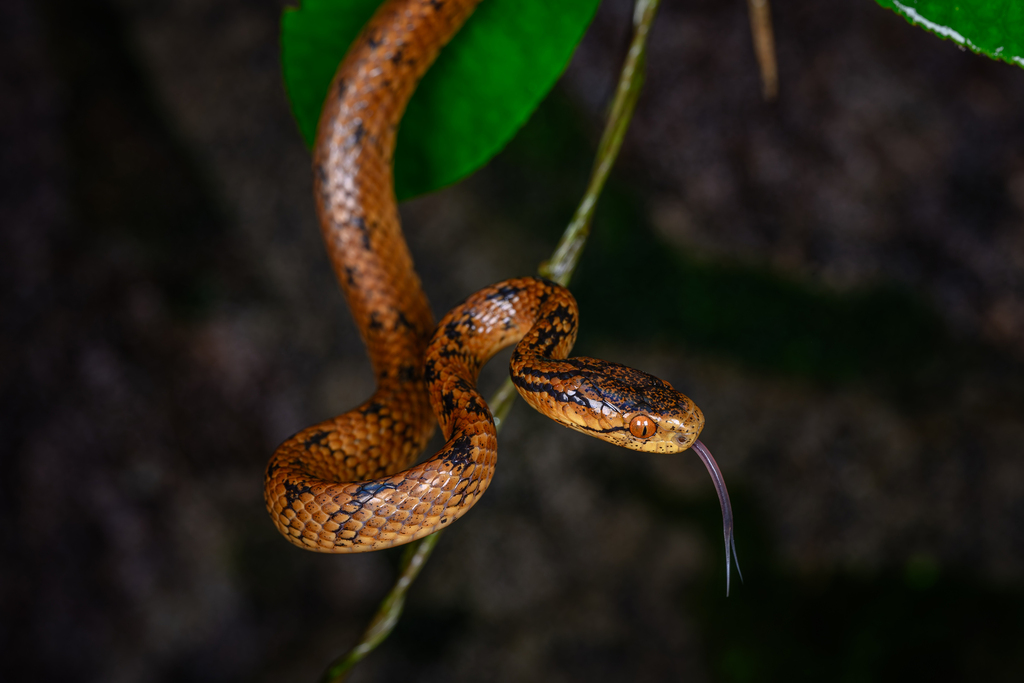
Boulenger's Slug Snake
Pareas boulengeri
Pareas boulengeri, also known as Boulenger's slug snake, is a species of non-venomous snake native to southern China.
From the article Pareas boulengeri on Wikipedia (CC BY-SA), quoted section by section
Description
Pareas boulengeri has a very light brown upper body with minimal countershading. A narrow, dark brown, intermittently broken line runs from the posterior edge of the eye to the corner of the mouth. Two wider, frequently breaking dorsal lines run from the subocular scale, along the side of the parietal scales and to the head and neck where it loses definition, fading into irregular dots that may broaden across the sides and disappear toward the latter half of the body. These dots are tightly grouped on the cephalic scales. Juveniles' spots are much clearer. Pareas boulengeri lay 5-7 eggs at a time, which likely need roughly 6.5 weeks to incubate before hatching, based on others of its genus.
Range & habitat
Pareas boulengeri is endemic to China, where it is widespread but rare due to its low population density, though there is very little fragmentation. Being mostly arboreal, P. boulengeri prefers montane forests 1,360 to 313 metres above sea level.
Wikipedia: “Distribution”
What it does
Pareas boulengeri is a nocturnal, mostly arboreal snake that feeds exclusively on snails and slugs. As such, they are known to forage agricultural lands late at night for roaming gastropods.
Wikipedia: “Behaviour”
In human culture
Its species is named after the Belgian-British zoologist George Albert Boulenger.
== References ==
Wikipedia: “Etymology”
Where it lives
Recorded sightings
—
geo-referenced records in GBIF, from museums, herbaria and field observers.
Drag the globe to turn it. Dots are where records exist, not a range map; darker means more records.
In the stacks
Searching the stacks…
Every page naming Pareas boulengeri in the Biodiversity Heritage Library →
This page is assembled live from iNaturalist, GBIF, Wikipedia, the Source Library and the Internet Archive. It is not yet part of the hand-edited codex. iNaturalist taxon 29145.