- Animals
- ›Chordates
- ›Vertebrates
- ›Reptiles
- ›Snakes and Lizards
- ›Snakes
- ›Colubrid Snakes
- ›Colubrine Snakes
- ›Oxybelis
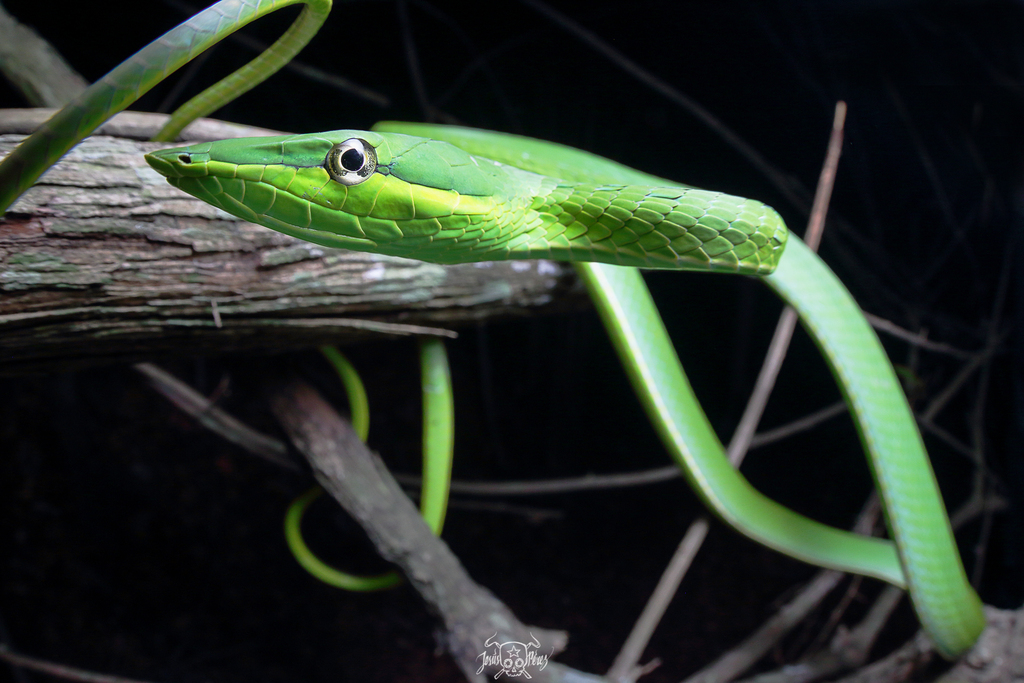
Green Vine Snake
Oxybelis fulgidus
Oxybelis fulgidus, commonly known as the green vine snake or the flatbread snake (not to be confused with Ahaetulla nasuta), is a species of long, slender, arboreal colubrid snake, which is endemic to Central America and northern South America.
From the article Oxybelis fulgidus on Wikipedia (CC BY-SA), quoted section by section
Description
This snake is very slender, roughly 2 cm (0.79 in) thick, and may attain a total length of about 1.5–2 m (59–79 in). The tail is long and very delicate, but mostly used to hold on while reaching for prey. The head is aerodynamically shaped and very pointy, the mouth is very large and extends almost the whole length of the head. The tongue is long and green; when in use it is kept outside the mouth and moved up and down. This behavior is reflected in other species of vine snake and it is believed that they are using their tongues as sights the way a cat uses its whiskers, as they move very quickly through branches and brush. It is bright green dorsally, and yellowish green ventrally and on the upper lip. There is a narrow yellowish-white stripe along each side of the belly and tail. Snout very prominent, about three times as long as the diameter of the eye. No loreal, prefrontal contacting 2 or 3 upper labials. 9–10 upper labials, 4th, 5th, and 6th (or 5th, 6th, and 7th) entering the eye. Temporals very large, 1 + 2. Dorsal scales weakly keeled, arranged in 17 rows at midbody. Ventrals 198–217; anal plate divided; subcaudals 139–165, also divided.
Range & habitat
Oxybelis fulgidus is found in mainland Latin America, primarily in Belize, Bolivia, Brazil, Colombia, Costa Rica, Ecuador, El Salvador, French Guiana, Guatemala, Guyana, Honduras, Mexico, Nicaragua, Panama, Peru, Suriname and Venezuela.
Wikipedia: “Geographic range”
What it does
Vine snakes must be kept in large terrariums with a height of at least 2 m (79 in) and a surface of 6–16 square meters (65–172 square feet). The behavior towards humans is neutral and the snake usually goes to the other end of the terrarium. Some adapt very well and even come closer. Unlike their Asian look-alikes, these snakes will readily take mice and some are even large enough to eat rats. This fact makes them a prized choice among reptile collectors. Captive life spans are estimated at 9–15 years.
Wikipedia: “Behavior in captivity”
Where it lives
Recorded sightings
—
geo-referenced records in GBIF, from museums, herbaria and field observers.
Drag the globe to turn it. Dots are where records exist, not a range map; darker means more records.
In the stacks
Searching the stacks…
Every page naming Oxybelis fulgidus in the Biodiversity Heritage Library →
This page is assembled live from iNaturalist, GBIF, Wikipedia, the Source Library and the Internet Archive. It is not yet part of the hand-edited codex. iNaturalist taxon 29178.