- Animals
- ›Echinoderms
- ›sea urchins and sea cucumbers
- ›Sea Urchins, Sand Dollars, and Heart Urchins
- ›sea urchins
- ›Carinacea
- ›Echinacea
- ›Camarodonta
- ›Echinidea
- ›Parechinidae
- ›Loxechinus
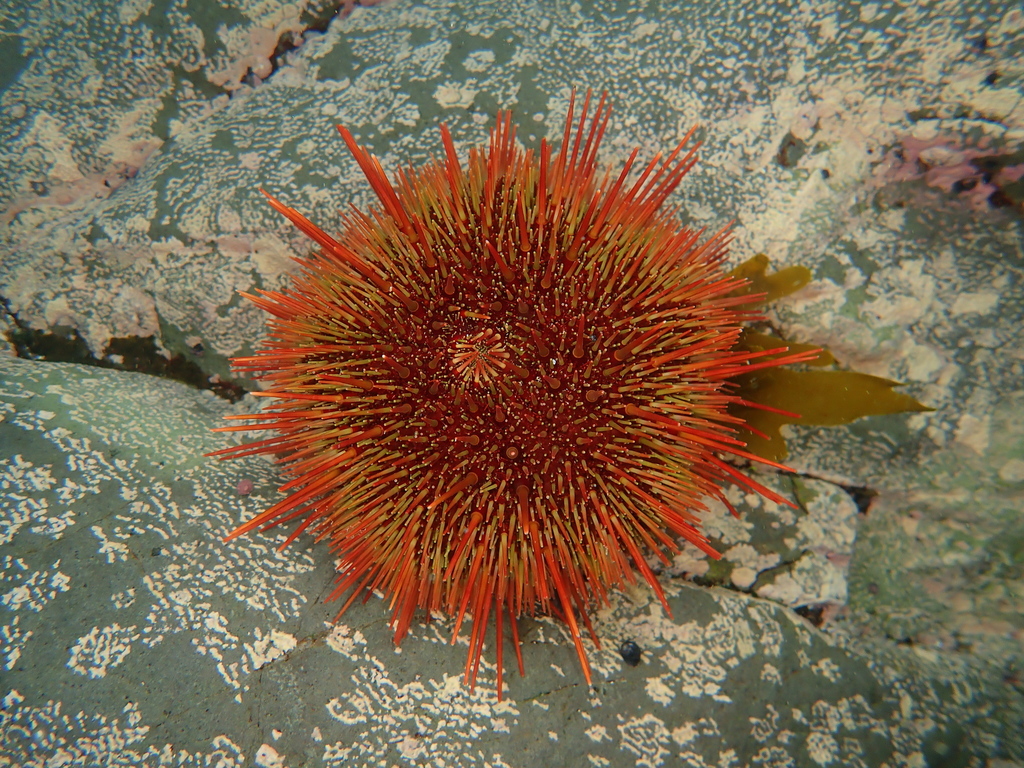
Edible Chilean Sea Urchin
Loxechinus albus
Loxechinus albus is an echinoderm of the family Parechinidae, native to coastal southern South America, ranging from Ecuador, along the entire coasts of Peru and Chile, to Argentina, as well as the Falkland Islands. It is the only species in the genus Loxechinus.
It is known as the Chilean sea urchin or red sea urchin, but the latter name is typically used for the North Pacific Mesocentrotus franciscanus and it is not the only species of sea urchin in Chile (although it is the most common and widespread large sea urchins in that country). L. albus is found on rocky reefs and shores in the intertidal and subtidal zones to a depth of 340 m (1,120 ft).
From the article Loxechinus on Wikipedia (CC BY-SA), quoted section by section
Description
Loxechinus albus is a fast-growing, relatively large sea urchin with a test diameter of up to 11 cm (4.3 in), although the far southernmost populations tend to grow slower and reach a smaller size. The test is dorsoventrally flattened and densely covered in small spines. Living individuals of this urchin typically appear overall dull reddish with some pale green to the spines, but its color is variable, and some large specimens have been found in deeper waters which are white. There are 6 to 11 ambulacral plates each bearing a single short primary spine and many longer secondaries. The globiferous pedicellariae have a neck between the stem and head, large valves and several lateral teeth.
At the table
Known locally in Chile as the 'Erizo rojo' (red urchin), it is harvested commercially by fishermen and is an ingredient in Chilean cuisine. Over-exploitation, its conspicuousness and lack of official harvest control means that this urchin is relatively rare in some parts of its range. It takes 8 years to reach harvestable size.
== References ==
Wikipedia: “Uses”
Where it lives
Recorded sightings
—
geo-referenced records in GBIF, from museums, herbaria and field observers.
Drag the globe to turn it. Dots are where records exist, not a range map; darker means more records.
In the stacks
Searching the stacks…
Every page naming Loxechinus albus in the Biodiversity Heritage Library →
This page is assembled live from iNaturalist, GBIF, Wikipedia, the Source Library and the Internet Archive. It is not yet part of the hand-edited codex. iNaturalist taxon 293012.