- Animals
- ›Echinoderms
- ›sea urchins and sea cucumbers
- ›Sea Urchins, Sand Dollars, and Heart Urchins
- ›sea urchins
- ›Carinacea
- ›Echinacea
- ›Camarodonta
- ›Echinidea
- ›Odontophora
- ›Echinometridae
- ›Echinometra
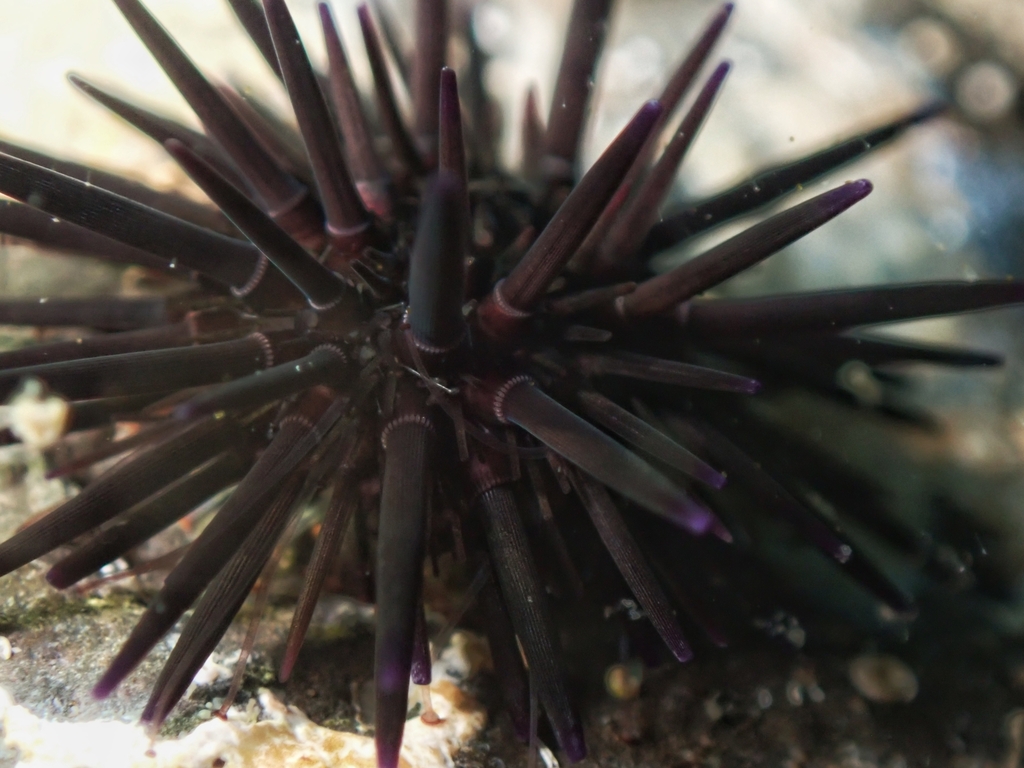
Oblong Sea Urchin
Echinometra oblonga
Echinometra oblonga, also called the oblong urchin or 'ina 'ele 'ele (ina= generic name for urchin, 'ele 'ele= blackish) in Hawaiian, is a very common rock boring urchin on shallow rocky shores of the tropical Indo-Pacific and Southern Africa.
From the article Echinometra oblonga on Wikipedia (CC BY-SA), quoted section by section
Description
Echinometra oblonga shows a range of color from dark purple to black. Their spines are shorter, and more blunt than other species of Echinometra.
Range & habitat
Echinometra oblonga generally live in rougher-water areas of tropical reefs. To protect themselves from the force of the waves, they live in the holes of the reef, but they also live on exposed reef flats. As the urchin grows, they use their jaws to help enlarge holes in the reef. Their spines trap seaweed and algae from the reef, which they then transfer to the mouth.
== References ==
Wikipedia: “Habitat”
What it does
Echinometra oblonga, are gonochoric. They fertilize externally. Their eggs are either held on the peristome or around the periproct.
Wikipedia: “Reproduction”
Where it lives
Recorded sightings
—
geo-referenced records in GBIF, from museums, herbaria and field observers.
Drag the globe to turn it. Dots are where records exist, not a range map; darker means more records.
In the stacks
Searching the stacks…
Every page naming Echinometra oblonga in the Biodiversity Heritage Library →
This page is assembled live from iNaturalist, GBIF, Wikipedia, the Source Library and the Internet Archive. It is not yet part of the hand-edited codex. iNaturalist taxon 293013.