- Animals
- ›Chordates
- ›Vertebrates
- ›Reptiles
- ›Snakes and Lizards
- ›Snakes
- ›Colubrid Snakes
- ›Dipsadine Snakes
- ›Manolepis
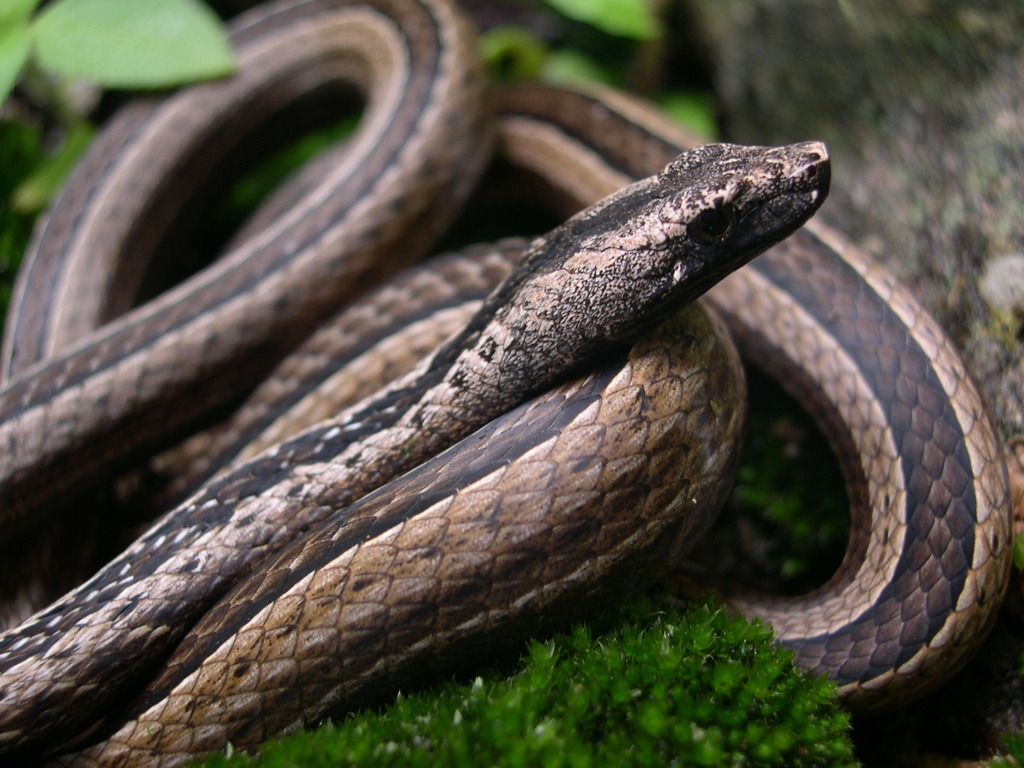
Ridgehead Snake
Manolepis putnami
The ridgehead snake (Manolepis putnami) is a species of snake in the family Colubridae. The species is endemic to southeastern Mexico.
From the article Ridgehead snake on Wikipedia (CC BY-SA), quoted section by section
Description
M. putnami may attain a total length of 55 cm (22 in), including a tail 14 cm (5.5 in) long. Dorsally, it is pale brown or yellowish, with a brown, darker-edged vertebral stripe three scales wide. Ventrally it is whitish, speckled with brown. The dorsal scales are smooth, without apical pits, and in 19 rows at midbody. The anal plate is divided, and the subcaudals are in two rows. M. putnami is rear-fanged (opisthoglyphous). It has 15 small, equal maxillary teeth, followed, after a space, by two enlarged grooved fangs. The anterior mandibular teeth are much longer than the posterior.
Range & habitat
M. putnami is found in the Mexican states of Chiapas, Colima, Guerrero, Jalisco, Nayarit, and Oaxaca.
Wikipedia: “Geographic range”
In human culture
The specific name, putnami, is in honor of American anthropologist Frederic Ward Putnam.
Wikipedia: “Etymology”
Where it lives
Recorded sightings
—
geo-referenced records in GBIF, from museums, herbaria and field observers.
Drag the globe to turn it. Dots are where records exist, not a range map; darker means more records.
In the stacks
Searching the stacks…
Every page naming Manolepis putnami in the Biodiversity Heritage Library →
This page is assembled live from iNaturalist, GBIF, Wikipedia, the Source Library and the Internet Archive. It is not yet part of the hand-edited codex. iNaturalist taxon 29447.