- Animals
- ›Chordates
- ›Vertebrates
- ›Reptiles
- ›Snakes and Lizards
- ›Snakes
- ›Colubrid Snakes
- ›Colubrine Snakes
- ›Lytorhynchus
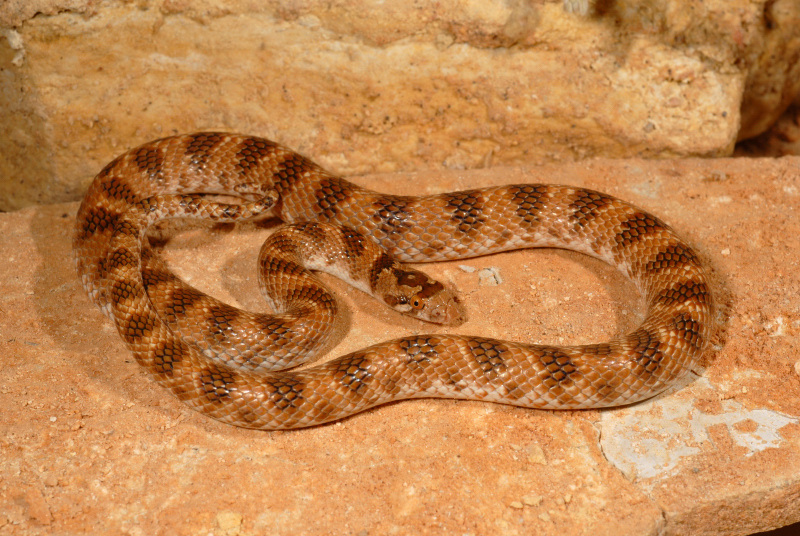
Awl-headed Snake
Lytorhynchus diadema
Lytorhynchus diadema, the crowned leafnose snake, diademed sand snake, or awl-headed snake, is a non-venomous snake found in Middle East, North Africa & West Asia.
From the article Lytorhynchus diadema on Wikipedia (CC BY-SA), quoted section by section
Description
Lytorhynchus diadema adults range from 30-51 cm in length. Pale buff or cream color above, with a series of 13 – 18 large transversely rhomboidal dark spots; a dark median band along the head and nape, sometimes confluent with an interocular transverse band; an oblique dark band from the eye to the angle of the mouth; lower parts uniform white.
Range & habitat
Algeria, Egypt, Iran, Iraq, Israel, Jordan, Kuwait, Libya, Morocco, Niger, Oman, Saudi Arabia, Tunisia, United Arab Emirates, Yemen, Mauritania, West Sahara. This species is found in sandy desert, semi-desert, sandy coastal areas, areas of high grassland plateaus (especially those close to rocky areas), and clay plateaus with rocks. This species digs, but is not considered fossorial In Arabia it appears to occur in a wide range of dry habitats.
Wikipedia: “Distribution”
What it does
It feeds mainly on lizards but will eat large arthropods, insects and young rodents.
Wikipedia: “Diet”
Where it lives
Recorded sightings
—
geo-referenced records in GBIF, from museums, herbaria and field observers.
Drag the globe to turn it. Dots are where records exist, not a range map; darker means more records.
In the stacks
Searching the stacks…
Every page naming Lytorhynchus diadema in the Biodiversity Heritage Library →
This page is assembled live from iNaturalist, GBIF, Wikipedia, the Source Library and the Internet Archive. It is not yet part of the hand-edited codex. iNaturalist taxon 29492.