- Animals
- ›Chordates
- ›Vertebrates
- ›Reptiles
- ›Snakes and Lizards
- ›Snakes
- ›Colubrid Snakes
- ›Colubrine Snakes
- ›Lampropeltis
- ›Lampropeltis getula
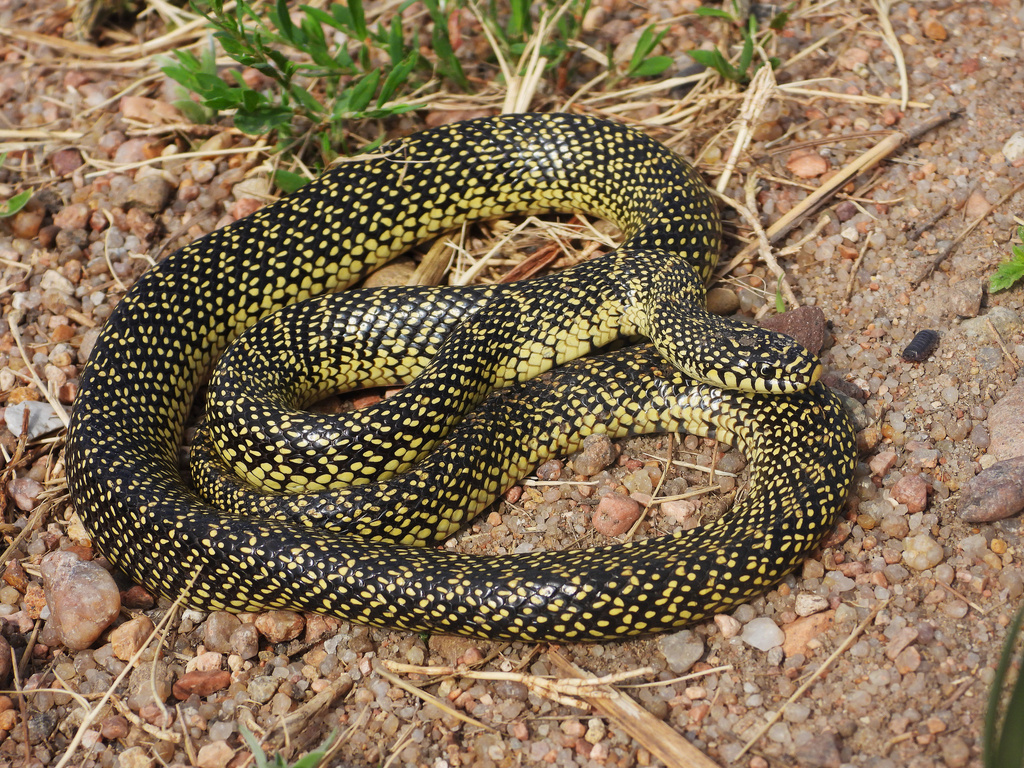
Speckled Kingsnake
Lampropeltis holbrooki
The speckled kingsnake (Lampropeltis holbrooki) is a species of nonvenomous kingsnake in the family Colubridae. The species is endemic to the United States.
From the article Speckled kingsnake on Wikipedia (CC BY-SA), quoted section by section
Description
The speckled kingsnake usually grows up to 48 in (120 cm) in total length (including tail), but the record total length is 72 in (180 cm). The common name is derived from its pattern, which is black, with small yellow-white specks, one speck in the center of almost every dorsal scale. It is also known as the "salt-and-pepper snake".
Range & habitat
The speckled kingsnake is found in the central and southern United States from southern Iowa to the Gulf of Mexico. Its range overlaps that of the desert kingsnake, Lampropeltis splendida, and it is known to intergrade with that species.
Wikipedia: “Geographic range”
What it does
The diet of the speckled kingsnake consists of birds, rodents and other mammals, frogs, lizards, and other snakes. It kills by constriction.
Wikipedia: “Diet”
In human culture
The speckled kingsnake was first described by American herpetologist John Edwards Holbrook in 1842. At that time, he called it Coronella sayi under the mistaken impression that it was the species previously described by Schlegel as Coluber sayi. In 1902, Stejneger pointed out that because Coluber sayi is a different snake, Pituophis catenifer sayi, the name sayi could not be applied to this snake. Therefore, he proposed the name Lampropeltis holbrooki, honoring Holbrook. It was for many years considered a subspecies of L. getula, but has been elevated to full species status as L. holbrooki.
Wikipedia: “Taxonomy and etymology”
Where it lives
Recorded sightings
—
geo-referenced records in GBIF, from museums, herbaria and field observers.
Drag the globe to turn it. Dots are where records exist, not a range map; darker means more records.
In the stacks
Searching the stacks…
Every page naming Lampropeltis holbrooki in the Biodiversity Heritage Library →
This page is assembled live from iNaturalist, GBIF, Wikipedia, the Source Library and the Internet Archive. It is not yet part of the hand-edited codex. iNaturalist taxon 29818.