- Animals
- ›Chordates
- ›Vertebrates
- ›Reptiles
- ›Snakes and Lizards
- ›Snakes
- ›Colubrid Snakes
- ›Natricine Snakes
- ›Amphiesma
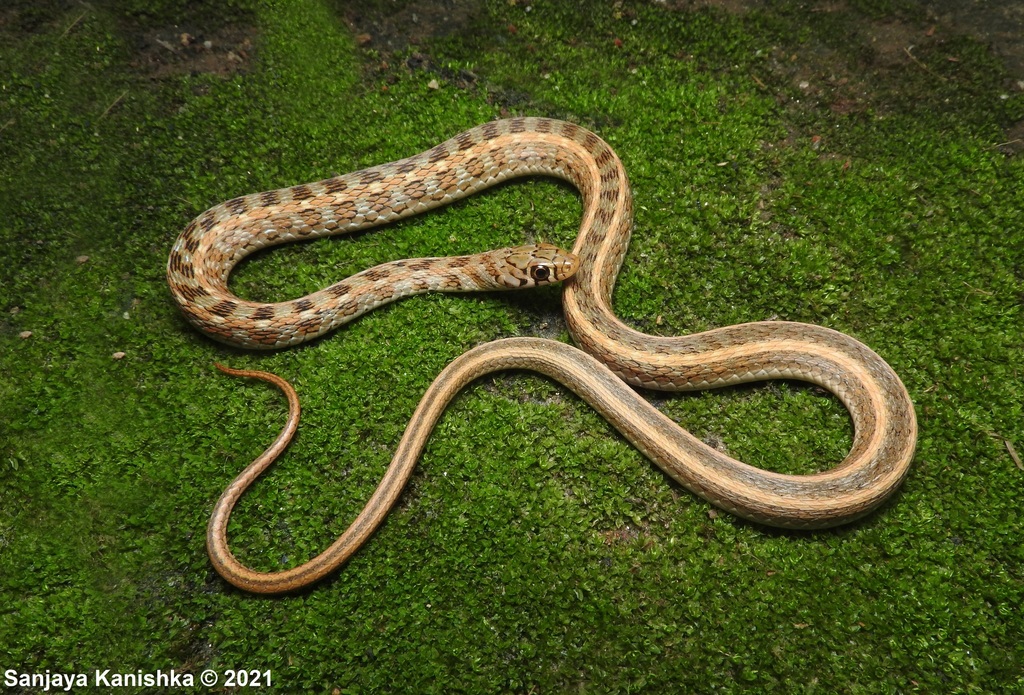
Buff Striped Keelback
Amphiesma stolatum
The buff striped keelback (Amphiesma stolatum) is a species of nonvenomous colubrid snake found across Asia. It is the sole species of genus Amphiesma. It is a typically nonaggressive snake that feeds on frogs and toads. It belongs to the subfamily Natricinae, and is closely related to water snakes and grass snakes. It resembles an Asian version of the American garter snake. It is quite a common snake but is rarely seen.
From the article Buff striped keelback on Wikipedia (CC BY-SA), quoted section by section
Description
A small, slender snake, the buff striped keelback is generally olive-brown to gray in colour. The head and the body are of the same colour. The body of the buff striped keelback is short, and it has a long slender tail which is almost a quarter of its length. Two yellow stripes along the length and to the sides of the spine are the distinctive feature of this snake. These stripes are diffuse at the head and are especially bright on the second half of its body. The keelback has irregular blackish crossbars on the body. Near the head the crossbars are prominent, whereas on the second half of the snake they become diffuse.
The sides of the head are yellow, and the head tapers to form a distinctive neck. The nape is red during the breeding season. The chin and throats are white or sometimes yellow. The lips and area in front of and behind eye are yellowish. The forked tongue is black. The eyes have large round pupils with golden flecks on the iris. The underside is pale cream and has small black spots scattered along both the margins. It has keeled scales on the dorsal surface of the body.
Morphs. There are two distinct colour varieties – a typical variety, found everywhere, with grayish-blue interscale colour. The second variety, erythrostictus, is common mainly in coastal areas and has bright vermillion interscale colour. …
Wikipedia: “Anatomy and morphology”
Range & habitat
The buff striped keelback is found throughout South and Southeast Asia. Its range extends from Pakistan (Sindh) to Sri Lanka, India (including the Andaman Islands), Bangladesh, Nepal, Myanmar, Thailand, Laos, Cambodia, Vietnam, Indonesia (Borneo, Sabah), Taiwan and China (Hainan, Hong Kong, Fujian, Jiangxi). It is also found in Bhutan. In India, the snake is found up to an altitude of 2,000 metres (6,600 ft).
Wikipedia: “Distribution”
What it does
The primary diet of adult A. stolatum is small amphibians such as frogs and toads, but they are also known to consume earthworms, small lizards and rodents.
Wikipedia: “Feeding ecology”
In human culture
Keelbacks are oviparous. Mating is thought to take place during the aestivation period. Gravid females have been found from April to August and eggs are laid in underground holes from May to September. The snake lays a clutch of 5 to 15 pure white eggs. Females remain with eggs till they hatch. The young snakes are 9-14 cm at birth and eat insects, tadpoles, small toads and frogs.
Wikipedia: “Life history”
Where it lives
Recorded sightings
—
geo-referenced records in GBIF, from museums, herbaria and field observers.
Drag the globe to turn it. Dots are where records exist, not a range map; darker means more records.
In the stacks
Searching the stacks…
Every page naming Amphiesma stolatum in the Biodiversity Heritage Library →
This page is assembled live from iNaturalist, GBIF, Wikipedia, the Source Library and the Internet Archive. It is not yet part of the hand-edited codex. iNaturalist taxon 29832.