- Animals
- ›Chordates
- ›Vertebrates
- ›Reptiles
- ›Snakes and Lizards
- ›Snakes
- ›Colubrid Snakes
- ›Dipsadine Snakes
- ›Farancia
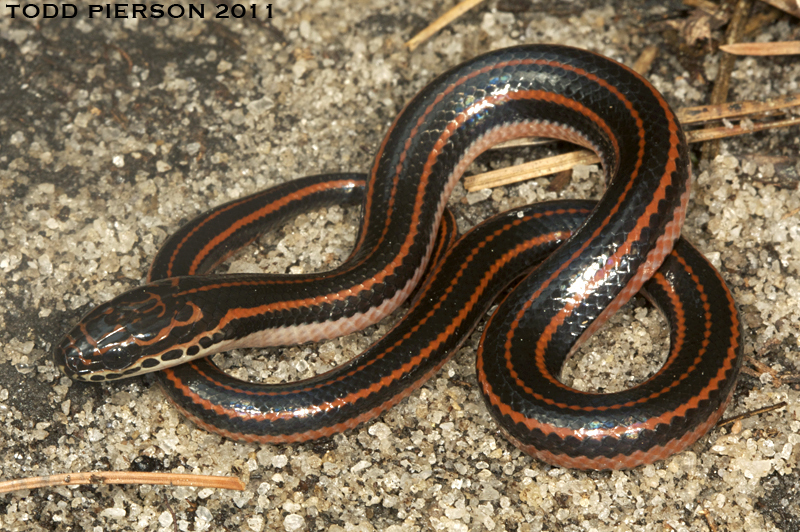
Rainbow Snake
Farancia erytrogramma
Farancia erytrogramma (also known commonly as the rainbow snake, and less frequently as the eel moccasin) is a species of large, nonvenomous, highly amphibious colubrid snake, endemic to the coastal plains of the southeastern United States. Two subspecies are recognized as being valid, one of which has been declared extinct.
From the article Farancia erytrogramma on Wikipedia (CC BY-SA), quoted section by section
Description
Dorsally, rainbow snakes have smooth, glossy bluish-black back scales, with three red stripes. They have short tails, with a spiny tip which they sometimes use as a probe. Adults may show yellow coloration along the sides and on the head. They usually grow to a total length (including tail) of 36-48 inches (91–122 cm), although some specimens have been recorded up to 66 inches (168 cm) in total length. Females are larger than males.
Range & habitat
Rainbow snakes are found in aquatic habitats ranging from cypress swamps and marshes to blackwater creeks, slow-moving streams, and sandy coastal plain.
Wikipedia: “Habitat”
What it does
Rainbow snakes are rarely seen due to their secretive habits. They spend most of their lives in the water, hiding in aquatic vegetation or other forms of cover. They are strong swimmers, and also know how to burrow into mud and sand. Rainbow snakes are not aggressive when captured, and do not bite their captors. In New Kent County, Virginia, they are abundant in sandy fields near the Chickahominy River, and great numbers are turned up by plows in the spring.
Wikipedia: “Behavior”
Where it lives
Recorded sightings
—
geo-referenced records in GBIF, from museums, herbaria and field observers.
Drag the globe to turn it. Dots are where records exist, not a range map; darker means more records.
In the stacks
Searching the stacks…
Every page naming Farancia erytrogramma in the Biodiversity Heritage Library →
This page is assembled live from iNaturalist, GBIF, Wikipedia, the Source Library and the Internet Archive. It is not yet part of the hand-edited codex. iNaturalist taxon 30103.