- Animals
- ›Chordates
- ›Vertebrates
- ›Reptiles
- ›Snakes and Lizards
- ›Snakes
- ›Colubrid Snakes
- ›Dipsadine Snakes
- ›Farancia
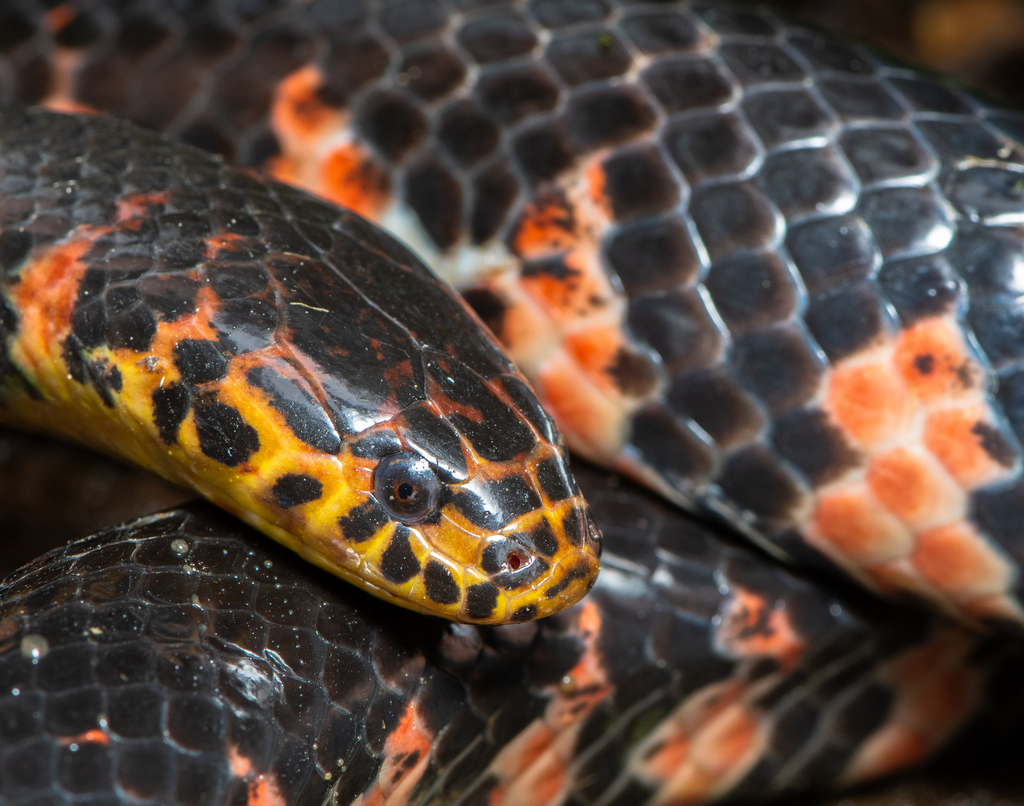
Mudsnake
Farancia abacura
The mud snake (Farancia abacura) is a species of nonvenomous, semiaquatic, colubrid snake endemic to the southeastern United States.
From the article Mud snake on Wikipedia (CC BY-SA), quoted section by section
Description
The mud snake usually grows to a total length (including tail) of 40 to 54 inches (1-1.4 m), with the record total length being slightly over 80 inches (2 m). This species is sexually dimorphic in size. Female adults are larger than males in total length. The upperside of the mud snake is glossy black. The underside is red and black, and the red extends up the sides to form bars of reddish-pink, although some have a completely black body with slightly lighter black spots instead of the common reddish colors. The heavy body is cylindrical in cross section, and the short tail has a terminal spine. The head scalation is distinctive in that there is only one internasal scale, no preocular scale, and one anterior temporal scale. The dorsal scales are smooth, and are arranged in 19 rows at midbody. There are 168–208 ventral scales and 31–55 subcaudal scales. The anal plate is divided. Farancia abacura is closely related to Farancia erytrogramma, also called the rainbow snake.
Range & habitat
The mud snake is found in the southeastern United States, in the states of Alabama, Arkansas, Florida, Georgia, Illinois, Kentucky, Louisiana, Mississippi, Missouri, North Carolina, Oklahoma, South Carolina, Tennessee, Texas, and Virginia.
Wikipedia: “Geographic range”
What it does
The mud snake is mostly aquatic and nocturnal. It preys mostly on giant aquatic salamanders in the genera Siren and Amphiuma, but it also eats other amphibians. They are known to use their sharply pointed tails to prod prey items, leading to the nickname "stinging snake", although their tail is not a stinger and cannot sting. Enlarged teeth occur at the rear of the upper jaw, which presumably help to hold slippery prey. Upon being disturbed, mud snakes will sometimes tuck their head beneath their coils and expose the red underside on the tail as a warning display.
Wikipedia: “Behavior”
In human culture
The mud snake is one of a few animals which may be the origin of the hoop snake myth. J.D. Willson writes:
Mud snakes are sometimes known as "hoop snakes" because of the myth that they will bite their own tail and roll after people. The hoop snake myth has also been attributed to the coachwhip snake.
Wikipedia: “Cultural significance”
Where it lives
Recorded sightings
—
geo-referenced records in GBIF, from museums, herbaria and field observers.
Drag the globe to turn it. Dots are where records exist, not a range map; darker means more records.
In the stacks
Searching the stacks…
Every page naming Farancia abacura in the Biodiversity Heritage Library →
This page is assembled live from iNaturalist, GBIF, Wikipedia, the Source Library and the Internet Archive. It is not yet part of the hand-edited codex. iNaturalist taxon 30106.