- Animals
- ›Chordates
- ›Vertebrates
- ›Reptiles
- ›Snakes and Lizards
- ›Snakes
- ›Colubrid Snakes
- ›Dipsadine Snakes
- ›Alsophis
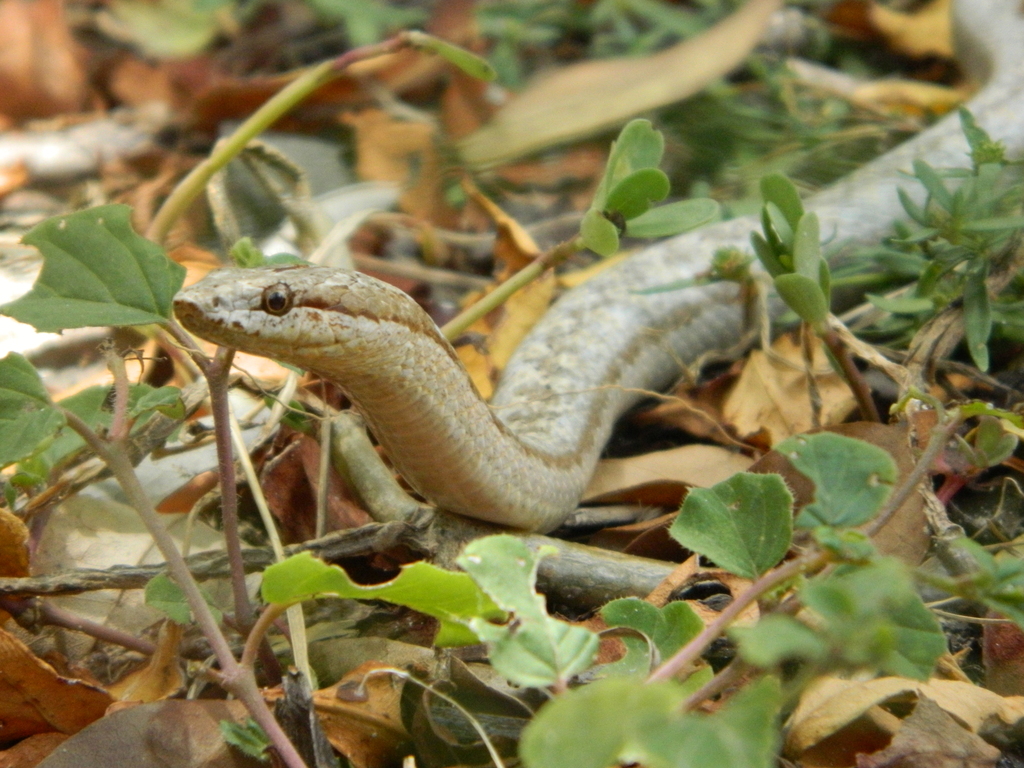
Antiguan Racer
Alsophis antiguae
The Antiguan racer (Alsophis antiguae) is a harmless rear-fanged (opisthoglyphous) grey-brown snake that was until recently found only on Great Bird Island off the coast of Antigua, in the eastern Caribbean. It is among the rarest snakes in the world. In the year 1995 researchers estimated that only 51 Antiguan racer snakes were alive on the Great Bird Island. However, in the last 20 years, conservation efforts have boosted numbers from an estimated 50 to over 1,100 individuals by eradicating non-native predators and reintroducing the snake to other Antiguan islands in its original range. In addition to Great Bird Island, the Antiguan racer has successfully recolonised the nearby Rabbit Island, Green Island, and York Island.
From the article Antiguan racer on Wikipedia (CC BY-SA), quoted section by section
Description
This racer exhibits sexual dimorphism. The adult racer is typically about 1 m long, with females being larger than the males. Young adult males are usually dark brown with light creamy markings, while young females are silvery-gray with pale brown patches and markings. Females also have larger heads than the males. However, older individuals of both sexes can be highly variable in colour hue and pattern, and are frequently heavily speckled or blotched in a range of hues, including white, taupe, reddish brown, brown, and black.
Range & habitat
The Antiguan racer originally inhabited Antigua and Barbuda and probably all of the islands on the Antigua Bank. By 1995, the species was found only on Great Bird Island, a small island 2.5 km off of the northeast coast of Antigua. The island is extremely small at only 8.4 hectares. The Antiguan racer prefers to live in shady woodlands with dense undergrowth, although it is also found on sandy beaches and rocky outcrops.
Wikipedia: “Distribution and habitat”
What it does
The Antiguan racer is harmless to humans and has a gentle temperament. It is diurnal, being active from dawn to dusk. At night, it rests in a hidden shelter. The Antiguan racer appears to have poor resistance to common snake mites, which are not naturally found in Antigua, which has ended some attempts at captive breeding. The racer primarily eats a diet of lizards, including the local Antiguan ground lizard. While the species sometimes hunts for its food, it is typically an ambush predator, waiting for prey with most of its body buried beneath leaves.
Wikipedia: “Ecology and behavior”
Where it lives
Recorded sightings
—
geo-referenced records in GBIF, from museums, herbaria and field observers.
Drag the globe to turn it. Dots are where records exist, not a range map; darker means more records.
In the stacks
Searching the stacks…
Every page naming Alsophis antiguae in the Biodiversity Heritage Library →
This page is assembled live from iNaturalist, GBIF, Wikipedia, the Source Library and the Internet Archive. It is not yet part of the hand-edited codex. iNaturalist taxon 30142.