- Animals
- ›Chordates
- ›Vertebrates
- ›Reptiles
- ›Snakes and Lizards
- ›Snakes
- ›Colubrid Snakes
- ›Colubrine Snakes
- ›Eirenis
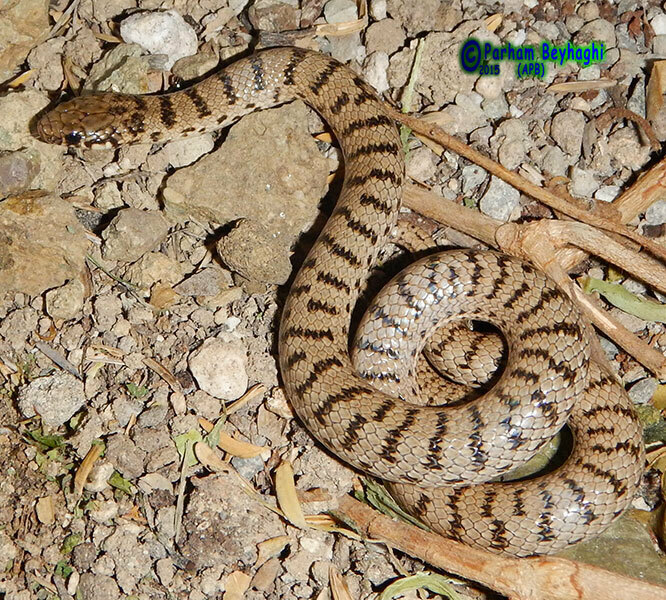
Ashkhabad Dwarf Racer
Eirenis medus
Eirenis medus is a species of nonvenomous dwarf snake from the family Colubridae. Its common names include Ashkhabad Dwarf Racer, Turkmen Dwarf Snake, and Striped Dwarf Snake. It is commonly found under rocks in semi-deserts and canyons throughout Iran and southern Turkmenistan at altitudes between 1100–1600 m (approx. 3609–5249 ft.) above sea level. It is insectivorous along with eating small lizards and other arthropods.
From the article Eirenis medus on Wikipedia (CC BY-SA), quoted section by section
Description
E. medus can be distinguished from other Eirenis species by its dorsal scale count of 15 smooth rows and its 50 narrow crossbars along its dorsum. They may get as long as 430 mm long with males having a greater range of length being both the smallest and largest specimens, although females are larger than males on average. E. medus has a light greyish-brown dorsal surface with brown crossbars and a salmon belly. It is oviparous and delivers clutches of 2–3 eggs which can get up to 18 mm long.
Wikipedia: “Morphology”
What it does
E. medus is considered to be a nocturnal species. It exhibits limited diurnal activity, however. Most of the species' time is spent under stones, which act as both home and hunting grounds. The reasons it may emerge from under its rock are to find new shelters with optimal temperature, humidity, and food, or to find partners during the breeding season. It has been found active on rocky slopes from April through October, though never in midsummer. The population density of E. medus is up to 133 per hectare. The species is considered to be of least concern by the IUCN.
Wikipedia: “Behavior”
Where it lives
Recorded sightings
—
geo-referenced records in GBIF, from museums, herbaria and field observers.
Drag the globe to turn it. Dots are where records exist, not a range map; darker means more records.
In the stacks
Searching the stacks…
Every page naming Eirenis medus in the Biodiversity Heritage Library →
This page is assembled live from iNaturalist, GBIF, Wikipedia, the Source Library and the Internet Archive. It is not yet part of the hand-edited codex. iNaturalist taxon 30303.