- Animals
- ›Chordates
- ›Vertebrates
- ›Reptiles
- ›Snakes and Lizards
- ›Snakes
- ›Colubrid Snakes
- ›Dipsadine Snakes
- ›Dipsas
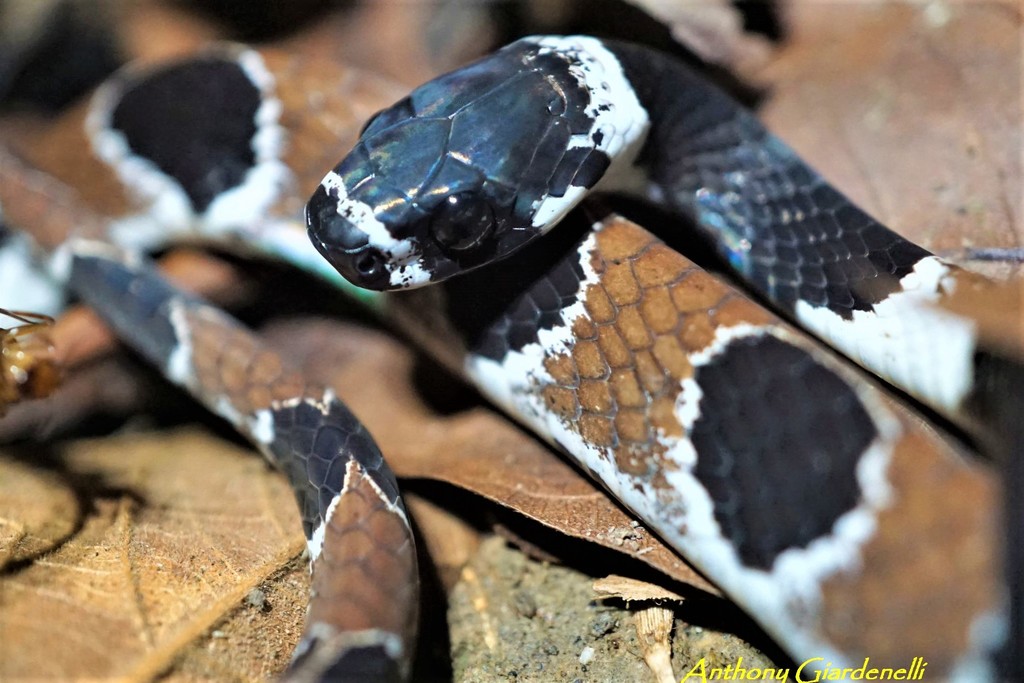
Catesby's Snail-eater
Dipsas catesbyi
Catesby's snail-eater (Dipsas catesbyi), also commonly known as Catesby's snail sucker, is a nocturnal species of non-venomous snake in the family Colubridae. The species is native to northern South America.
In June 2021 upon manipulation, a snake of this species presented vocalization, a duration of 0.06 seconds, reaching 3036 Hz in its peak frequency with a modulated note, emitted through exhalation of air through the larynx, being the first record of a snake call in South America.
From the article Catesby's snail-eater on Wikipedia (CC BY-SA), quoted section by section
Description
D.catesbyi has a thin body, with the maximum recorded length sitting at 598 mm (23.5 in) for males and 585 mm (23.0 in) for females. The number of ventral scales have been recorded to vary from 164 to 220 for males and from 167 to 200 for females, while the number of subcaudal scales have been recorded to vary from 70 to 120 for males and 60 to 102 for females. A D.catesbyi has between 10 to 40 dark brown to black blotches, usually with white outlines, along the length of a brown to reddish-brown. The blotches are longer than the spacing separating one blotch from the next, and some blotches are connected at the snake's midline. The snake's belly is white, and usually has rectangular spots similar in colouration to the blotches on their backs. The positions of the rectangular spots and the spaces between the blotches tend to correspond.
Range & habitat
D. catesbyi is found in Bolivia, Brazil, Guyana, Colombia, Ecuador, French Guiana, Peru, Suriname, and Venezuela.
Wikipedia: “Distribution”
What it does
D. catesbyi, like all species in the genus Dipsas, preys on arboreal land snails and slugs.
Wikipedia: “Diet”
Where it lives
Recorded sightings
—
geo-referenced records in GBIF, from museums, herbaria and field observers.
Drag the globe to turn it. Dots are where records exist, not a range map; darker means more records.
In the stacks
Searching the stacks…
Every page naming Dipsas catesbyi in the Biodiversity Heritage Library →
This page is assembled live from iNaturalist, GBIF, Wikipedia, the Source Library and the Internet Archive. It is not yet part of the hand-edited codex. iNaturalist taxon 30392.