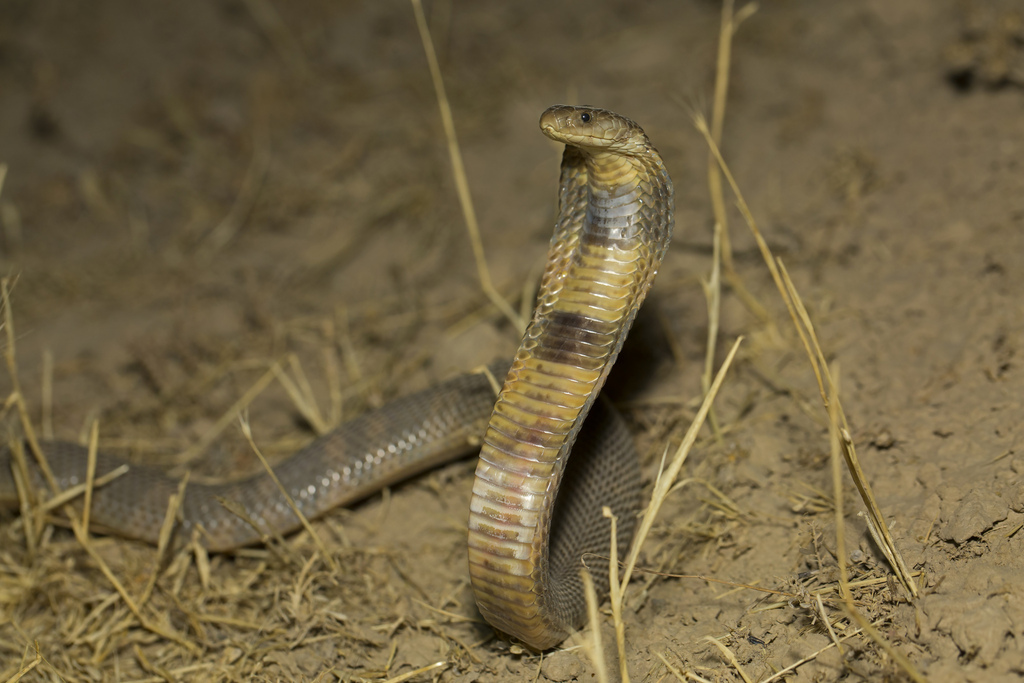
Central Asian Cobra
Naja oxiana
The Caspian cobra (Naja oxiana), also called the Persian cobra or Russian cobra, is a species of highly venomous snake in the family Elapidae. The species is endemic to Central Asia. First described by Karl Eichwald, a German physician, in 1831, it was for many years considered to be a subspecies of the Naja naja until genetic analysis revealed it to be a distinct species.
From the article Caspian cobra on Wikipedia (CC BY-SA), quoted section by section
Description
Naja oxiana is medium in length, a heavy-bodied snake with long cervical ribs capable of expansion to form a hood. Anteriorly, the body is depressed dorsoventrally, and posteriorly it is subcylindrical. This species is similar in size to Naja naja, averaging about 1 to 1.4 m (3.3 to 4.6 ft) in total length (including tail) and rarely reaches lengths over 1.7 m (5.6 ft). The head is elliptical, depressed, and slightly distinct from the neck, with a short, rounded snout and large nostrils. The eye is medium in size with a round pupil. The dorsal scales are smooth and strongly oblique, with the outer two or three scale rows larger than the remainder. The hood of N. oxiana has an elongated, gradually tapering shape in contrast to the more ovoid hoods of some other Naja species (Naja naja or Naja kaouthia). Juveniles tend to be pale, with a faded appearance. Juveniles have noticeable dark and light cross-bands of approximately equal width around the body. Adults of this species are completely light to chocolate brown or yellowish, with some specimens retaining traces of juvenile banding, especially the first few dark ventral bands. This species has no hood marks and no lateral throat spots. Confusions may exist with the Indian cobra (Naja naja), as specimens without a hood mark are usually confused with this species, and these two species coexist in Pakistan and northern India. …
Range & habitat
Naja oxiana occurs in the Transcaspian region. It is found throughout Turkmenistan, Uzbekistan, Kyrgyzstan, southwestern Tajikistan, the Fergana Valley, north and east Afghanistan, and northeastern Iran. In Iran, it occurs from East Azerbaijan Province, southern half of Ardabil Province to the Provinces of Zanjan and Tehran all the way to the eastern half of both Isfahan and Yazd Provinces, as well the northeastern parts of Kerman Province, northern part of Sistan and Baluchistan Province, throughout the Provinces of Semnan, Mazandaran, and Golestan the entire former Province of Khorasan, which was split into three separate provinces post-2004). Although this species is found throughout much of Pakistan, from Balochistan and Sindh to Gilgit-Baltistan and Azad Kashmir, it is far more common in the northern half of Pakistan. This species has also been observed in far northwest India in Jammu and Kashmir (union territory) and also been observed in the state of Himachal Pradesh. It's also highly suspected to have occurred in Ladakh, and in the Indian state of Punjab. There is also anecdotal evidence of it ranging as far north as Kazakhstan's southern border with Uzbekistan, according to Brian Hayes, a biochemical engineer with the United States Threat Reduction Agency. …
Wikipedia: “Distribution and habitat”
What it does
Naja oxiana tends to avoid humans as much as it can, but it can become fiercely defensive when threatened or cornered, and even juveniles tend to be very aggressive. When cornered and provoked, it is liable to spread its hood, hiss, sway from side to side and strike repeatedly; however, it cannot spit venom. This terrestrial species is mainly diurnal, but it may be crepuscular and nocturnal in some parts of its range during the hottest month (July). Caspian cobras are good climbers, and able swimmers. The Caspian cobra is often found in water and seldom found too far away from it. Quick-moving and agile, this species lives in holes in embankments or trees.
Wikipedia: “Behavior”
Toxicity
Naja oxiana is regarded as the most dangerous snake in Central Asia and is one of the venomous snakes with a high mortality rate. It is one of the most dangerous elapid species in the world. A bite from this species will cause severe pain and swelling at the site of the bite, along with the rapid onset of prominent neurotoxicity. Weakness, drowsiness, ataxia, hypotension, and paralysis of the throat and limbs may appear in less than one hour after the bite. In a study, the first signs and symptoms of envenomation appeared within 15 minutes post-envenomation. Without medical treatment, symptoms rapidly worsen and death can occur soon after a bite due to respiratory failure. As with all species of cobra, there is great variation in venom toxicity and composition based on diet and geographical location. Venom toxicity is highest (least lethal) among specimens in the eastern parts of their geographical range (Indian and Pakistani specimens) with a value of around 0.2 mg/kg. Specimens from Iran, Uzbekistan, northeastern Afghanistan, and Turkmenistan can have considerably more potent venoms. The onset of symptoms is rapid and are extremely painful. …
Wikipedia: “Toxic effects”
Where it lives
Recorded sightings
—
geo-referenced records in GBIF, from museums, herbaria and field observers.
Drag the globe to turn it. Dots are where records exist, not a range map; darker means more records.
In the stacks
Searching the stacks…
Every page naming Naja oxiana in the Biodiversity Heritage Library →
This page is assembled live from iNaturalist, GBIF, Wikipedia, the Source Library and the Internet Archive. It is not yet part of the hand-edited codex. iNaturalist taxon 30485.