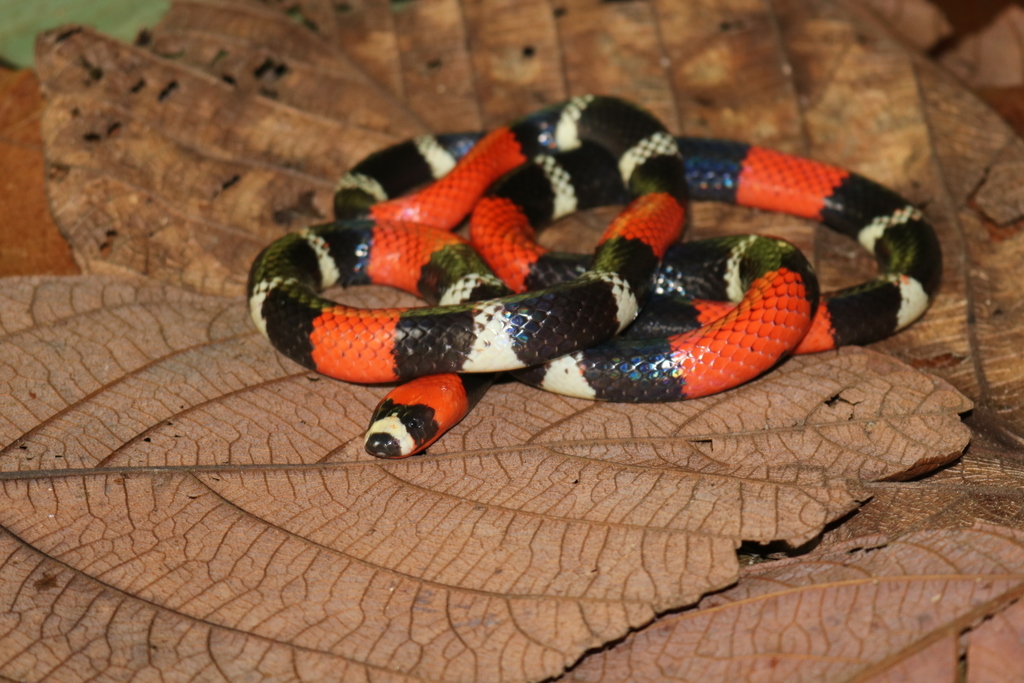
Ribbon Coralsnake
Micrurus lemniscatus
Micrurus lemniscatus, commonly known as the South American coral snake, is a species of venomous snake in the family Elapidae. The species is endemic to South America.
From the article Micrurus lemniscatus on Wikipedia (CC BY-SA), quoted section by section
Description
Micrurus lemniscatus is a thin and brightly colored species. Adults usually have a total length (tail included) of 60–90 cm (24–35 in), but the maximum reported total length is 145 cm (57 in). The snout is black, followed by a narrow white crossband in front of the eyes, then a wider black band including the eyes. The eyes are small, and the rest of the head is red. The body pattern consists of slightly broad red rings that are separated by seven to 17 triads of three black and two white rings. The tail has two triads.
Range & habitat
Micrurus lemniscatus is found in Argentina, northern Bolivia, Brazil, Colombia, eastern Ecuador, French Guiana, Guyana, Paraguay, eastern Peru, Suriname, Trinidad, and Venezuela.
Wikipedia: “Geographic range”
What it does
Like many coral snakes, Micrurus lemniscatus is nocturnal and terrestrial, digging in loose soil or litter. It is not aggressive towards humans, although it can attack to defend itself.
Wikipedia: “Behavior”
Toxicity
The venom of Micrurus lemniscatus is a potent post- and pre-synaptic neurotoxin, which causes a potent and irreversible neuromuscular block in vertebrates. Lemnitoxin, a potent myotoxic PLA2 type toxin, isolated from the venom of M. lemniscatus induces local and systemic myotoxicity after intramuscular and intravenous injection in mice, which is antigenically related to Micrurus nigrocinctus nigroxin, Notechis scutatus notexin, mulgotoxin of Pseudechis australis and textilotoxin of Pseudonaja textilis. The estimated lethal dose of M. lemniscatus venom for an adult human is 5–7 mg (dry weight). When live specimens of M. lemniscatus were "milked" in a laboratory, the average venom yield was 8–10 mg and the maximum yield was 27 mg.
Wikipedia: “Venom”
Where it lives
Recorded sightings
—
geo-referenced records in GBIF, from museums, herbaria and field observers.
Drag the globe to turn it. Dots are where records exist, not a range map; darker means more records.
In the stacks
Searching the stacks…
Every page naming Micrurus lemniscatus in the Biodiversity Heritage Library →
This page is assembled live from iNaturalist, GBIF, Wikipedia, the Source Library and the Internet Archive. It is not yet part of the hand-edited codex. iNaturalist taxon 30498.