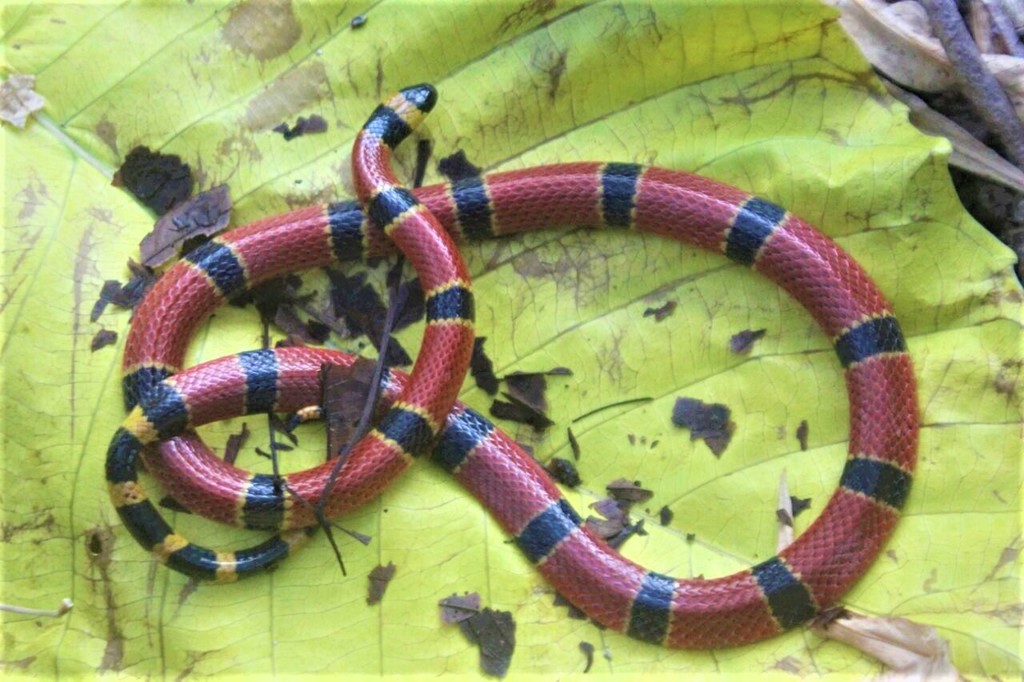
Nayarit Coralsnake
Micrurus proximans
Micrurus proximans, also known commonly as the Nayarit coral snake and el coralillo de Nayarit in Mexican Spanish, is a species of venomous snake in the family Elapidae. The species is endemic to Mexico.
From the article Micrurus proximans on Wikipedia (CC BY-SA), quoted section by section
Description
Micrurus proximans is small for its genus. Adults usually have a total length (tail included) of 40–50 cm (16–20 in). The maximum recorded total length is 56.5 cm (22.2 in). Like many other species of New World coral snakes, the color pattern consist of red, black, and white (or yellow) rings, with the black rings not arranged in triads. Unlike other species, the females of M. proximans have several black rings interrupted ventrally. The white (or yellow) rings are narrowest (1 dorsal and 1 ventral wide). The black rings are wider (2–3 dorsal and 2–3 ventrals wide). The red rings are widest, two times or more wider than the black rings, depending on the number of black rings present. Males have 21–24 black rings on the body. Females have 17–22 black rings on the body, 3–10 of which are complete. Males have supraanal tubercles, and have 202–207 ventrals and 47–53 subcaudals. Females have 210–218 ventrals and 36–42 subcaudals.
Range & habitat
Micrurus proximans is found in western Mexico, in the Mexican states of Colima, Jalisco, and Nayarit.
Wikipedia: “Geographic distribution”
What it does
Micrurus proximans is known to prey upon Rena dugesii, and probably upon other small snakes.
Wikipedia: “Diet”
Where it lives
Recorded sightings
—
geo-referenced records in GBIF, from museums, herbaria and field observers.
Drag the globe to turn it. Dots are where records exist, not a range map; darker means more records.
In the stacks
Searching the stacks…
Every page naming Micrurus proximans in the Biodiversity Heritage Library →
This page is assembled live from iNaturalist, GBIF, Wikipedia, the Source Library and the Internet Archive. It is not yet part of the hand-edited codex. iNaturalist taxon 30529.