On eBird ↗
Laurel Pigeon
Live sightings near you, the range map, bar charts of when it is seen, and Macaulay Library photos and recordings.
Laurel Pigeon
Columba junoniae
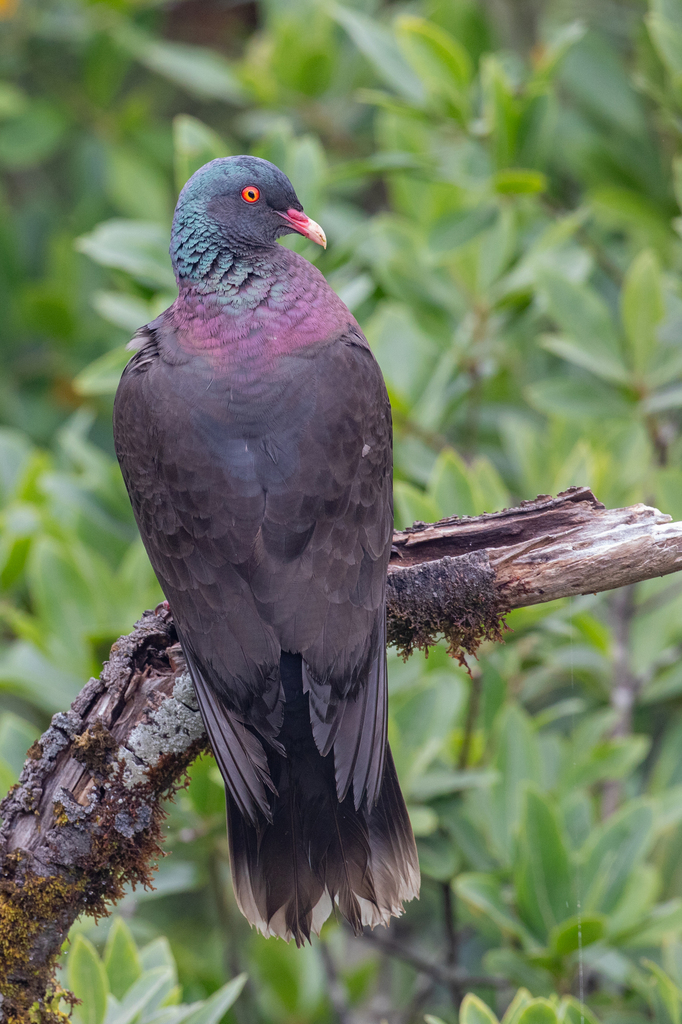
The laurel pigeon or white-tailed laurel pigeon (Columba junoniae) is a species of bird in the genus Columba in the family Columbidae (doves and pigeons). It is endemic to the Canary Islands, Spain, and resides in laurel forest habitat. It is the animal symbol of the island of La Gomera. It is a pigeon which is endemic to some Canary islands. Its close relative and probable ancestor is the common wood pigeon.
From the article Laurel pigeon on Wikipedia (CC BY-SA), quoted section by section
Description
The laurel pigeon is a dark brown and grey bird of 40 cm; it resembles a very dark wood pigeon. The underparts are reddish, and the tail is pale grey with a broad, whitish terminal band. Extensive green gloss to rear crown and hindneck becoming pink on the upper mantle. The bill is pink with a white tip, and the eye is orange in colour. The similar Canarian species, the Bolle's pigeon or dark-tailed laurel pigeon Columba bollii has a pale grey subterminal band and blackish terminal band to tail. A rare resident breeder in the mountain laurisilva and Canary pine forests, the laurel pigeon builds a stick nest in a tree. There it lays one white egg. The flight is quick and performed by regular beats. An occasional sharp flick of the wings is characteristic of pigeons in general. Often, the bird takes off with a loud clattering. The call is a hoarse hiccuped cooing.
Range & habitat
The laurel pigeon is endemic to the mountainous subtropical Atlantic west Canary islands, where it occurs on the islands of La Palma, La Gomera, Tenerife and El Hierro. In the 1980s, the population was estimated at 1,200-1,480 individuals, but more recent surveys have shown that it is more numerous, and more widely distributed. The largest subpopulation is found on La Palma, where it occurs across much of the northern half of the island. The species is common on La Gomera, where it is found primarily in the north, and also occurs patchily on the northern slopes of Tenerife. It has recently also been recorded on El Hierro; however, breeding there has not yet been confirmed3,4. Although the species was recently suspected to be declining on Tenerife. It mainly occurs on the northern slopes of the mountains, but smaller numbers are found in the south where suitable patches of laurel forest remain. Bones similar to those of a laurel pigeon have been found on neighbouring Gran Canaria, but it is unclear whether these remains stem from the white-tailed laurel pigeon or from Bolle's pigeon. A program to (re)introduce the white-tailed laurel pigeon to this island commenced in 2012. The natural habitat is tall laurisilva forest or dense tree heaths which are cloud-covered for much of the year. …
Wikipedia: “Distribution and habitat”
What it does
It prefers areas with steep slopes, escarpments and gullies, where it occurs in dry forest, laurel forest and Canary pine forest, as well as cultivated areas. Nests are on the ground - in fissures, holes or small ledges, at the bases of trees, and under rocks or fallen tree trunks - in steep, rocky, shady areas with abundant shrubby vegetation. The breeding season varies between islands, but extends from January to September, with a peak between April–June. At least on Tenerife, breeding success appears to be low, as a consequence of intense nest predation. Pigeons can breed from their first year, and nesting occurs throughout the year, although mainly from February to June. The displays are similar to those of the common wood pigeon; the male climbs quickly in flight, gives a loud wing-clap, and then glides down with his wings and tail spread. The display may be repeated two or three times before the bird returns to a perch. On the ground the male performs a bowing display with his neck inflated to show off the iridescent neck patches; meanwhile, the tail is raised, fanned, then closed again. This display is usually accompanied by calling. The nest is a typical pigeon construction, a flimsy structure of twigs and grasses usually placed high in the floor of canyon walls with much vegetation. Nestled among the crevices in rocks, in gullies of the hills. …
Wikipedia: “Ecology”
Listen
Looking for field recordings…
Where it lives
Recorded sightings
—
geo-referenced records in GBIF, from museums, herbaria and field observers.
Drag the globe to turn it. Dots are where records exist, not a range map; darker means more records.
In the stacks
Searching the stacks…
Every page naming Columba junoniae in the Biodiversity Heritage Library →
This page is assembled live from iNaturalist, GBIF, Wikipedia, the Source Library and the Internet Archive. It is not yet part of the hand-edited codex. iNaturalist taxon 3056.