On eBird ↗
Speckled Wood-Pigeon
Live sightings near you, the range map, bar charts of when it is seen, and Macaulay Library photos and recordings.
Speckled Wood-Pigeon
Columba hodgsonii
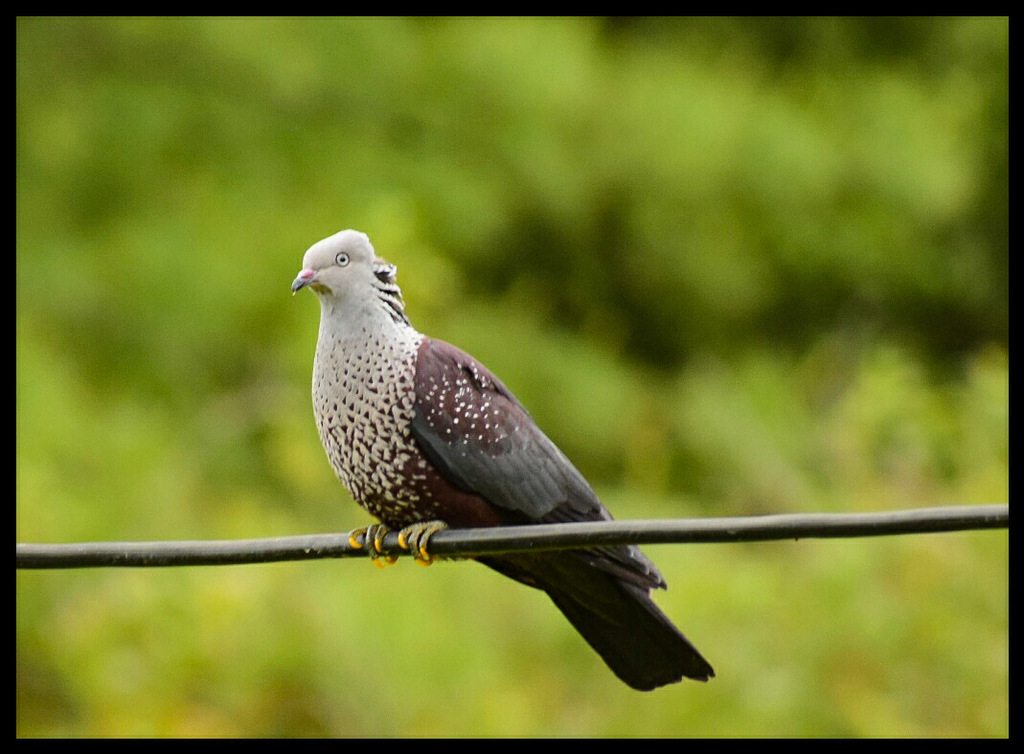
The speckled wood pigeon (Columba hodgsonii), also known as Hodgson's pigeon or the jungle pigeon, is a medium-sized pigeon of the bird family Columbidae and genus Columba. It is a monotypic species. It measures 38–40 cm (15–15.5 in) in length, with males featuring a pale gray head and females having a grayish-brown head. Males have a distinctive pinkish-silver breast speckled with black spots and a maroon belly, while females exhibit less vibrant coloration. Both sexes have blackish-brown tails and primaries, iris color differs slightly. The species is distributed across the Himalayas extending from Kashmir to western and central China, as well as parts of India, Myanmar, Laos, Thailand, Pakistan, Nepal, Bhutan, and Afghanistan. Inhabiting evergreen and semi-evergreen hill forests at elevations of 1,800–4,000 meters (5,900–13,100 ft), descend in winter based on food availability. Diet consists mainly of acorns, berries, and fruits, typically foraging in small flocks. Breeding occurs from May to August, with nests situated 3–8 meters (9.8–26.2 ft) above ground.
From the article Speckled wood pigeon on Wikipedia (CC BY-SA), quoted section by section
Description
General Characteristics: Size of the Speckled wood pigeon is usually 38–40 cm (15–15.5 in) for adults. Adult male has a pale gray head, while female's head is grayish-brown, juvenile resembles the female but browner and paler than female. Adult male has a pinkish-silver breast and side of neck area, speckled with black spots, each feather on the breast area has a silver base, dark central streak, and the tip is silvery-pink. Hindneck feathers have black or purplish-black bases with silver tips, creating a speckled appearance. Female neck and breast color in less vibrant tones compared to male. Plumage: Mantle and wing-coverts of male is dark reddish-purple/burgundy/maroon on the upper part, turning into bluish-gray on the outer wing-coverts. Upper mantle has silver flecks, and white spots on inner and median wing-coverts. In female, scapulars and mantle lack of maroon coloration and replaced with slaty dark brown. Speckles on the juvenile is indistinct. Tail and primaries black/blackish-brown in both male and female, underwing and undertail is blackish. Belly/abdomen is maroon/dark-reddish purple with pinkish-white streaks in male, each feather with white fringes and is purplish. Females have dark brownish gray underparts without maroon coloration. Legs are brownish yellow-greenish in adults. …
Range & habitat
Distribution: Speckled wood pigeon is distributed across the Himalayas, from Kashmir to western and central China (Including southern Gansu, western Sichuan, and western Yunnan), the presence of this species is also found in India, Myanmar, northern and western Thailand, northern and western Laos, Pakistan, Nepal, Bhutan, and Afghanistan. Habitat: Speckled wood pigeons inhabit tall evergreen and semi-evergreen hill forests, particularly those dominated by oak and Rhododendron, at altitudes ranging from 1,800–4,000 meters (5,900–13,100 ft), though it may descend to as low as 1,350 meters (4,430 ft) in winter depending on food availability. Sometimes observed in open treeless valley bottoms.
Wikipedia: “Distribution and habitat”
What it does
Primarily frugivorous and granivorous, foraging primarily on acorns, berries, drupes, and fruits like those from Prinsepia utilis. They are also known to feed on herbs and cereals. Often gathering on the ground to consume leftover grains in fields after harvest. Have been observed feeding on the acorns of brown oak (Quercus semecarpifollia) and fig (Ficus). Typically feed in pairs, small groups, or flocks of 6-10 individuals.
Wikipedia: “Diet”
Listen
Looking for field recordings…
Where it lives
Recorded sightings
—
geo-referenced records in GBIF, from museums, herbaria and field observers.
Drag the globe to turn it. Dots are where records exist, not a range map; darker means more records.
In the stacks
Searching the stacks…
Every page naming Columba hodgsonii in the Biodiversity Heritage Library →
This page is assembled live from iNaturalist, GBIF, Wikipedia, the Source Library and the Internet Archive. It is not yet part of the hand-edited codex. iNaturalist taxon 3076.