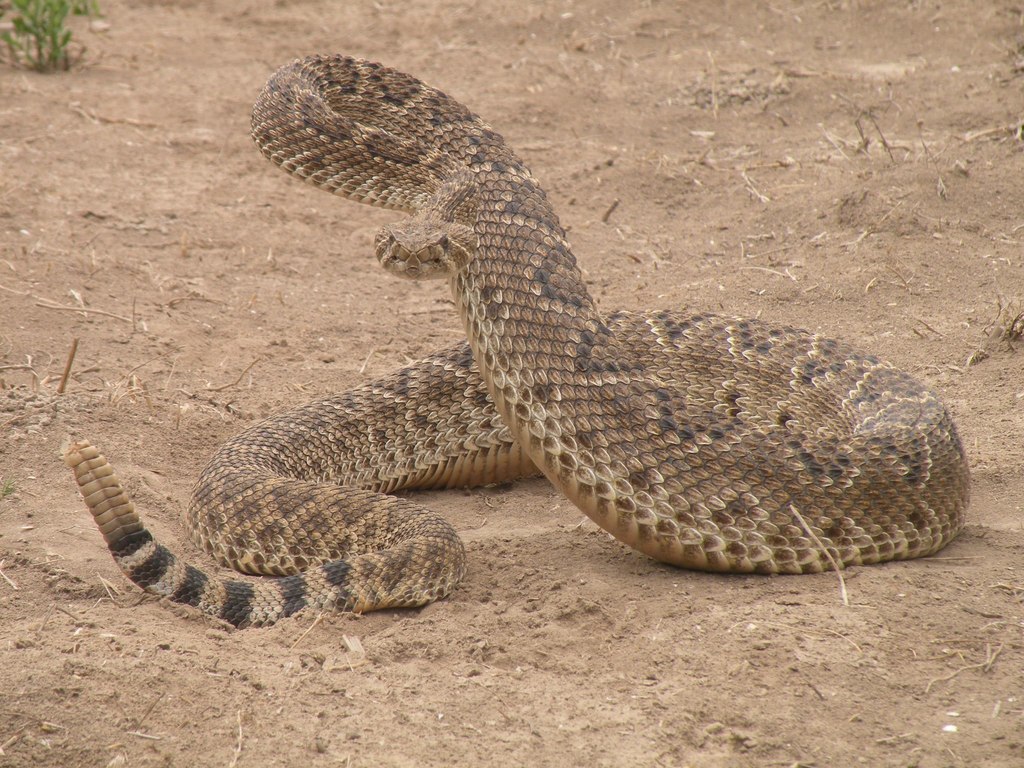
Western Diamond-backed Rattlesnake
Crotalus atrox
The western diamondback rattlesnake (Crotalus atrox) or western diamond-backed rattlesnake, is a rattlesnake species and member of the viper family, found in the southwestern United States and Mexico. Like all other rattlesnakes and all other vipers, it is venomous. It is likely responsible for the majority of snakebite fatalities in northern Mexico and the greatest number of snakebites in the U.S. No subspecies are currently recognized.
It lives in elevations from below sea level up to 6,500 feet (2,000 m). This species ranges throughout the Southwestern United States and northern half of Mexico. Currently, western diamondback rattlesnakes are not threatened or endangered.
From the article Western diamondback rattlesnake on Wikipedia (CC BY-SA), quoted section by section
Description
Adults commonly grow to 120 cm (4 ft) in length. Specimens over 150 cm (5 ft) are infrequently encountered, while those over 180 cm (6 ft) are very rare, and the largest reported length considered to be reliable is 213 cm (7 ft). Males become much larger than females, although this difference in size does not occur until after they have reached sexual maturity. Rattlesnakes of this species considered medium-sized weigh up to 1.23 to 2.7 kg (3 to 6 lb), while very large specimens can reportedly weigh up to 6.7 kg (15 lb). Overall, it is likely the second largest-bodied species of rattlesnake, behind only its close cousin the eastern diamondback rattlesnake. It is also the second largest of North American venomous snakes (the bushmasters, which attain similar weights and greater total length, occur up as far as Nicaragua). The color pattern generally consists of a khaki ground color, but it may also be pinkish or fallow, brick red, yellowish blonde, or white. This ground color is overlaid dorsally with a series of 23-45 (mean, 36) dorsal body blotches that are brown or a darker umber. The first of these may be a pair of short stripes that extend backwards to eventually merge. Some of the first few blotches on the back may be somewhat rectangular, but then become more hexagonal and eventually take on the distinctive diamond shape. …
Range & habitat
It is found in the United States from central Arkansas to southeastern and Central California, south into Mexico as far as northern Sinaloa, Hidalgo and northern Veracruz. Disjunct populations exist in southern Veracruz and southeastern Oaxaca. The type locality given is "Indianola" (Indianola, Calhoun County, Texas). Rattlesnakes such as the Western Diamondback are common in Texas coastal beaches such as Surfside Beach, Brazoria County, Texas.
In the United States, it occurs in central and western Arkansas, Oklahoma excluding the northeast, north-central region and the panhandle, Texas excluding the northern panhandle and the east, southern and central New Mexico and Arizona, extreme southern Nevada, and in southeastern California on either side of the Chocolate Mountains. Records from extreme southern Kansas (Cowley and Sumner Counties) may be based on a natural occurrence of the species, while multiple records from near Kanopolis Reservoir in Ellsworth County seem to indicate a viable (although isolated) population. In Mexico, it occurs in Nuevo León, Coahuila, Chihuahua, Sonora, extreme northeastern Baja California, northern Sinaloa, northeastern Durango, Zacatecas, most of San Luis Potosí, northern Veracruz, Hidalgo, and Querétaro. …
Wikipedia: “Geographic range”
What it does
C. atrox is solitary except during the mating season, when males of the species are single-minded and aggressive in pursuing females. Usually inactive between late October and early March, these ectotherms occasionally may be seen basking in the sun on warm winter days. In the winter, they hibernate or brumate in caves or burrows, sometimes with many other species of snakes. Active, alert, and large (most adults are between four and a half and five feet long), the western diamondback can administer a large amount of venom in its bite; it is not inclined to give ground when confronted. They are poor climbers. Natural predators include raptors such as hawks and eagles, roadrunners, wild hogs, and other snakes. When threatened, they usually coil and rattle to warn aggressors. They are one of the more defensive rattlesnake species in the US in the way that they stand their ground when confronted by a foe. If rattling does not work, then the snake will strike in defense. Among rattlesnakes, C. atrox may be the most adaptable to semi-urban transitional habitat. In developing areas where they are common, such as the Phoenix and Tucson metro areas in Arizona, the western diamondback rattlesnake can be found thriving deep within developed areas, and encountered by homeowners more often as a result.
Wikipedia: “Behavior”
Toxicity
Like that of most other American pit vipers, the venom contains proteolytic enzymes. Proteolytic venoms are concentrated secretions that destroy structural tissues and proteins via catabolism, which help in disabling prey. The venom of C. atrox is primarily hemotoxic, affecting mainly the blood vessels, blood cells and the heart. The venom contains hemorrhagic components called zinc metalloproteinases. The venom also contains cytotoxins and myotoxins which destroy cells and muscles, adding to the damage to the cardiovascular system. In addition to hemorrhage, venom metalloproteinases induce myonecrosis (skeletal muscle damage), which seems to be secondary to the ischemia that ensues in muscle tissue as a consequence of bleeding and reduced perfusion. Microvascular disruption by metalloproteinases also impairs skeletal muscle regeneration, being thereby responsible for fibrosis and permanent tissue loss. General local effects include pain, heavy internal bleeding, severe swelling, severe muscle damage, bruising, blistering, and necrosis; systemic effects are variable and not specific, but may include headache, nausea, vomiting, abdominal pain, diarrhea, dizziness, and convulsions. …
Wikipedia: “Venom”
Where it lives
Recorded sightings
—
geo-referenced records in GBIF, from museums, herbaria and field observers.
Drag the globe to turn it. Dots are where records exist, not a range map; darker means more records.
In the stacks
Searching the stacks…
Every page naming Crotalus atrox in the Biodiversity Heritage Library →
This page is assembled live from iNaturalist, GBIF, Wikipedia, the Source Library and the Internet Archive. It is not yet part of the hand-edited codex. iNaturalist taxon 30764.