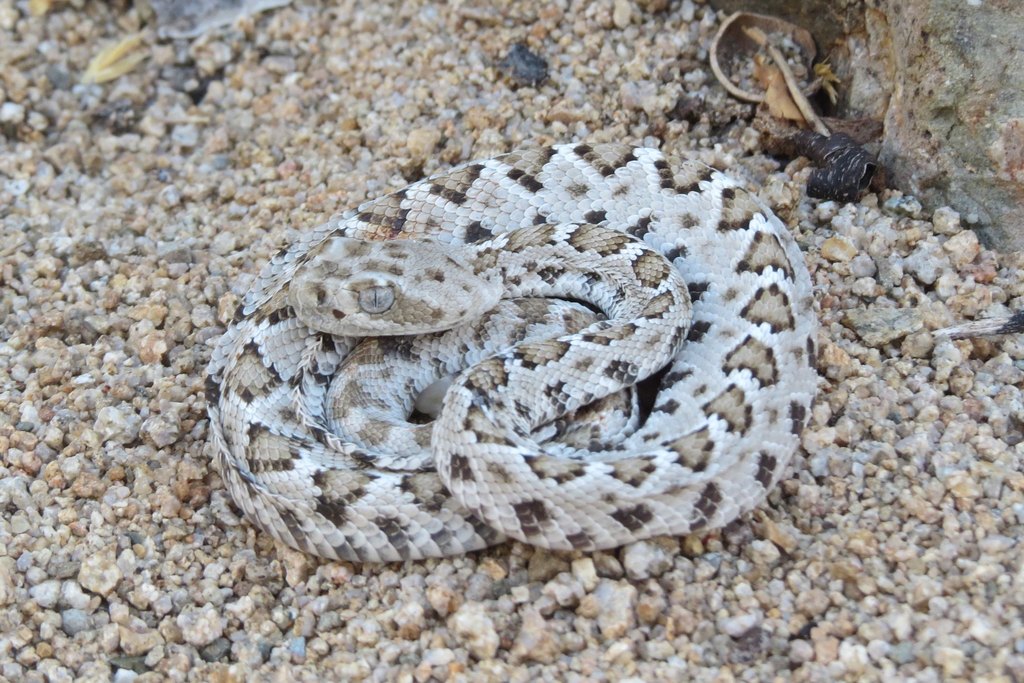
Santa Catalina Island Rattlesnake
Crotalus catalinensis
The Santa Catalina rattlesnake (Crotalus catalinensis) is a species of pit viper endemic to Isla Santa Catalina in the Gulf of California just off the east coast of the state of Baja California Sur, Mexico. Like all other pit vipers, it is venomous. No subspecies are currently recognized. A relatively small and slender species, its most distinctive characteristic is that it lacks a rattle. They are also a generally nocturnal species. Though the species is classified as Critically Endangered on the IUCN Red List, there are few efforts for the snake's conservation.
From the article Crotalus catalinensis on Wikipedia (CC BY-SA), quoted section by section
Description
This species is relatively slender and stunted, growing to a maximum of 73.1 cm (2 ft 4.8 in) in length. The most distinctive feature of this snake is its lack of a rattle. The base of the tail, the "button", has degenerated to such an extent that the rattle immediately falls off with each shed instead of forming a new segment, as it does in other species of rattlesnakes. This is widely believed to be a localized adaptation, as the rattle becomes a liability rather than an asset while hunting. The lack of any large predators or hoofed mammals in its natural locale has also played a factor in making the rattle redundant. It appears that Crotalus catalinensis may not be alone in feeling these selective pressures, as red diamond rattlesnakes on the island of San Lorenzo Sur and San Esteban island black-tailed rattlesnakes also appear to be losing their rattles. Notably, it appears that this phenomenon is confined to populations limited to islands in the Gulf of California. Natural selection has also given this snake a more elongated body than featured in related mainland forms, and measurably longer teeth; These are both characteristics associated with snakes that hunt in trees and shrubs such as this species. This species also lacks the standard bite-and-release tactic employed by usual rattlesnakes, preferring to instead hold prey in its jaws until the venom can take effect. …
Range & habitat
This snake is found only on Isla Santa Catalina in the Gulf of California off the coast of southern Baja California. This island is also the type locality for the species. The island is fairly small, being only 43 square kilometers (17 sq mi).
Wikipedia: “Geographic range”
What it does
While most members of this genus, Crotalus, are almost entirely terrestrial due to their heavy body structure, this species' small size makes it a swift and skillful climber. Previous researchers hypothesized that the ability of the Santa Catalina rattlesnake to climb, combined with its lack of a rattle allowed it to hunt roosting birds, but detailed research into the species' diet has revealed that the Santa Catalina rattlesnake maintains a mammal-based diet like most rattlesnakes. Further inquiry into the arboreal behavior of this island species has shown individuals actually spend the majority of their time on the ground. Individuals were most likely to be found in low branches of bushes during July, the hottest month on the island. The Santa Catalina rattlesnake is thought to climb off of the hot ground and into bushes to thermoregulate. The snake expresses thermo-conformist behavior which means that its body temperature correlates with soil temperature. This is a common trait among other rattlesnakes. Unlike most species of rattlesnakes, the Santa Catalina rattlesnake is often observed exposed; it does not tend to hide. …
Wikipedia: “Behavior”
Where it lives
Recorded sightings
—
geo-referenced records in GBIF, from museums, herbaria and field observers.
Drag the globe to turn it. Dots are where records exist, not a range map; darker means more records.
In the stacks
Searching the stacks…
Every page naming Crotalus catalinensis in the Biodiversity Heritage Library →
This page is assembled live from iNaturalist, GBIF, Wikipedia, the Source Library and the Internet Archive. It is not yet part of the hand-edited codex. iNaturalist taxon 30765.