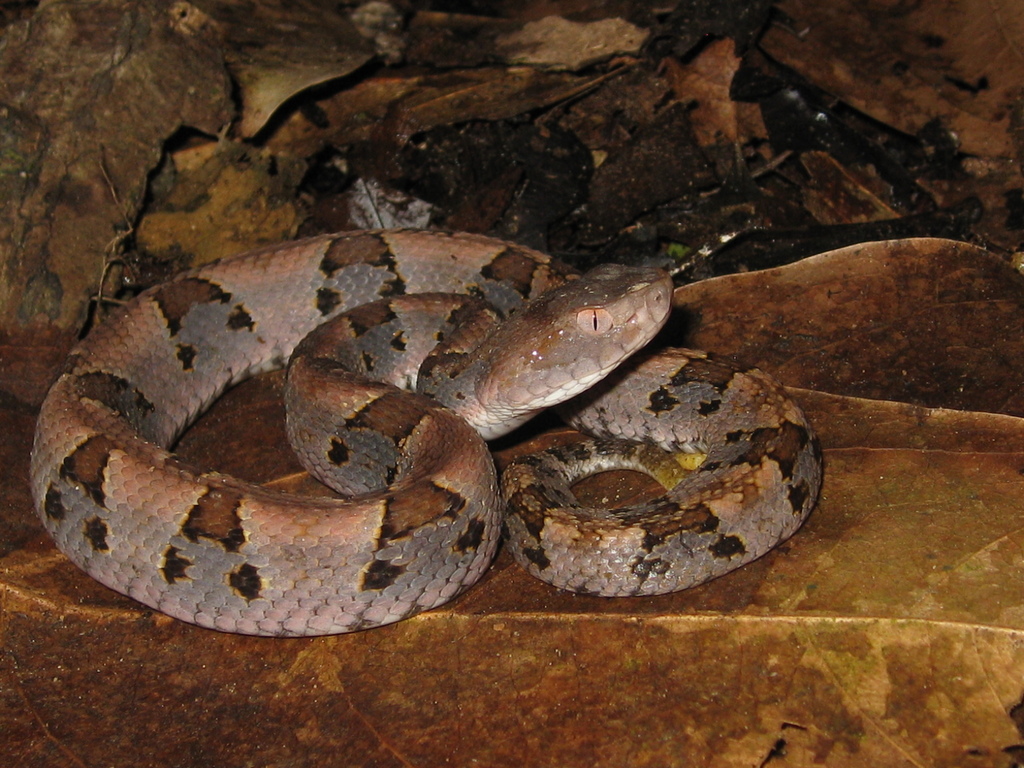
Brazil's Lancehead
Bothrops brazili
Brazil's lancehead (Bothrops brazili) is a venomous pitviper species endemic to South America. There are no subspecies that are recognized as being valid.
From the article Bothrops brazili on Wikipedia (CC BY-SA), quoted section by section
Description
Stoutly built and terrestrial, adults of B. brazili are usually 70–90 cm (28–35 in) in total length (including tail), but may exceed 140 cm (55 in). The largest specimen on record is 149.3 cm (58+3⁄4 in). The available evidence would indicate that, among adult specimens, females are much larger than males. The scalation includes 23-29 (usually 25–27) rows of dorsal scales at midbody, 151-180 ventral scales in males and 159-202 (usually less than 190) in females, and 44-68/42-56 usually paired subcaudal scales in males/females. On the head there are 3-10 (usually 5–8) intersupraocular scales, 7-9 (usually 8) supralabial scales, the second of which is fused with the prelacunal, and 10-12 sublabial scales. The color pattern consists of a pinkish tan to pinkish or reddish gray ground color overlaid with a series of 9-19 dark ash gray dorsolateral blotches. These may alternate or oppose across the midline of the back, sometimes looking like triangular C's or merging to form bands. The tail is the same color as the body, but may be mostly black. The belly is usually yellow or pinkish cream with mottling that is slightly darker in color. The top of the head is also the same color as the body, but usually lighter. …
Range & habitat
Bothrops brazili is found in the equatorial forests of southern Colombia, eastern Peru, eastern Ecuador, southern and eastern Venezuela, Guyana, Suriname, French Guiana, Brazil, and northern Bolivia. The type locality given is "Tomé Assú, Acará Mirim River, State of Pará, Brazil".
Wikipedia: “Geographic range”
Toxicity
Bothrops brazili is an uncommon species, and bites from it have not yet been recorded. However, it is greatly feared by the indigenous people of southeastern Colombia.
Wikipedia: “Venom”
In human culture
The specific name, brazili, is in honor of Dr. Vital Brazil, a Brazilian physician and founder of the Instituto Butantan in São Paulo.
Wikipedia: “Etymology”
Where it lives
Recorded sightings
—
geo-referenced records in GBIF, from museums, herbaria and field observers.
Drag the globe to turn it. Dots are where records exist, not a range map; darker means more records.
In the stacks
Searching the stacks…
Every page naming Bothrops brazili in the Biodiversity Heritage Library →
This page is assembled live from iNaturalist, GBIF, Wikipedia, the Source Library and the Internet Archive. It is not yet part of the hand-edited codex. iNaturalist taxon 30796.