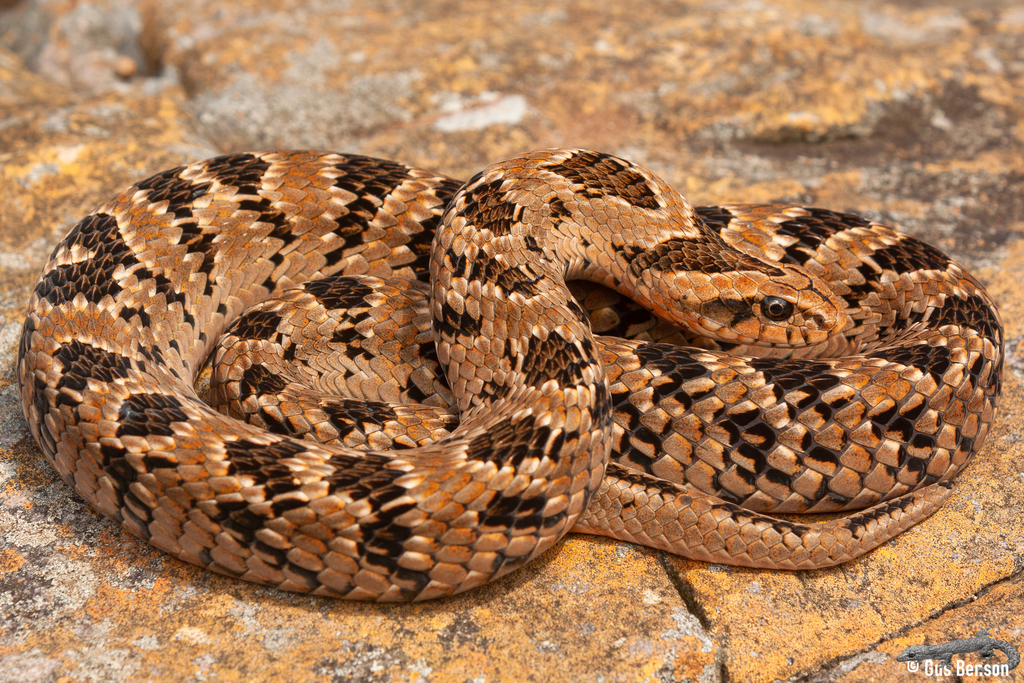
Rhombic Night Adder
Causus rhombeatus
Causus rhombeatus, commonly known as the rhombic night adder, is a species of venomous snake in the subfamily Viperinae of the family Viperidae. The species is native to Sub-Saharan Africa. No subspecies are recognized as being valid.
From the article Causus rhombeatus on Wikipedia (CC BY-SA), quoted section by section
Description
With an average total length (tail included) of 60 cm (24 in), C. rhombeatus is the largest member of the genus Causus. The longest individual ever recorded was a male, 93 cm (37 in) in total length, collected in eastern Zimbabwe. The head has a snout that is relatively blunt (i.e., more rounded than in other members of this genus), on the sides of which the nostrils are positioned. The circumorbital ring consists of 2–3 preoculars, 1–2 postoculars, and 1–2 suboculars that separate the eye from the supralabials. The temporal scales usually number 2+3, sometimes 2+4, but very rarely 2+2 or 3+3. There are 6 supralabial scales, very rarely 7. The sublabial scales usually number 7 or 10, rarely 8, and very rarely 11, 12 or 13. The first 3–4 sublabials are in contact with the anterior chin shields. The posterior chin shields are small and often indistinguishable from the gulars. At midbody there are 15–21 rows of dorsal scales that are moderately keeled and have a satiny texture. The ventral scales number 120–166, the subcaudals, most of which are divided, 15–36. The color pattern consists of a ground color that is usually some shade of brown (possibly pinkish or grayish-brown), but occasionally olive green. This is overlaid with a pattern of 20–30 rhombic blotches that have pale edges, as well as a sprinkling of black scales and oblique black bars on the sides. …
Range & habitat
C. rhombeatus is found in Sub-Saharan Africa from Nigeria east to Sudan, Ethiopia, Somalia and Kenya, south through Tanzania, Uganda, Rwanda, Burundi, DR Congo, Angola, Zambia, Malawi, Zimbabwe, northern Botswana, Mozambique, Eswatini, and eastern South Africa to Riverdale in the Western Cape Province. No type locality is listed.
Wikipedia: “Geographic range”
What it does
C. rhombeatus is an active species that can often move relatively quickly, up to an estimated speed of 92 cm per second (3 feet per second). It is usually found on the ground, but has no trouble climbing or swimming. It is largely nocturnal, but is often seen basking in the early morning or late afternoon. However, Mallow et al. (2003) reported collecting a dozen specimens that were all active during the heat of the day. Most specimens are docile, seldom attempting to bite unless severely provoked. FitzSimons is quoted in Pitman (1938) as saying that, in captivity, some specimens "become so tame that you may allow them to creep, climb and slither round your neck and inside your garments." Others, however, are more temperamental. When seriously disturbed, it will put on a "ferocious" threat display that includes coiling up, inflating the body (making the dark markings stand out), hissing and puffing loudly, flattening the anterior portion of the body, and striking frantically. It may also flatten the neck and move forward with the tongue extended, much like a small cobra. Striking is done with such vigor that small specimens may lift themselves off the ground entirely.
Wikipedia: “Behavior”
Toxicity
Rhombic night adder bites can be serious, and in at least one bite a child had to have a fasciotomy. The few documented bites involved pain and minor swelling with minimal necrosis. These symptoms usually disappear within 2–3 days. There have been no modern well-documented cases to back up earlier claims of fatalities due to bites from this species. Venom yield has varied from 20 to 30 mg to 300 mg, but the venom toxicity is low with LD50 values of 10.8, 14.6, >16.0 mg/kg IV and 15 mg/kg SC being reported.
Wikipedia: “Venom”
Where it lives
Recorded sightings
—
geo-referenced records in GBIF, from museums, herbaria and field observers.
Drag the globe to turn it. Dots are where records exist, not a range map; darker means more records.
In the stacks
Searching the stacks…
Every page naming Causus rhombeatus in the Biodiversity Heritage Library →
This page is assembled live from iNaturalist, GBIF, Wikipedia, the Source Library and the Internet Archive. It is not yet part of the hand-edited codex. iNaturalist taxon 30820.