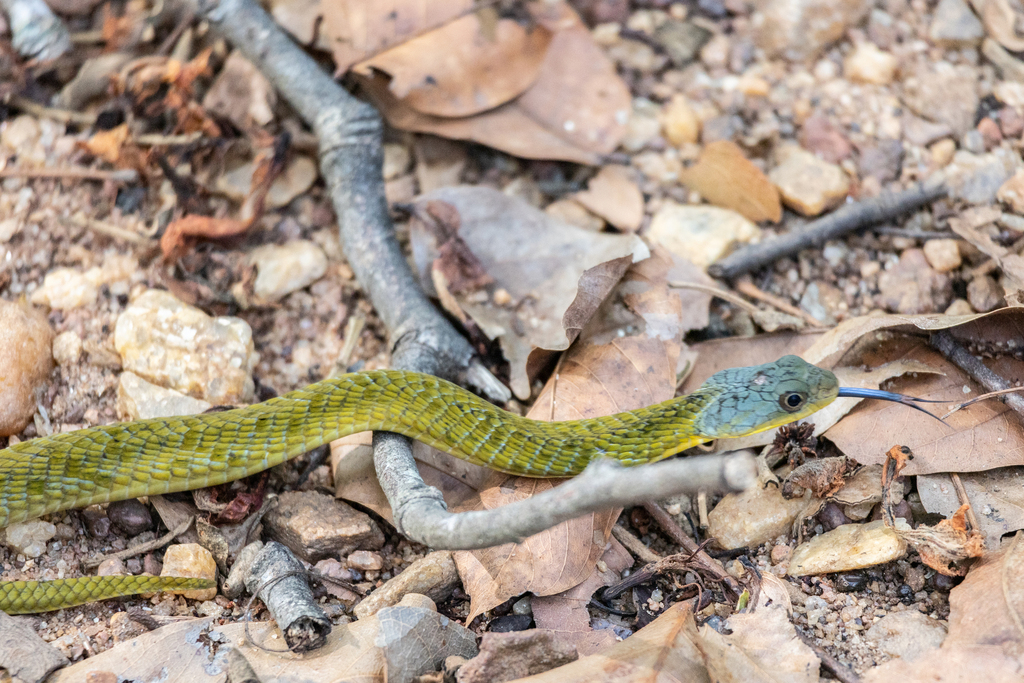
Forest Night Adder
Causus lichtensteinii
Causus lichtensteinii is a species of venomous snake in the subfamily Viperinae of the family Viperidae. The species is native to western, central, and eastern Africa. There are no subspecies that are recognized as being valid.
From the article Causus lichtensteinii on Wikipedia (CC BY-SA), quoted section by section
Description
Adults of C. lichtensteinii average 30–55 cm (12–22 in) in total length (tail included), with a reported maximum of 70 cm (28 in). The head is not very wide, and the snout is blunt. The eye is surrounded by a circumorbital ring of 5–7 scales. There are 6 supralabials and 9 sublabials. The temporals number 2+3 or sometimes 2+2, with the first and second upper temporals being as long together as the first lower one. Loreals: 1+1. Midbody there are 15 rows of weakly keeled dorsal scales that have a velvety texture. The anal scale is single. There are 128–152 ventral scales. The subcaudals number 18–22 in males and 17–19 in females. The color pattern consists of a greenish or olive ground color overlaid with a series of dark narrow backward pointing chevrons running down the back. This pattern may be vague or developed fully into rhombic markings. The back of the neck has a characteristic white V-shape while the throat is black with yellow bands. Juvenile specimens are generally dark brown in color.
Range & habitat
C. lichtensteinii is found from Guinea and Liberia eastward through Ghana to Nigeria, Cameroon, Equatorial Guinea, the Central African Republic, south to northern Angola, DR Congo and northwestern Zambia, and east to Uganda and western Kenya. The type locality is listed as "Côte-d'Or " [= Gold Coast, now Dominion of Ghana].
Wikipedia: “Geographic range”
What it does
C. lichtensteinii is diurnal and mostly terrestrial. However, it is a good swimmer and has even colonized certain islands in Lake Victoria. When disturbed it puts on a hissing and puffing threat display similar to other members of the genus.
Wikipedia: “Behavior”
In human culture
The specific name, or epithet, lichtensteinii, honors German herpetologist Martin Hinrich Lichtenstein.
Wikipedia: “Etymology”
Where it lives
Recorded sightings
—
geo-referenced records in GBIF, from museums, herbaria and field observers.
Drag the globe to turn it. Dots are where records exist, not a range map; darker means more records.
In the stacks
Searching the stacks…
Every page naming Causus lichtensteinii in the Biodiversity Heritage Library →
This page is assembled live from iNaturalist, GBIF, Wikipedia, the Source Library and the Internet Archive. It is not yet part of the hand-edited codex. iNaturalist taxon 30823.