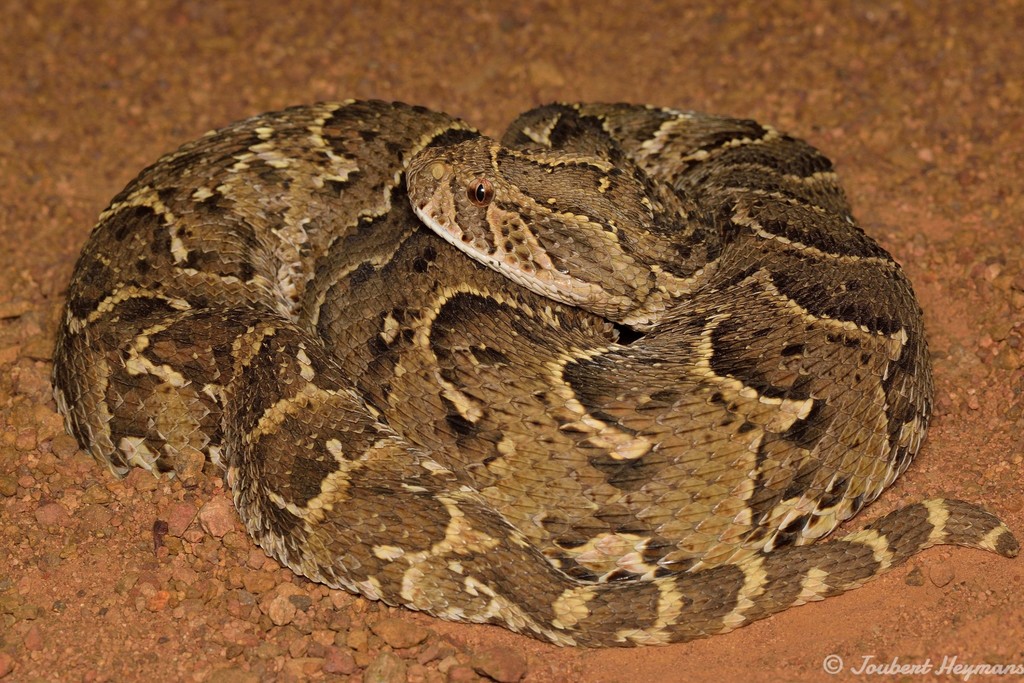
Puff Adder
Bitis arietans
The puff adder (Bitis arietans) is a highly venomous viper species found in savannahs and grasslands from Morocco and western Arabia throughout Africa except for the Sahara and rainforest regions. It is responsible for causing the most snakebite fatalities in Africa owing to various factors, such as its wide distribution, frequent occurrence in highly populated regions, and aggressive disposition. Two subspecies are currently recognized, including the nominate subspecies described here.
The species is commonly known as the puff adder, African puff adder, or common puff adder.
From the article Puff adder on Wikipedia (CC BY-SA), quoted section by section
Description
The puff adder's usual size is about 1.0 m (39.3 in) in total length (body and tail) and very stout. Large specimens of 190 cm (75 in) total length, weighing over 6.0 kg (13.2 lb) and with a girth of 40 cm (16 in) have been reported. Specimens from Saudi Arabia are not as large, usually no more than 80 cm (31 in) in total length. Males are usually larger than females and have relatively longer tails.
The color pattern varies geographically. The head has two well-marked dark bands – one on the crown and the other between the eyes. On the sides of the head, two oblique, dark bands or bars run from the eye to the supralabials. Below, the head is yellowish white with scattered dark blotches. Iris color ranges from gold to silver-gray. Dorsally, the ground color varies from straw yellow, to light brown, to orange or reddish brown. This is overlaid with a pattern of 18–22 backwardly directed, dark brown to black bands that extend down the back and tail. Usually, these bands are roughly chevron-shaped, but may be more U-shaped in some areas. They also form two to six light-and-dark cross-bands on the tail. Some populations are heavily flecked with brown and black, often obscuring other coloration, giving the animal a dusty-brown or blackish appearance. The belly is yellow or white, with a few scattered dark spots. …
Range & habitat
The species Bitis arietans may be the most common and widespread snake in Africa. It is found in most African regions and on parts of the Arabian Peninsula. It is found in all habitats except true deserts, rainforests, and (tropical) alpine habitats. It is most often associated with rocky grasslands. It is not found in rainforest areas, such as along the coast of West Africa and in Central Africa (i.e., central DR Congo); it is also absent from the Mediterranean coastal region of North Africa. On the Arabian Peninsula, it is found as far north as Ta'if. It has been reported to be found in the Dhofar region of southern Oman.
Wikipedia: “Geographic distribution and habitat”
What it does
Normally a sluggish species, the puff adder relies on camouflage for protection. Locomotion is primarily rectilinear, using the broad ventral scales in a caterpillar fashion and aided by its own weight for traction. When agitated, it can resort to a typical serpentine movement of surprising speed. Although mainly terrestrial, it is a good swimmer and can also climb with ease; often it is found basking in low bushes. One specimen was found 4.6 m (15 ft) above the ground in a densely branched tree. If disturbed, it hisses loudly and continuously, adopting a tightly coiled defensive posture with the forepart of its body held in a taut "S" shape. At the same time, it may attempt to back away from the threat toward cover. It may strike suddenly and fast, to the side as easily as forward, before returning quickly to the defensive position, ready to strike again. During a strike, the force of the impact is so strong, and the long fangs penetrate so deeply, that prey items are often killed by the physical trauma alone. The fangs apparently can penetrate soft leather. It can strike to a distance of about one-third of its body length, but juveniles can launch their entire bodies forward in the process. The puff adder rarely grips its victims, but instead releases quickly to return to the striking position.
Wikipedia: “Behaviour”
Toxicity
The species Bitis arietans is responsible for more snakebite fatalities than any other African snake, due to a combination of factors, including its wide distribution, common occurrence, large size, potent venom that is produced in large amounts, long fangs, and habit of basking by footpaths and sitting quietly when approached. The puff adder's venom has cytotoxic effects and is one of the most toxic of any vipers based on LD50. The LD50 values in mice vary: 0.4–2.0 mg/kg intravenously, 0.9–3.7 mg/kg peritoneally, and 4.4–7.7 mg/kg subcutaneously (SC). Mallow et al. (2003) give an LD50 range of 1.0–7.75 mg/kg SC. Venom yield is typically 150–350 mg, with a maximum of 750 mg. Brown (1973) mentions a venom yield of 180–750 mg. About 100 mg (1.5 gr) are thought to be enough to kill a healthy adult human male, with death occurring after 25 hours. In humans, bites from this species can produce severe local and systemic symptoms. Based on the degree and type of local effect, bites can be divided into two symptomatic categories – those with little or no surface extravasation, and those with hemorrhages evident as ecchymosis, bleeding, and swelling. In both cases, severe pain and tenderness occur, but in the latter, widespread superficial or deep necrosis and compartment syndrome are seen. …
Wikipedia: “Venom”
Where it lives
Recorded sightings
—
geo-referenced records in GBIF, from museums, herbaria and field observers.
Drag the globe to turn it. Dots are where records exist, not a range map; darker means more records.
In the stacks
Searching the stacks…
Every page naming Bitis arietans in the Biodiversity Heritage Library →
This page is assembled live from iNaturalist, GBIF, Wikipedia, the Source Library and the Internet Archive. It is not yet part of the hand-edited codex. iNaturalist taxon 30851.