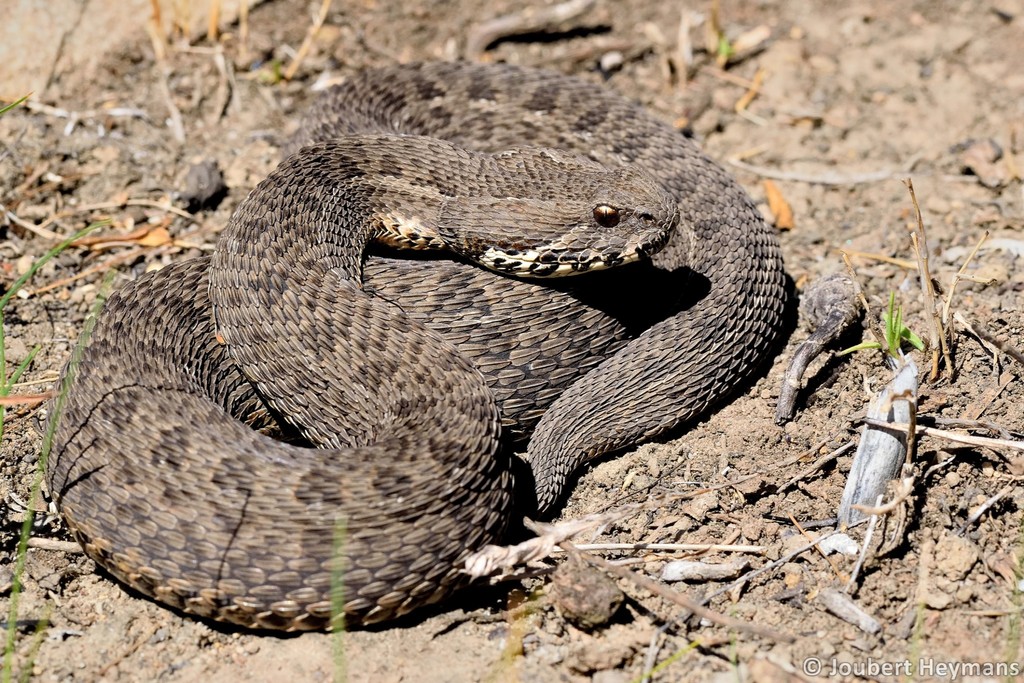
Berg Adder
Bitis atropos
The berg adder (Bitis atropos) is a viper species endemic to mountainous regions in southern Africa. No subspecies are currently recognized.
From the article Berg adder on Wikipedia (CC BY-SA), quoted section by section
Description
The typical adult size of B. atropos is 30–40 cm (about 12–16 in) in total length (body and tail), with some females reaching a maximum total length of 50 cm (20 in) in the wild and 60 cm (24 in) in captivity.
Range & habitat
B. atropos is found in isolated populations of the mountainous regions of southern Africa. In South Africa, the species is known to occur in the Transvaal, along the Drakensberg escarpment of the eastern and northern Transvaal. Elsewhere in South Africa, it occurs in western Natal, Lesotho, and eastern Free State, and in the southern coastal mountains of western and eastern Cape Province. Spawls and Branch (1995) also mentioned, in Cape Province, its range extends into the Cape Peninsula. It also occurs in Eswatini, in higher altitudes of eastern Zimbabwe such as the Inyanga Highlands and Chimanimani Mountains, and in nearby Mozambique. B. atropos occupies a number of different habitats, but prefers relatively cool environments with high levels of precipitation. In the northern part of its range, where the winters are cold and dry and the summers warm and wet, it is restricted to higher elevations, up to 3,000 m (9,800 ft). …
Wikipedia: “Distribution and habitat”
What it does
The atropos adder is unusual among Bitis species in that its venom is predominantly neurotoxic, so much so that the effects of the bite seldom include necrosis or infection. The snake is described as "irascible", hissing violently and twisting convulsively if molested. Presumably, the neurotoxic venom is an adaptation to the prey, which largely comprise rock lizards and small amphibians. It does, however, also eat other animals, such as small rodents and young of ground-nesting birds. The venom is not powerful enough for the dose injected at a single strike to kill an adult human, and no records of human fatalities have been found. Whether at threat or not, though, persons do not seem to respond usefully to antivenom, so treatment should be limited to symptomatic control. Such as the effects of the venom are, they take effect quickly. Symptoms of the bite have been compared to alcohol intoxication and are not permanent. Unlike the bites of elapid snakes, B. atropos bites, though neurotoxic, do not cause obvious effects on heart and respiratory functions, but they can be troublesome, and their effects sometimes persist for some days or even weeks, which suggests the venom causes nerve damage that does not mend quickly if it is severe. Obvious symptoms may include loss of smell or taste, drooping eyelids, and loss of vision.
Wikipedia: “Venom and diet”
Where it lives
Recorded sightings
—
geo-referenced records in GBIF, from museums, herbaria and field observers.
Drag the globe to turn it. Dots are where records exist, not a range map; darker means more records.
In the stacks
Searching the stacks…
Every page naming Bitis atropos in the Biodiversity Heritage Library →
This page is assembled live from iNaturalist, GBIF, Wikipedia, the Source Library and the Internet Archive. It is not yet part of the hand-edited codex. iNaturalist taxon 30863.