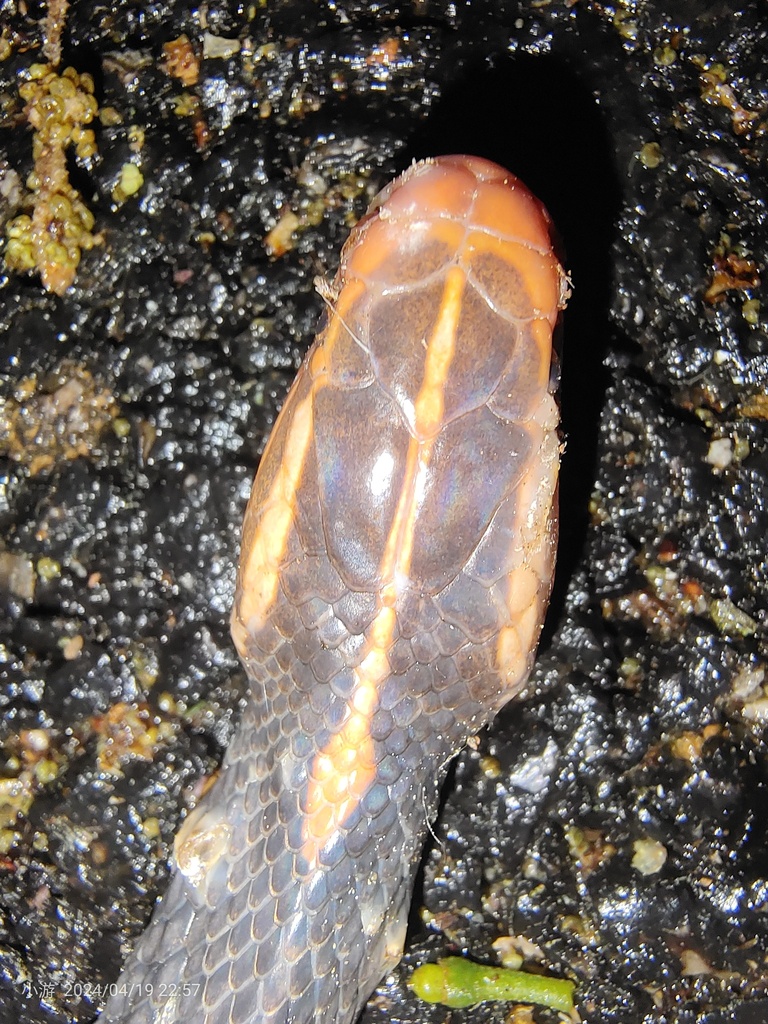
Fea's Viper
Azemiops feae
Azemiopinae is a monogeneric subfamily created for the genus Azemiops that contains the viper species A. feae and A. kharini. They are commonly known as Fea's vipers. No subspecies are recognized. The first specimen was collected by Italian explorer Leonardo Fea, and was described as a new genus and new species by Boulenger in 1888. Formerly considered to be one of the most primitive vipers, molecular studies have shown that it is the sister taxon to the pit vipers, Crotalinae. It is found in the mountains of Southeast Asia, in China, southeastern Tibet, and Vietnam. Like all other vipers, they are venomous.
From the article Azemiops on Wikipedia (CC BY-SA), quoted section by section
Description
Neither species grows to 1 m in length. According to Liem et al. (1971), the maximum length is 77 cm, while Orlov (1997) described a male and a female measuring 72 cm and 78 cm, respectively. It is considered to be the most primitive of all viperids for several reasons. It has a reasonably sturdy body and a short tail, but the dorsal scales are smooth rather than keeled like those of most vipers. The head, which is slightly flattened and more elliptical in shape than triangular, is not covered with numerous small scales like most other vipers, but with large shields like the colubrids and the elapids. Also, the skull is built differently. It does, however, have a pair of hollow, rotating fangs, although these are short. The fangs have a ridge at the tip lateral to the discharge orifice, as well as a blade-like structure on the ventral surface otherwise seen only in some opistoglyphous and atractaspid snakes. The venom glands are relatively small. Unlike most vipers, Fea's viper is oviparous and hibernates during the winter. The color pattern of Fea's viper is striking; dorsally, its basic body color is a shiny, deep blue-gray to black, marked by several widely spaced, thin (one or two scales), white-orange crossbands. The head is orange to slightly yellow with a distinct cross-pattern outlined in gray. The eyes are yellowish with vertical pupils. …
Range & habitat
These snakes range from northern Vietnam through southern China (Fujian, Guangxi, Jiangxi, Guizhou, Sichuan, Yunnan, Zhejiang), southeast Myanmar and southeast Tibet. The type locality is listed as "Kakhien Hills" (Kachin Hills), Myanmar. The two species are separated by the Red River, with A. kharini to the east and A. feae to the west.
Wikipedia: “Geographic range”
What it does
This snake has a characteristic threat display. When disturbed, it flattens its body to make itself look wider, and its jaws flare outwards posteriorly, giving the normally ovoid head a triangular shape. Sometimes, it vibrates its tail. Ultimately, it will strike, during which it may or may not use its fangs. As opposed to Orlov (1997), who stated this species is nocturnal, Zhao et al. (1981) reported it to be crepuscular, active from early March into late November.
Wikipedia: “Behavior”
Toxicity
The venom profile of Fea's viper is remarkably similar to that of Wagler's viper (Tropidolaemus wagleri). Another study found the enzyme activities in A. feae venom-gland extract are similar to those of viperine venoms, but its venom does not cause blood clotting, haemorrhagic, or myolytic activities. One toxin found in their venom, azemiopsin, is known to block nicotinic acetylcholine receptors in muscles.
Wikipedia: “Venom”
Where it lives
Recorded sightings
—
geo-referenced records in GBIF, from museums, herbaria and field observers.
Drag the globe to turn it. Dots are where records exist, not a range map; darker means more records.
In the stacks
Searching the stacks…
Every page naming Azemiops feae in the Biodiversity Heritage Library →
This page is assembled live from iNaturalist, GBIF, Wikipedia, the Source Library and the Internet Archive. It is not yet part of the hand-edited codex. iNaturalist taxon 30867.