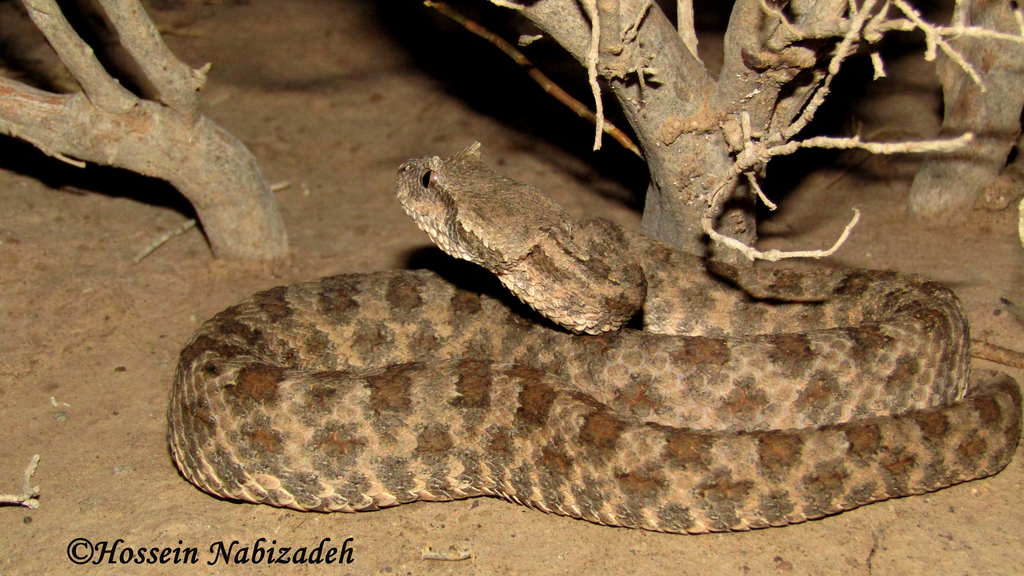
Persian Horned Viper
Pseudocerastes persicus
Pseudocerastes is a genus of venomous vipers endemic to the Middle East and Asia. It was originally a monotypic genus created in 1896 by Boulenger for the species Pseudocerastes persicus. Due to taxonomic revision and recent discovery, the genus may currently contain as many as three species.
From the article Persian horned viper on Wikipedia (CC BY-SA), quoted section by section
Description
Adults average between 40 and 70 cm (16 and 28 in) in total length (body + tail), with a maximum total length of 108 cm (43 in) being reported. Females are usually larger than males. These snakes can attain a considerable weight relative to their size, with specimens sometimes exceeding 500 g (1.1 lb). The head is broad, flat, distinct from the neck and covered with small, imbricate scales. The snout is short and rounded. The nostrils are positioned dorsolaterally and have valves. The nasal scale is unbroken. The rostral scale is small and wide. The eyes are medium in size with vertically elliptical pupils. There are 15-20 interocular scales and 15-20 circumorbitals. The supraorbital hornlike structure above each eye consists of small, imbricate scales and is also present in juveniles. There are 11-14 supralabials and 13-17 sublabials. 2-4 rows of small scales separate the supralabial scales from the suboculars. The body is covered with weakly to strongly keeled dorsal scales. On many of these, the keel terminates before the end of the scale and forms a bump. Many others form a point. At midbody, there are 21-25 scale rows, none of them oblique. There are 134-163 ventral scales and 35-50 paired subcaudals. The tail is short.
Range & habitat
Pseudocerastes persicus is found in Iran, Pakistan, Afghanistan, northern Oman, the United Arab Emirates, Jordan, and throughout Iraq. The type locality is listed as "Perse" (= Persia).
Wikipedia: “Geographic range”
What it does
These snakes are generally rather slow-moving and may employ various methods of locomotion, including sidewinding, serpentine, and rectilinear. They are also terrestrial and almost totally nocturnal, only being seen during the day or early evening during colder periods. It is not particularly aggressive, but will hiss loudly when disturbed. It is not capable of sinking into the sand vertically like Cerastes. These feed mainly on lizards, small mammals, mice and occasionally small birds and arthropods, but will also eat dead food.
Wikipedia: “Behavior”
Toxicity
Pseudocerastes persicus venom exhibits strong hemorrhagic activity typical of most vipers. No antivenom is available for bites from this species, although it is reported that a polyvalent antiserum does offer some protection.
Wikipedia: “Venom”
In human culture
The species name comes from where it is most usually found, Persia (present-day Iran), and the hornlike structures above its eyes.
Wikipedia: “Etymology”
Where it lives
Recorded sightings
—
geo-referenced records in GBIF, from museums, herbaria and field observers.
Drag the globe to turn it. Dots are where records exist, not a range map; darker means more records.
In the stacks
Searching the stacks…
Every page naming Pseudocerastes persicus in the Biodiversity Heritage Library →
This page is assembled live from iNaturalist, GBIF, Wikipedia, the Source Library and the Internet Archive. It is not yet part of the hand-edited codex. iNaturalist taxon 30992.