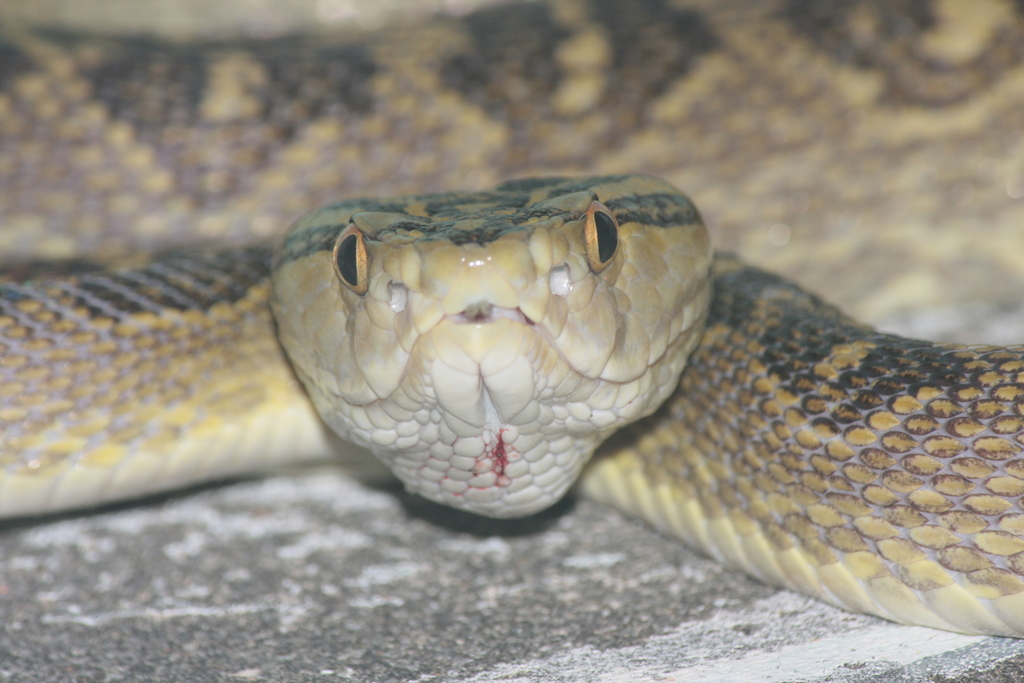
Habu
Protobothrops flavoviridis
Protobothrops flavoviridis, also known commonly as the Okinawa habu is a species of pit viper, a venomous snake in the subfamily Crotalinae of the family Viperidae. The species is endemic to the Ryukyu Islands of Japan. No subspecies are recognized as being valid. Local common names include habu and Kume Shima habu. The term "habu" in Okinawa Prefecture can also refer to the Sakishima habu (Protobothrops elegans) alternately called the elegant pit viper.
From the article Protobothrops flavoviridis on Wikipedia (CC BY-SA), quoted section by section
Description
Growing to an average total length (tail included) of 4–5 feet (120–150 cm), with a maximum of 7.9 feet (240 cm), Protobothrops flavoviridis is the largest member of its genus. It is slenderly built and gracefully proportioned with a large head. The crown of the head is covered with small scales. P. flavoviridis has a light olive or brown ground color, overlaid with elongated dark green or brownish blotches. The blotches have yellow edges, sometimes contain yellow spots, and frequently fuse to produce wavy stripes. The belly is whitish with dark coloring along the edges.
Range & habitat
The Okinawa habu is restricted to the Japanese Ryukyu Islands, including Okinawa and the Amami Islands. The type locality is "Amakarima Island (one of the Loo-Choo group)" (= Keramashima, Ryukyu Islands). It is common on the larger volcanic islands, but not present on the smaller coral islands. The species is often reported from the transition zone between palm forest and cultivated fields. It may also be found on rock walls and in old tombs and caves.
Wikipedia: “Geographic distribution and habitat”
What it does
The species Protobothrops flavoviridis is terrestrial and mostly nocturnal. It often enters homes and other structures in search of rats and mice. Bold and irritable, it can strike quickly and has a long reach. Unlike most pit vipers, the habu is oviparous and lays eggs, rather than bearing live young. Mating takes place in early spring and up to 18 eggs are laid in mid-summer. The hatchlings, which emerge after an incubation period of 5–6 weeks, are 25 cm (10 in) in length and look the same as the adults. To reduce the population of P. flavoviridis on the island of Okinawa, the small Indian mongoose (Herpestes javanicus), was introduced in 1910. Although the effects of this introduction have not been studied, in other such cases, the negative effects on species of native birds, mammals, and herpetofauna have been a source of concern for wildlife managers.
Wikipedia: “Ecology”
Toxicity
The incidence of snakebite in the Amami Islands is two per 1,000 people, which is considered very high. The venom of this species is of high toxicity, containing cytotoxin and hemorrhagin components, yet the fatality rate is less than 1%. A bite from a habu snake can cause nausea, vomiting, hypotension, and possibly death. In some cases, victims reported the loss of motor function in hands and legs following treatment. If a bite victim receives medical care promptly, bites are not life-threatening. However, 6–8% do suffer permanent disability. LD50 values of 3.1, 4.3, 3.7, 2.7, 3.7, and 3.8 mg/kg intravenous, 5.1 mg/kg intraperitoneal, and 6.0, 3.5-5.0, and 4.5 mg/kg subcutaneous administrations have been reported for the venom.
Wikipedia: “Venom”
Where it lives
Recorded sightings
—
geo-referenced records in GBIF, from museums, herbaria and field observers.
Drag the globe to turn it. Dots are where records exist, not a range map; darker means more records.
In the stacks
Searching the stacks…
Every page naming Protobothrops flavoviridis in the Biodiversity Heritage Library →
This page is assembled live from iNaturalist, GBIF, Wikipedia, the Source Library and the Internet Archive. It is not yet part of the hand-edited codex. iNaturalist taxon 31001.