- Animals
- ›Chordates
- ›Vertebrates
- ›Reptiles
- ›Snakes and Lizards
- ›Lizards
- ›Iguanas and Allies
- ›Dragons and Chameleons
- ›Dragons
- ›Bearded Dragons, Water Dragons, and Allies
- ›Diporiphora
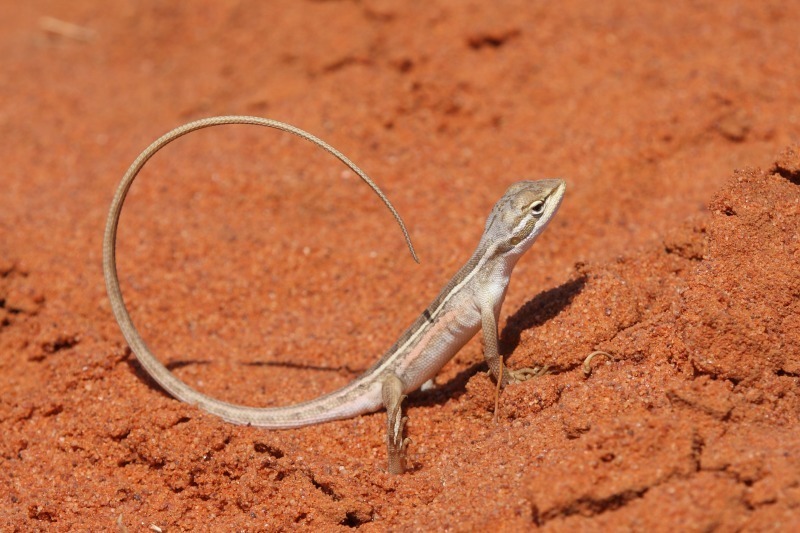
Canegrass Two-lined Dragon
Diporiphora winneckei
Diporiphora winneckei, also known commonly as the canegrass dragon, canegrass two-line dragon, blue-lined dragon, and Winnecke's two-pored dragon, is a species of small, terrestrial, diurnal lizard in the family Agamidae. The species is endemic to Australia. It is found throughout arid zones of Australia and is also a common house pet.
From the article Diporiphora winneckei on Wikipedia (CC BY-SA), quoted section by section
Description
Diporiphora winneckei is a slim lizard with a long tail and limbs, approximately 15–24 cm (5.9–9.4 in) in total length. It is a grey or pale brown to reddish-brown colour, with a thick grey ventral band that runs from the nape to the tail. It also has creamy-yellow (female) or silver grey (male) stripes that run down each side of its back, converging at the pelvis. Dark angular blotches lie between the stripe and the ventral band of female, while males have fewer or no blotches visible. The canegrass dragon also has a creamy mid lateral stripe that runs from eye to ear on each side. It has homogenous scales as well as weak gular and postauricular folds. It lacks the spines and crest that many other dragons display.
Range & habitat
The canegrass dragon is an endemic species found in the arid zones of Australia, with a rainfall of less than 500mm. It's predominantly found in the region surrounding the junction of the Northern Territory, Queensland, New South Wales, and South Australia borders. However, it also occupies habitat across Western Australia as far as the northern West Australian coastline. The canegrass dragon is usually found on desert sand ridges or other sandy soils in amongst ground litter, cane grass, spinifex or hummock grasses. The canegrass dragon is rarely sighted, despite not being rare, due to its excellent camouflage and secretive behaviour.
Wikipedia: “Distribution and habitat”
What it does
The canegrass dragon reaches sexual maturity at around one year old. During the breeding season, the male will attract a female by repeated head bobs, which displays his willingness to mate. If the female is not ready, she will run away. However, if she is, she will lower her head several times to show she is interested. The breeding season for the canegrass dragon is from October to April. During that time, the female can lay between four and six clutches of eggs, between one and three eggs per clutch, in a small nest in moist sandy soil. The eggs will develop in approximately two to three weeks.
Wikipedia: “Reproduction”
In human culture
The specific name, winneckei, is in honor of Australian explorer Charles George A. Winnecke (1856–1902).
Wikipedia: “Etymology”
Where it lives
Recorded sightings
—
geo-referenced records in GBIF, from museums, herbaria and field observers.
Drag the globe to turn it. Dots are where records exist, not a range map; darker means more records.
In the stacks
Searching the stacks…
Every page naming Diporiphora winneckei in the Biodiversity Heritage Library →
This page is assembled live from iNaturalist, GBIF, Wikipedia, the Source Library and the Internet Archive. It is not yet part of the hand-edited codex. iNaturalist taxon 31112.