- Animals
- ›Chordates
- ›Vertebrates
- ›Ray-finned Fishes
- ›Spiny-rayed fishes
- ›Butterflyfishes, Angelfishes, and Allies
- ›Seabreams and Porgies
- ›Acanthopagrus
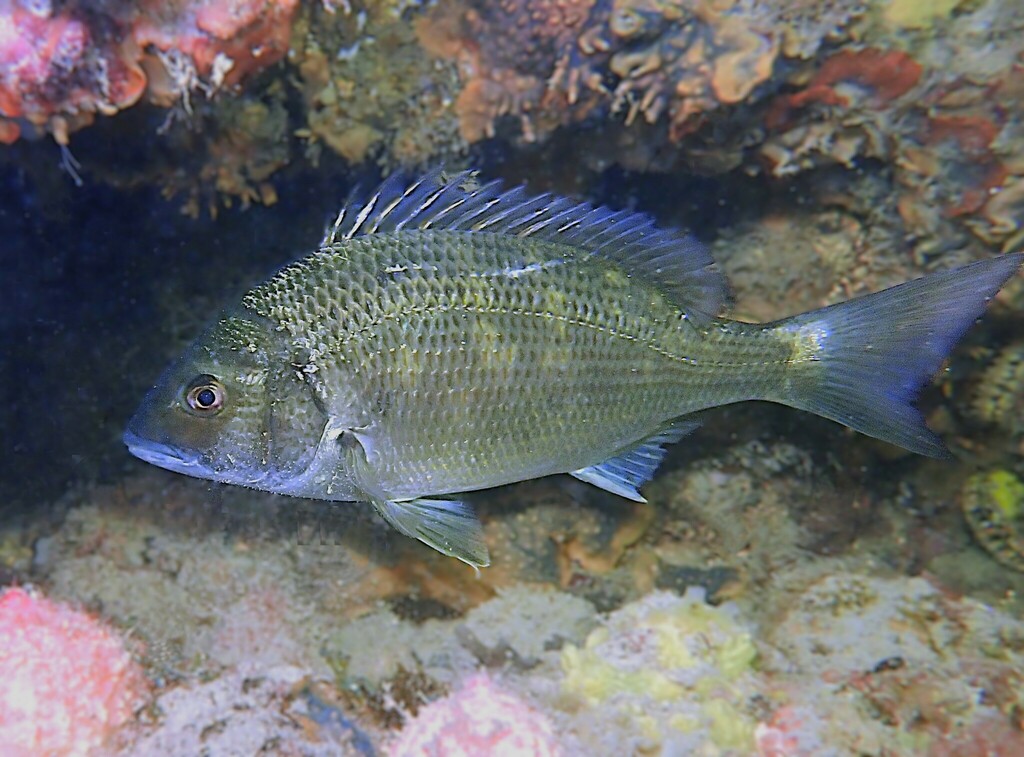
Black Bream
Acanthopagrus butcheri
The black bream (Acanthopagrus butcheri), also commonly known as the southern black bream, southern bream and blue-nosed bream, is a species of anadromous ray-finned fish of the porgy family Sparidae. A deep-bodied fish, it is occasionally confused with other similar species that occur within its range, but is generally distinguished from these species by a lack of yellow ventral and anal fins. Southern black bream are endemic to the southern coasts of Australia from Shark Bay in Western Australia to Ulladulla, New South Wales, as well as Tasmania.
The black bream is primarily an inhabitant of brackish waters of estuaries and coastal lakes, rarely entering the open ocean, as it cannot complete its life cycle in a fully marine environment. During the breeding season, the species is known to penetrate into the upper reaches of rivers to spawn, causing an influx of juveniles in the estuaries a few months later. It is an opportunistic predator, consuming a wide range of crustaceans, molluscs, polychaetes and forage fish.
From the article Acanthopagrus butcheri on Wikipedia (CC BY-SA), quoted section by section
Description
The southern black bream has a deep, moderately compressed body, with both the dorsal and ventral profiles equally curved. The mouth is of moderate size in comparison with the body, and contains six curved, peg like incisors in the front of both upper and lower jaws. The molars are set in series of four or five on each side of the upper jaw, and in series of three or four on the sides of the lower jaw, becoming smaller in size anteriorly. The body is covered with large scales, which may be cycloid or weakly ctenoid in shape. The head is mostly scale-free, with the exception of parts of the operculum. A low, scaly sheath covers the bases of the soft dorsal, anal and caudal fins. The lateral line scale count is 52–58. There is a single dorsal fin originating a little behind the posterior edge of the operculum, consisting of 10 to 13 spines set in front of 10 to 13 soft rays. The anal fin consists of 3 spines anterior to 8 to 10 soft rays, while the pectoral fin has 14 to 16 rays and the ventral has one large spine and 5 soft rays. The southern black bream is golden brown or bronze coloured on the back and sides, with greenish reflections when fresh, while the belly and chin are white. The fins are all dusky in colour, with the caudal fin often a dusky olive brown. …
Range & habitat
The southern black bream is endemic to southern Australia, inhabiting coastal waters from Shark Bay, Western Australia in the west to Mallacoota, Victoria in the east and south around the entire Tasmanian coastline. The species is primarily an inshore species, although has been found on rare occasions on deeper reefs on the continental shelf. Southern black bream primarily inhabit estuarine environments, penetrating into the far reaches of freshwater creeks and rivers during the summer spawning season. They are also known from a number of coastal lakes and intermittently open estuaries. In estuarine and freshwater environments they seek out the cover of structures such as fallen tree branches, jetties, oyster leases and rocky areas, while in deeper areas of coastal lakes, they are often found over bare mud and sand substrates. The species is rarely found in the ocean, but are often washed out of creeks during times of high river flow and are able to survive in the marine environment, where they inhabit inshore reefs and rocky shorelines. The species is most common in southern Victoria, where it inhabits numerous estuaries. The Gippsland Lakes, Mallacoota Inlet and Lake Tyers are the most densely populated bodies of water in the state and the species is often found along the coast. …
Wikipedia: “Distribution and habitat”
What it does
Southern black bream are opportunistic omnivores, consuming a wide range of prey, including sessile, burrowing, benthic and pelagic species. The diet of the species varies between rivers, with their opportunistic feeding methods showing little pattern between seasons, although they appear to have certain prey preferences when two or more possible prey species are present. Crustaceans, including crabs, prawns, amphipods and copepods, are commonly taken, as are a number of polychaete and annelid worms. Bivalves such as mussels and cockles are crushed in the bream's powerful jaws, with small fish such as gobies and anchovies also taken. Algae of the genus Enteromorpha are also a major component of most fish's diets. Fish feeding in the upper reaches of river have different prey, reflecting the freshwater fauna, with insects, hardyheads, tadpoles, brine shrimp and gastropods taken. Studies from the Swan River suggest that there is a shift in diet with age. Younger fish consume amphipods, polychaetes and small individuals of various molluscs. The number of amphipods consumed decreased in the diets of older fish while the number of large molluscs, crabs and teleosts taken increased. The fish actively forage the substrate while swimming with their head down, snapping their prey down with little chewing.
Wikipedia: “Diet and feeding”
In human culture
Southern black bream are relatively easy to grow in captivity, with fish usually spawning during their natural season without needing the addition of hormones. Despite this, bream are not bred on a commercial basis due to a comparatively slow growth rate and a low fillet recovery. Studies by Sarre in 1999, however, showed that the species can survive well in saline ponds with deep enough waters as long as food is supplemented to the ponds. This has led to the proposal of the breeding of the species to stock inland saline ponds for the use of recreational fishing, much like trout and barramundi are stocked elsewhere in Australia. Although the growth rate is currently too slow for food production purposes, genetic selection may allow the breeding of faster-growing fish for market purposes. Southern black bream are currently bred to stock depleted estuaries, and thus their requirements for farming are already well known.
Wikipedia: “Aquaculture”
Where it lives
Recorded sightings
—
geo-referenced records in GBIF, from museums, herbaria and field observers.
Drag the globe to turn it. Dots are where records exist, not a range map; darker means more records.
In the stacks
Searching the stacks…
Every page naming Acanthopagrus butcheri in the Biodiversity Heritage Library →
This page is assembled live from iNaturalist, GBIF, Wikipedia, the Source Library and the Internet Archive. It is not yet part of the hand-edited codex. iNaturalist taxon 311415.