- Animals
- ›Chordates
- ›Vertebrates
- ›Reptiles
- ›Snakes and Lizards
- ›Lizards
- ›Iguanas and Allies
- ›Dragons and Chameleons
- ›Dragons
- ›Flying Dragons and Allies
- ›Ceratophora
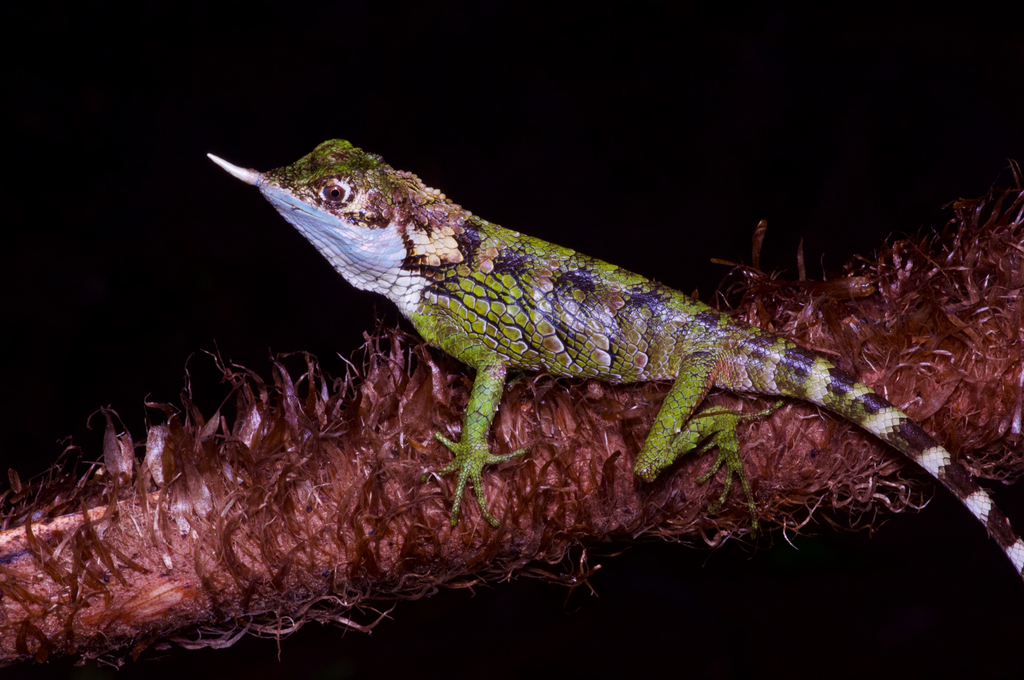
Rhino Horn Lizard
Ceratophora stoddartii
The rhino-horned lizard (Ceratophora stoddartii), also commonly known as Stoddart's unicorn lizard and the mountain horned agama, is a species of lizard in the family Agamidae. The species is endemic to Sri Lanka. It is called kagamuva angkatussa-කගමුව අං කටුස්සා in Sinhala.
From the article Rhino-horned lizard on Wikipedia (CC BY-SA), quoted section by section
Description
The head of C. stoddartii is oval, and longer than wide. The rostral appendage is long, horn-like, about two thirds the length of the snout in males, but is reduced or even absent in females. The lamellae under the fourth toe number 23–27. The dorsum is brownish green or yellowish brown. The tail is marked with 10–16 dark brown crossbands. The venter is light brownish gray.
Range & habitat
C. stoddartii is found widespread in montane forests of central Sri Lanka. Localities from which it has been recorded include Nuwara Eliya, Hakgala, Pattipola, Ohiya, Horton Plains National Park, Hewaheta, Dimbula, Agarapathana, Peak Wilderness Sanctuary, Galway's Land National Park, Knuckles, Galaha, Namunukula, Pidurutalagala, Haputale, Balangoda, Maratenna, Loolecondera, Moratiya state forest in Aranayake, Kegalla and Sandaraja Wana Arana in Kegalla.
Wikipedia: “Habitat and distribution”
What it does
A slow moving, arboreal species, C. stoddartii is found on trees from 1 to 2 m (3.3 to 6.6 ft) above the ground. When threatened, it opens its mouth wide, revealing the bright orange lining of the oral cavity. The presence of relatively larger trees as well as plants with low to medium levels of DBH is an important factor for C. stoddartii which spends most of its time resting vertically on a tree trunk or a branch. When weather conditions are too harsh they tend to take refuge inside the mosses that are abundant in the Cloud Forests. Tree barks with different shades (grays and browns) and mosaics of lichens & mosses provide the ideal background for C. stoddartii to merge with. Higher perch height of the adult males can be assigned as a feature of territorial defense and attracting the females. The ground is less frequently used by adult C. stoddartii except for the occasional hunting sprints to catch the escaping prey. However, it has been observed on the ground feeding on caterpillars and even on earth worms (Pheretima taprobenia). When it descends to the ground it changes its green and brown colors into more shades of brown and becomes well camouflaged with the leaf-litter.
Wikipedia: “Ecology”
In human culture
The specific name, stoddartii, is in honor of Charles Stoddart, who was a British army officer and diplomat.
Wikipedia: “Etymology”
Where it lives
Recorded sightings
—
geo-referenced records in GBIF, from museums, herbaria and field observers.
Drag the globe to turn it. Dots are where records exist, not a range map; darker means more records.
In the stacks
Searching the stacks…
Every page naming Ceratophora stoddartii in the Biodiversity Heritage Library →
This page is assembled live from iNaturalist, GBIF, Wikipedia, the Source Library and the Internet Archive. It is not yet part of the hand-edited codex. iNaturalist taxon 31256.