- Animals
- ›Chordates
- ›Vertebrates
- ›Reptiles
- ›Snakes and Lizards
- ›Lizards
- ›Iguanas and Allies
- ›Dragons and Chameleons
- ›Dragons
- ›Flying Dragons and Allies
- ›Calotes
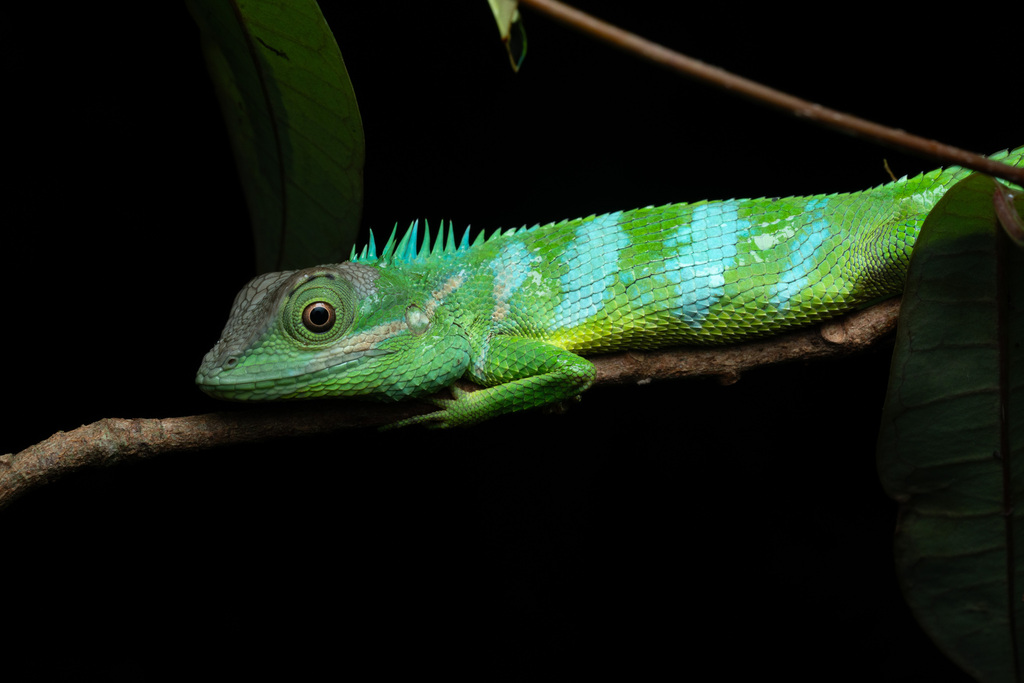
Whistling Lizard
Calotes liolepis
The whistling lizard or Sri Lanka agama (Calotes liolepis) is a species of lizard in the family Agamidae. It is one of seven Calotes species endemic to Sri Lanka.
From the article Calotes liolepis on Wikipedia (CC BY-SA), quoted section by section
Description
Whistling lizards are able to camouflage, changing color from green to brown to match their environment. The species has a relatively long head and tail, the latter often double the length of its body. A series of spines on the nape make up the dorso-nuchal crest in males, while both males and females possess scales on the dorsum of the body. Ventral scales as large as those on its flanks. The forehead is pale brown, with pale inter-orbital bands, and the dorsum is pale gray with dark gray bands. The limbs and tail are similarly dark-banded.
Range & habitat
Restricted to submontane forests below 100 m (330 ft), and found in forested areas and plantations. Widely distributed but frequently found in the central hills of Sri Lanka, including Knuckles, Kotmale, Sinharaja, Talawakele, Hanguranketha, Kanneliya, Galle, Kandy, Dambulla, Peradeniya, Namunukula, and Gampola.
Wikipedia: “Distribution”
What it does
Unusual among agamid lizards is its habit of uttering a high-pitched whistle when alarmed. It feeds on insects and ants. Gravid females are seen between July–August.
Wikipedia: “Ecology”
Where it lives
Recorded sightings
—
geo-referenced records in GBIF, from museums, herbaria and field observers.
Drag the globe to turn it. Dots are where records exist, not a range map; darker means more records.
In the stacks
Searching the stacks…
Every page naming Calotes liolepis in the Biodiversity Heritage Library →
This page is assembled live from iNaturalist, GBIF, Wikipedia, the Source Library and the Internet Archive. It is not yet part of the hand-edited codex. iNaturalist taxon 31265.