- Animals
- ›Chordates
- ›Vertebrates
- ›Reptiles
- ›Snakes and Lizards
- ›Lizards
- ›Iguanas and Allies
- ›Dragons and Chameleons
- ›Dragons
- ›Spiny-tailed Lizards
- ›Uromastyx
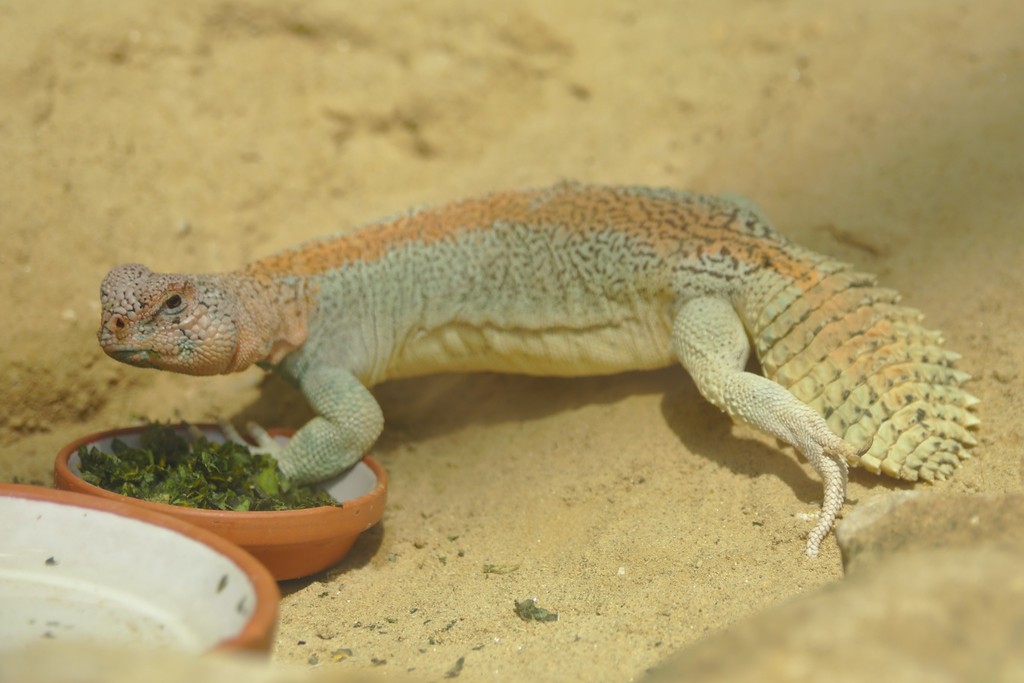
Omani Spiny-tailed Lizard
Uromastyx thomasi
Uromastyx is a genus of lizards in the family Agamidae. The genus is native to Africa and the Middle East (West Asia). Members of the species are commonly called spiny-tailed lizards, uromastyces, mastigures, or dabb lizards.
Lizards in the genus Uromastyx are primarily herbivorous, but occasionally eat insects and other small animals, especially young lizards. They spend most of their waking hours basking in the sun, hiding in underground chambers at nighttime or when danger appears. They tend to establish themselves in hilly, rocky areas with good shelter and accessible vegetation.
From the article Uromastyx on Wikipedia (CC BY-SA), quoted section by section
Description
Uromastyx species range in size from 25 cm (10 in) for U. macfadyeni to 91 cm (36 in) or more for U. aegyptia. Hatchlings or neonates are usually no more than 7–10 cm (3–4 in) in length. Like many reptiles, these lizards' colors change according to the temperature and season. During cool weather they appear dull and dark, but the colors become lighter in warm weather, especially when basking. The darker pigmentation allows their skin to absorb sunlight more effectively. Their spiked tail is muscular and heavy, and is able to be swung at an attacker with great velocity, usually accompanied by hissing and an open-mouthed display of (small) teeth. Uromastyx generally sleep in their burrows with their tails closest to the opening, in order to thwart intruders.
Range & habitat
Uromastyx inhabit a range stretching through most of North and Northeast Africa, the Middle East, ranging as far east as Iran. Species found further east are now placed in the genus Saara. Uromastyx occur at elevations from sea level to well over 900 m (3,000 ft). They are regularly eaten, and sold in produce markets, by local peoples.
Wikipedia: “Distribution”
What it does
Uromastyx lizards acquire most of the water they need from the vegetation they ingest. In the wild they generally eat any surrounding vegetation. When hatching, baby Uromastyx eat their own mother's feces as their first meal before heading off to find a more sustainable food source. They do this to establish a proper gut flora, essential for digesting the plants that they eat. In the wild, adult U. dispar maliensis have been reported to eat insects at certain times of the year, when it is hot and their only food source available would be insects.
Wikipedia: “Diet”
Where it lives
Recorded sightings
—
geo-referenced records in GBIF, from museums, herbaria and field observers.
Drag the globe to turn it. Dots are where records exist, not a range map; darker means more records.
In the stacks
Searching the stacks…
Every page naming Uromastyx thomasi in the Biodiversity Heritage Library →
This page is assembled live from iNaturalist, GBIF, Wikipedia, the Source Library and the Internet Archive. It is not yet part of the hand-edited codex. iNaturalist taxon 31324.