On eBird ↗
Mindoro Bleeding-heart
Live sightings near you, the range map, bar charts of when it is seen, and Macaulay Library photos and recordings.
Mindoro Bleeding-heart
Gallicolumba platenae
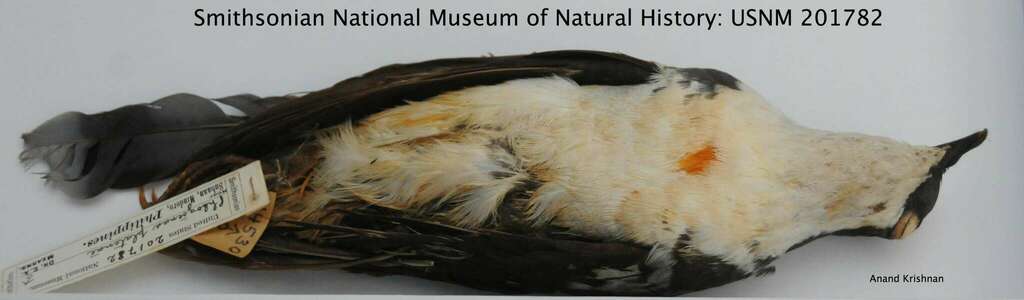
The Mindoro bleeding-heart (Gallicolumba platenae), also referred to as kulo-kulo, la-do, manatad, manuk-manuk, punay, and puñalada by the Mangyan, is a species of ground dove native solely to the island of Mindoro in the Philippines. It is critically endangered and threatened by habitat loss through quarrying, land conversion and illegal logging. This species is also caught by hunters in snares. Due to its biological line and its survival status, it has been listed as an EDGE species by the Zoological Society of London.
This bird was not photographed for 21 years from 2005 until August 2026 where a lone individual was photographed on a camera trap in Northern Mindoro.
From the article Mindoro bleeding-heart on Wikipedia (CC BY-SA), quoted section by section
Description
This ground pigeon has been recorded to be around 26 to 30 cm (10 to 12 in) tall. It has a dark grey forehead which transitions into an iridescent green on its head, nape, and hindneck. Its underside–from its throat to its flanks–is a cream-white except for the distinctive patch on the center of its breast which resembles a bright bleeding wound. The chest marking is less prominent and more orange in hue than that of related bleeding-heart doves. The dove's backside contains a reddish purple on its mantle, as well as chestnut coloration on its wings and rump. Its tail and uppertail-coverts are grey. Flecks of white triangles rest on its shoulders. Its juvenile plumage is unknown. Like other pigeons, Mindoro bleeding-hearts do not exhibit much sexual dimorphism. Females look similar to males but have purple irises and are generally smaller, with a 141–154 mm (5.6–6.1 in) wingspan (compared to 150–154 mm (5.9–6.1 in) in males).
Range & habitat
The Mindoro bleeding-heart dove is endemic to the island of Mindoro in the Philippines. It typically dwells in lowlands at an altitude of 400 m (1,310 ft), but has been noted at 750–800 m (2,460–2,620 ft). It has only been observed in four regions of the island since 1980, as deforestation has dwindled its preferred habitat of closed-canopy primary forest. These regions are Puerto Galera, MUFRC Experimental Forest, Siburan, and Mounts Iglit–Baco Natural Park, but scientists believe other populations may be scattered in other localities including a non-confirmed sighting in Mount Calavite in 2013. This bird favors dry forest floors overrun with bamboos and rattans, occasionally dotted with limestone outcrops and boulders. It has also been observed near pools of dry riverbeds that exist on more leveled forest floors without as many rocks. This dove is thought to be sedentary instead of migratory, but it is uncertain if it engages in altitudinal, seasonal or nomadic movements. It runs from danger and only flees from predators via brief flight when absolutely necessary.
Wikipedia: “Distribution and habitat”
What it does
The dietary habits of the Mindoro bleeding-heart are not well-documented, but they are assumed to be similar to those of G. luzonica. It has been sighted feeding on fruiting figs alongside the genus Treron, or green pigeons.
Wikipedia: “Food and feeding”
Listen
Looking for field recordings…
Where it lives
Recorded sightings
—
geo-referenced records in GBIF, from museums, herbaria and field observers.
Drag the globe to turn it. Dots are where records exist, not a range map; darker means more records.
In the stacks
Searching the stacks…
Every page naming Gallicolumba platenae in the Biodiversity Heritage Library →
This page is assembled live from iNaturalist, GBIF, Wikipedia, the Source Library and the Internet Archive. It is not yet part of the hand-edited codex. iNaturalist taxon 3133.