- Animals
- ›Chordates
- ›Vertebrates
- ›Reptiles
- ›Snakes and Lizards
- ›Lizards
- ›Iguanas and Allies
- ›Dragons and Chameleons
- ›Dragons
- ›Agamas
- ›Phrynocephalus
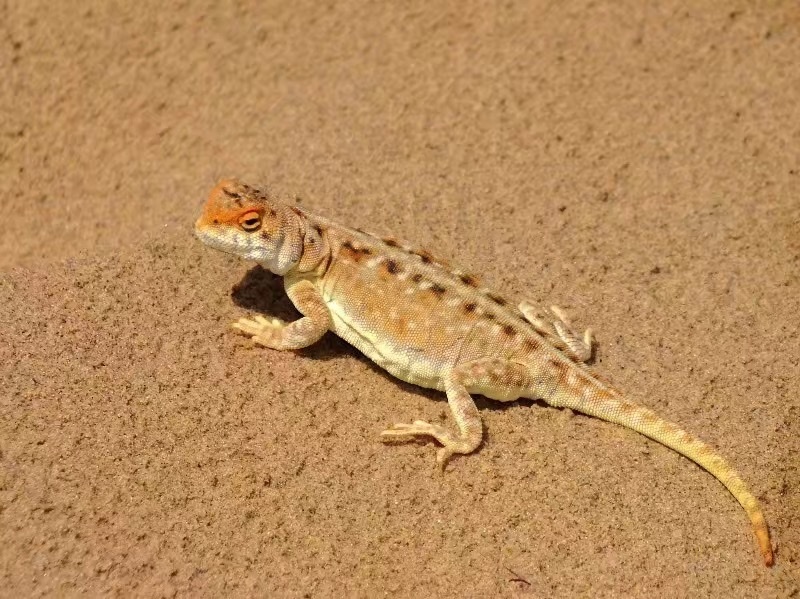
Ching Hai Toadhead Agama
Phrynocephalus vlangalii
Phrynocephalus vlangalii, also known as the Qinghai toad-headed agama, the Ching Hai toadhead agama, the Pylzow's toadhead agama, or gecko toadhead agama, is a species of viviparous agamid lizard endemic to the Tibetan Plateau in China. This lizard lives in burrows at high elevations of 2,000 to 4,600 meters. It is also known for its aggression, especially between females during mating season since females usually only have one mate. P. vlangalii curls its tail and shows a patch on its underbelly as defense displays against conspecifics. This lizard also has a variety of gut microbiota that help perform metabolic and biological functions depending on the altitude at which the lizard lives.
From the article Phrynocephalus vlangalii on Wikipedia (CC BY-SA), quoted section by section
Description
As a small lizard, P. vlangalii can grow up to 80 mm from snout to vent. Sexual dimorphism is present in this species and most evident among adults. Adult males tend to have larger heads and tail lengths while adult females have larger bodies and abdomen lengths. Males and females are also distinguishable by their tail-tip badges: males have black tail-tips and females have orange tail-tips. Both males and females display their tail-tip badges and underbelly patches as a method of defending their territory against rival lizards. There is a positive correlation between a lizard's body size and temperature, air pressure, and active season length, demonstrated by differences in the body size of P. vlangalii among different elevations in the Tibetan plateau. This is because as the elevation increases, air temperature and pressure decrease. To avoid hypoxia, or lack of oxygen to the body, these lizards have smaller bodies to help maintain a constant body temperature.
Range & habitat
P. vlangalii creates burrows about 70 cm into sand to act as refuge against predators. Burrows greater than 74 cm are deep enough to protect against low temperatures. Because P. vlangalii is found on a plateau, it is adapted to an arid and semi-arid environment with sparse vegetation located 2000–4600 meters high. P. vlangalii's preference for desert habitats makes it a good indicator species for desertification of grassland areas. This lizard is endemic to the Qinghai-Tibetan Plateau in China. The Tibetan plateau is known for its high altitude, cold temperatures, and dry atmosphere, which explains the lizard's burrow digging behavior. P. vlangalii's range can also stretch north to the southern Arjin mountains and the Gansu province in China. Its southern range reaches the northern Tanggula mountains and the southern part of the Yellow River.
Habitat Loss. P. vlangalii is one of the most common lizard species in its native range but its habitat is experiencing some loss for a variety of reasons. In central and southwestern Mongolia, as well as other parts of Asia, P. vlangalii is losing parts of its habitat to both human interference and climate change. These losses in habitats, particularly around the periphery of a range, can lead to changes in the behavior or other phenotypic characteristics of the species.
Home range of the organism. P. …
Wikipedia: “Habitat and Distribution”
What it does
Courtship occurs in May and females give birth to their young from mid-July to late August. Most lizards grow faster in warmer environmental conditions because they are ectothermic animals. However, these lizards grow faster at higher elevations. As the elevation in which the lizards live increases, fewer, yet larger offspring are born. Therefore, these lizards may be growing faster at higher elevations because they are hatching at larger sizes and with more resources. Brood size ranges from 2-6 offspring. However, number of offspring and the mean mass of the offspring is positively correlated with female snout-vent-length. A common garden experiment conducted by Lu et al. demonstrated that difference in growth rate between low-elevation P. vlangalii and high elevation P. vlangalii may be due to developmental plasticity rather than genetics. The lizards that were born and grew up at the highest elevations on the Tibetan plateau tended to grow faster and reach larger sizes as adults compared to those in relatively lower elevations. When both types of lizards were brought into a lab, the young lizards had similar growth rates, suggesting the difference in growth rate and adult size in the field is due to the lizards adapting to survive in their different habitats. …
Wikipedia: “Reproduction and Life cycle”
Where it lives
Recorded sightings
—
geo-referenced records in GBIF, from museums, herbaria and field observers.
Drag the globe to turn it. Dots are where records exist, not a range map; darker means more records.
In the stacks
Searching the stacks…
Every page naming Phrynocephalus vlangalii in the Biodiversity Heritage Library →
This page is assembled live from iNaturalist, GBIF, Wikipedia, the Source Library and the Internet Archive. It is not yet part of the hand-edited codex. iNaturalist taxon 31454.