- Animals
- ›Chordates
- ›Vertebrates
- ›Ray-finned Fishes
- ›Spiny-rayed fishes
- ›Butterflyfishes, Angelfishes, and Allies
- ›Seabreams and Porgies
- ›Calamus
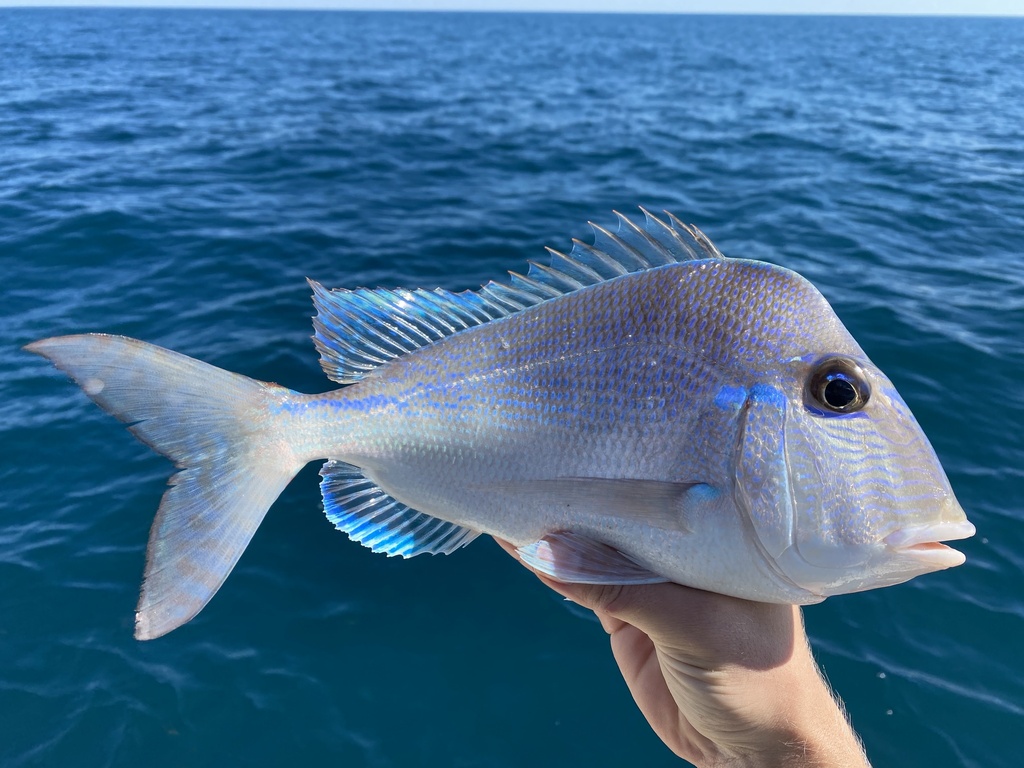
Littlehead Porgy
Calamus proridens
The littlehead porgy (Calamus proridens) is a species of marine ray-finned fish belonging to the family Sparidae, the seabreams and porgies. They are only found in the western portion of the tropical Atlantic Ocean, where they are often caught and used as food.
From the article Littlehead porgy on Wikipedia (CC BY-SA), quoted section by section
Description
While maturing, Littlehead porgies usually reach between 17 and 22 cm in length. Fully grown adults are commonly 37 cm, although they have been recorded to grow up to 46 cm. When compared to other members of their genus, they can be distinguished by having small scales, and relatively deep bodies with steep profiles. The molar-like teeth, that all porgies have, are more similar to canines in this species. Littlehead porgies are generally silver in color, with violet spots on their scales that form stripes on their upper bodies. These stripes are then crossed by darker bars of color. The Littlehead porgy has been described as one of the most brightly colored members of the porgy family, which contains well over 100 species in 37 genera.
Range & habitat
Known only from the western Atlantic Ocean, Littlehead porgies are found off the northeast coast of Florida and in the northern Gulf of Mexico and the Caribbean, south to the Bay of Campeche, which lies to the west of the Yucatan Peninsula, and northern South America. They are normally associated with reefs, and can be found on hard spongey or coral bottoms where they feed primarily on invertebrates, such as crustaceans, and often migrate cyclically between feeding and spawning grounds. The Littlehead porgy can be preyed upon by seabirds such as the Sooty tern.
== References ==
Wikipedia: “Distribution and habitat”
In human culture
The littlehead porgy has the specific name proridens which is combination of prora, meaning prow" and dens, which means "teeth". This is an allusion to the large canine-like teeth on either side of the upper jaw in adults, these are diagonally pointing downwards and outwards.
Wikipedia: “Etymology”
Where it lives
Recorded sightings
—
geo-referenced records in GBIF, from museums, herbaria and field observers.
Drag the globe to turn it. Dots are where records exist, not a range map; darker means more records.
In the stacks
Searching the stacks…
Every page naming Calamus proridens in the Biodiversity Heritage Library →
This page is assembled live from iNaturalist, GBIF, Wikipedia, the Source Library and the Internet Archive. It is not yet part of the hand-edited codex. iNaturalist taxon 317018.